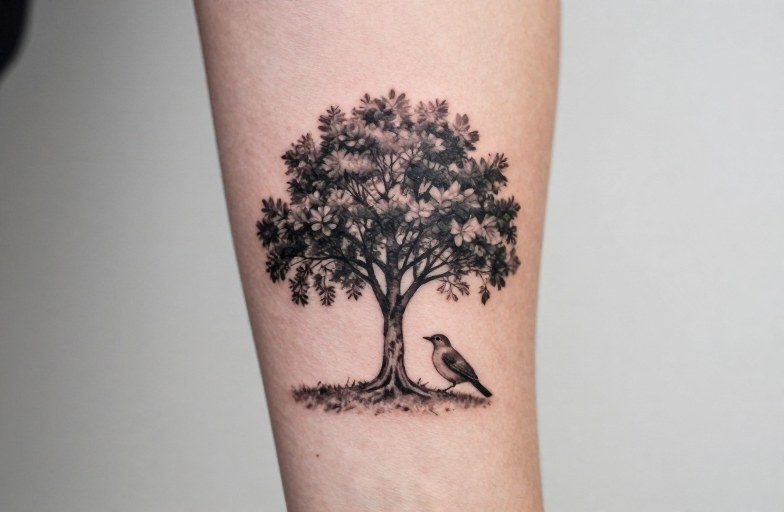
A tree and bird tattoo typically represents the tension and balance between being grounded and being free. The tree anchors the design in endurance, growth, and connection to place; the bird introduces movement, perspective, and liberation. Together, they speak to people who want to carry both qualities, stability without stagnation, freedom without rootlessness.
Symbolism & Core Meaning
The Tree: What It Actually Conveys
Trees in tattooing carry specific, readable weight. Roots visible below ground signal heritage, family, or origin. A trunk that thickens toward the base suggests time passed and weather survived. Branches reaching upward lean into aspiration without abandoning the core. In black-and-grey work, bark texture done with whip shading or fine line hatching can make a tree feel ancient or freshly alive depending on the approach. Color shifts the read: autumn leaves suggest transition; bare branches read as endurance or loss; full green canopy leans into vitality.
Placement affects meaning too. A tree rooted at the ankle or foot emphasizes groundedness literally. Across the ribs or side, it becomes more about internal, private growth. The tree doesn’t need to be literal, a gnarled oak reads differently than a slender birch, and artists choose species for these connotations as much as for visual balance with the bird.
The Bird: Motion and Point of View
Birds introduce the element of choice and departure. A bird perched on a branch suggests readiness, potential energy, a moment before action. One in flight pulls the eye upward and outward, expanding the composition’s space. Multiple birds can suggest family, flock, or the passage of time as they scatter at different heights.
Species matter here. Crows and ravens carry shadow and intelligence; songbirds lean tender; birds of prey project power and focus. A sparrow or swallow in traditional Americana connects to travel and return. The bird’s direction matters too, flying toward the tree suggests homecoming; away from it, departure or aspiration.
Personal & Modern Meanings
Recovery and Rebuilding
Many people arrive at this combination after significant life change. The tree marks what survived; the bird marks what became possible afterward. Divorce, sobriety, career pivots, geographic moves, this tattoo doesn’t announce those specifics to strangers, but it encodes them for the wearer. A tree half-dead on one side with new growth and a bird leaving or returning can map this without literal illustration.
Parenting and Family Structure
Some use the tree as the fixed home base and birds as children or partners, one departing, one returning, one still nested. This risks becoming too literal if over-explained in the design, but handled with restraint (varied species sizes, subtle positioning), it avoids greeting-card territory. The key is that the tree remains robust even with empty branches.
Environmental Connection
For people with bioregional loyalty, raised in the Pacific Northwest and still shaped by those forests, or Midwestern and marked by oak savanna, the specific tree species and native bird pairings carry personal geography. This isn’t abstract “nature love”; it’s place as identity, inked.
Who Chooses This Tattoo
The people who sit for this design tend to be further into life than those asking for their first piece at eighteen. There’s usually something to be rooted in, or something to fly from, or both. It appeals to people who find single-symbol tattoos insufficient, just a bird feels untethered, just a tree feels stuck. The combination resolves that.
- People between major life phases, marking the threshold rather than the destination
- Those with ambivalent relationships to hometown or family, love and escape both present
- Individuals in recovery or remission, where the body itself becomes a site of reclamation
- Parents, especially those with adult children, processing the shift from daily presence to distributed family
The back, upper arm, and thigh are common placements for the composition’s vertical needs. Smaller versions work on forearms if the tree is stylized and the bird reduced to essential silhouette. Chest pieces allow the tree to root near the heart with birds ascending toward the collarbone, effective but demanding in session length.
History & Cultural Roots
Norse and Germanic Connections
The world tree Yggdrasil appears in Norse sources with various creatures in its branches and roots, including an eagle often linked to cosmic oversight. This isn’t direct precedent for modern tattoos, no continuous visual tradition links medieval manuscripts to contemporary shop flash, but the pairing of axis-mundi tree and sky-dwelling bird has deep roots in Germanic imagination. Some trace the modern popularity of tree-and-bird designs partly to this submerged cultural memory, though tattoo artists more often credit compositional logic than mythology.
Celtic Tree of Life
The crann bethadh or sacred tree appears across Irish tradition, sometimes with birds in its branches. Here the bird often functions as messenger between worlds. Contemporary Celtic knotwork tattoos incorporating birds draw on this, though the specific tree-and-bird pairing as a standalone design is more modern shop evolution than direct revival.
East Asian Influences
Pine, bamboo, and plum form the “three friends of winter” in Chinese painting, with cranes or other birds frequently completing the composition. The pairing of enduring plant and mobile creature appears in Japanese screen painting as well. Western tattooing absorbed some of this through the global trade in flash and reference books, particularly from the 1990s onward as Japanese-style tattooing gained non-Japanese practitioners.
Mythology & Folklore
Beyond specific cultural traditions, the tree-and-bird pairing appears in widespread folk motifs. The bird in the treetop who knows what the ground-dweller cannot appears in tales from multiple continents, sometimes as helper, sometimes as trickster, often as the one who carries messages between human and divine realms.
In Slavic folklore, the world tree frequently has a bird nesting at its summit and a serpent or dragon at its roots, creating a vertical cosmos. The bird’s eye view becomes literally superior knowledge. This structure echoes in some modern tattoos where the bird looks downward, completing a compositional loop with the roots below.
The Roc of Arabic and Persian tradition, nesting in the tree that supports the world, offers another variant, though this rarely appears directly in tattoo form, the scale and drama of the concept sometimes informs large back pieces where the bird dominates.
Similar & Related Symbols
People considering tree-and-bird often look at related combinations before deciding. Understanding the alternatives clarifies why this pairing works or doesn’t for a specific intention.
- Tree alone: More static, more about endurance and time. Loses the dynamic tension that makes the combination active.
- Bird alone: Lighter, more purely aspirational. Risks feeling decorative rather than meaningful.
- Tree with moon: Shifts toward cycles, femininity, nocturnal consciousness. Less about freedom than about rhythm.
- Bird with key or lock: More narrative, more specific. Can feel illustrative in a way tree-and-bird usually avoids.
- Tree of life with human figures: Explicitly genealogical. The bird version allows non-human, non-literal representation of relationships.
The tree-and-bird combination succeeds partly because it resists single interpretation. It doesn’t lock the wearer into announcing “family” or “recovery” or “nature.” The symbols do enough work to be readable, not so much that they become prescriptive.
Final Thoughts
This tattoo endures in popularity because it solves a real compositional and symbolic problem: how to hold stillness and motion in one image. The technical execution matters enormously. A tree with flat, graphic leaves and a photorealistic bird will fight each other; consistent stylization, whether fine-line, traditional bold, or black-and-grey realism, holds the piece together. Over time, the fine details in bark texture and feather definition will soften, especially if the piece sees sun without protection. The silhouette relationship, the negative space between branch and wing, that’s what lasts.
Choose your species deliberately, not decoratively. Consider the bird’s direction, the tree’s season, whether roots show. These decisions aren’t arbitrary aesthetics; they’re the specific vocabulary this tattoo uses to say what you need it to say. The meaning isn’t injected afterward through explanation, it’s built into the structure from the first pencil line on skin.
Frequently Asked Questions
Does it matter which bird species I choose for this tattoo?
Species carry specific cultural weight. A crow reads darker and more intelligent than a dove; a hawk projects focus where a sparrow suggests vulnerability. The bird should match your intention, not just fill space. Your artist can help scale the species to your placement.
How well do fine-line tree and bird tattoos age?
Fine line work in this subject is risky. Bark texture and feather detail blur faster than bold outlines. If you want longevity, prioritize strong silhouette and contrast over delicate hatching. Expect a touch-up in five to seven years if the piece is heavily detailed.
Should the tree and bird be the same artistic style?
Yes, consistency matters. A geometric tree with a realistic bird creates visual dissonance unless that’s your specific intention. Most successful pieces unify approach, both traditional, both black-and-grey, both illustrative, so the symbols read as one composition.
Is this tattoo too common or generic?
The concept is familiar, but execution determines individuality. Specific species, personal season choice, root visibility, and bird direction all customize the template. The problem isn’t the symbol’s popularity; it’s lazy, unconsidered application. A good artist will push you past the obvious.
Leave a Reply