A sparrow tattoo most commonly signals loyalty, freedom, and the ability to endure hardship. Sailors made it famous as a mark of miles traveled and safe return, but the bird’s meaning stretches far beyond nautical tradition. Today people choose it to honor family bonds, mark personal survival, or simply capture a small, lively creature that ages better on skin than most intricate designs.
Symbolism & Core Meaning
What the Sparrow Actually Represents
Unlike the solitary eagle or predatory hawk, sparrows travel in flocks and mate for life. That social behavior gives the tattoo its strongest symbolic thread: loyalty to a partner, family, or community. The bird also survives harsh winters and urban environments worldwide, which feeds its second core meaning, resilience without flashiness. A sparrow doesn’t command attention; it persists.
Freedom enters the mix through the bird’s flight, but it’s a grounded, everyday freedom rather than grand liberation. Sparrows flit between branches and buildings, finding openings rather than soaring above clouds. That practical quality appeals to people who want a freedom symbol that acknowledges real-world constraints.
- Loyalty: Pair-bonding behavior makes it popular for couples or memorial pieces
- Resilience: Thrives in harsh conditions, adapts to displacement
- Grounded freedom: Movement within limits rather than escape from them
- Humility: Small, common bird rather than rare or dominant species
Two Sparrows vs. One
A single sparrow leans toward personal endurance or solo journey. Two sparrows locked in flight or perched together shift the meaning toward partnership, whether romantic, familial, or platonic. The distinction matters for placement too, two birds need more horizontal space, which affects where they fit comfortably on the body.
Mythology & Folklore
European and Mediterranean Threads
In Greek tradition, sparrows were often linked to Aphrodite, carrying associations with love and desire. That connection surfaces in some Renaissance paintings where the bird appears near figures of romantic pursuit. English folklore treated sparrows more practically: killing one was considered bad luck, and their presence near a home suggested protection rather than nuisance.
Some trace the bird’s association with the soul to medieval European belief, where a sparrow flying into a house could represent a visiting spirit or impending death. That duality, life and death, comfort and warning, gives the tattoo a philosophical depth that many wearers don’t initially consider.
Asian Traditions
Chinese art frequently pairs sparrows with plum blossoms to suggest resilience through winter and the promise of renewal. Japanese tattooing (irezumi) uses the bird less commonly than cranes or phoenixes, but when sparrows appear, they typically represent cheerfulness and the value of ordinary life. That cultural note matters if you’re combining a sparrow with Japanese-style waves or wind bars.
Personal & Modern Meanings
Contemporary wearers rarely stick to single symbolic readings. The sparrow’s small size and recognizable silhouette make it flexible for personal storytelling without requiring elaborate explanation.
Common Modern Interpretations
Memorial tattoos use sparrows to represent a specific person who was “ordinary” in the best sense, reliable, present, unpretentious. Recovery and survival narratives also gravitate toward the bird, especially when people want to mark hardship without the heavy visual weight of more dramatic symbols. The sparrow carries struggle lightly.
Travelers sometimes choose it as a quieter alternative to the swallow (the two birds get confused, but they’re distinct species). While swallows are strictly nautical, sparrows have broader habitat range, making them suitable for overland journeys or general restlessness rather than seafaring specifically.
- Memorial: For someone who lived simply and loyally
- Recovery: Quiet persistence through illness, addiction, or loss
- Travel: General wanderlust without sailor-specific imagery
- Minimalism: Meaningful tattoo that doesn’t dominate a body area
Design Tips & Pairings
Line Work vs. Shading Approaches
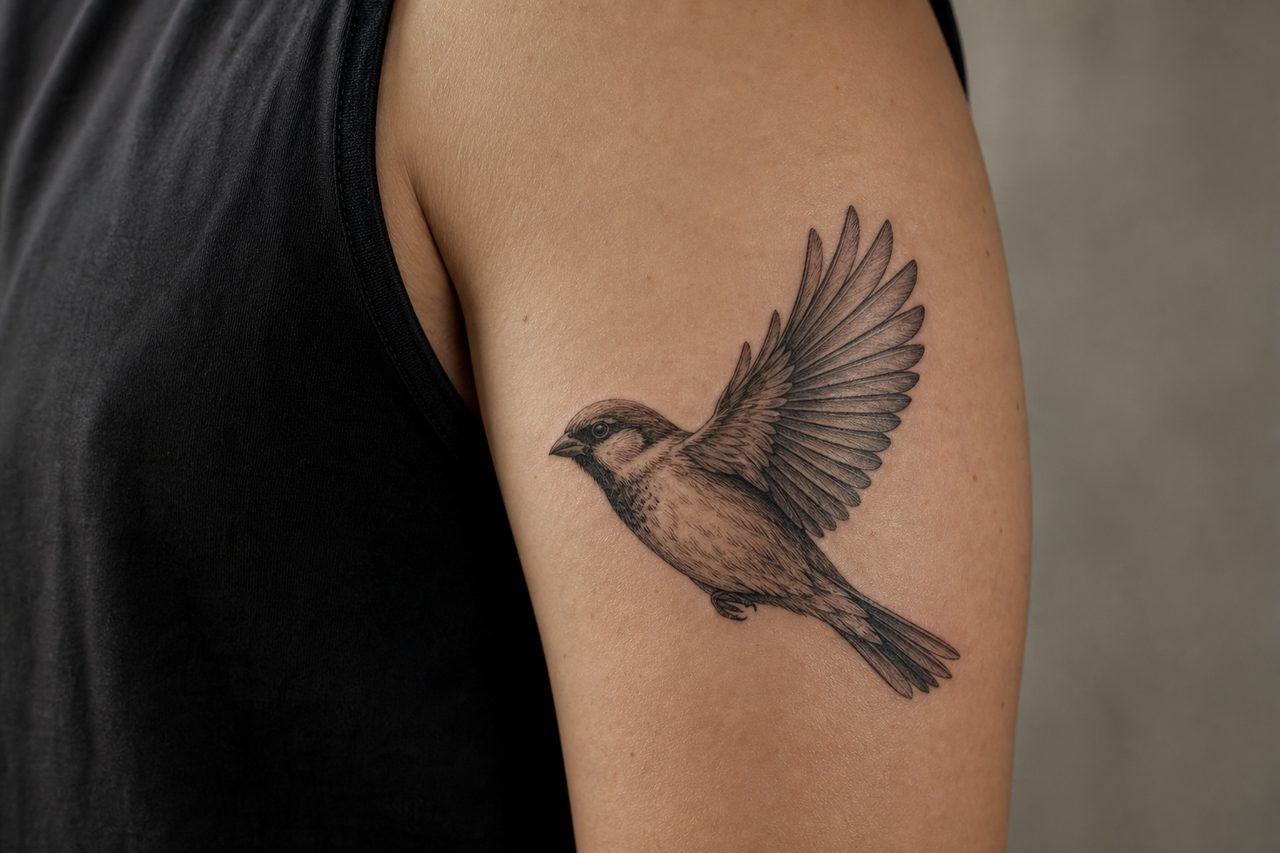
Sparrows work exceptionally well as fine-line tattoos because their natural form, small body, delicate legs, tapered wings, translates cleanly to thin needles. Heavy traditional shading can swallow the detail that makes the bird recognizable. If you want boldness, consider a traditional “sparrow” that’s actually a swallow (broader chest, forked tail) rather than forcing a true sparrow into a style that doesn’t suit its anatomy.
Color choices carry weight. Brown and gray tones read naturalistic and subdued. A red breast (borrowing from the unrelated robin) or blue accents push toward stylized or sentimental territory. All-black sparrows with dotwork texture age crisply and maintain readability at smaller sizes.
Smart Pairings and Placement
Popular combinations include sparrows with:
- Key and lock: Loyalty, partnership, works well as matching tattoos
- Compass or anchor: Nautical-adjacent without swallow specificity
- Floral elements: Plum blossoms for resilience, roses for romantic loyalty
- Banner with text: Names, dates, short phrases; keep the banner simple so it doesn’t overwhelm the bird
Placement affects longevity. Sparrows need enough space for wing detail to remain clear. The shoulder blade, outer forearm, and calf offer good flat surfaces. Finger and behind-ear placements risk blurring the fine lines that define the bird’s shape. Rib placements work but require the artist to scale up slightly to prevent the detail from mushing during healing.
How It Ages on Skin
This is where the sparrow’s simplicity becomes practical advantage. Small, high-contrast designs with clear silhouettes age better than intricate pieces with heavy detail clustering. A sparrow’s basic shape, rounded body, pointed wings, small head, stays readable even as lines soften and spread slightly over decades.
What to Expect Over Time
Black linework sparrows hold definition longest. Color versions, especially those with subtle brown-gray gradients, tend to fade toward a uniform muddy tone after ten to fifteen years. Fine-line sparrows with minimal shading need touch-ups sooner than bolder versions, but they also start from a cleaner baseline that doesn’t require heavy correction.
UV exposure matters significantly. Sparrows on frequently sun-exposed areas (forearms, calves, collarbone vicinity) will fade faster than those under clothing. The bird’s small size means there’s less ink total to lose, so protection becomes proportionally more important.
- Years 1-3: Settled, true to original design
- Years 5-10: Slight line spread, color softening
- Years 15+: Silhouette remains; fine detail merges
History & Cultural Roots
The Sailor Connection
The sparrow’s tattoo popularity is often linked to maritime tradition, though historians debate how directly. Sailors certainly wore bird tattoos, but the swallow was more common for marking nautical miles. Sparrows may have entered sailor culture through confusion between the species, or as a shore-bird alternative for those who wanted avian imagery without the swallow’s specific maritime code. Either way, the association stuck and broadened.
British and American tattooing from the 1920s-1950s shows sparrows in flash sheets alongside swallows, hearts, and banners. The bird’s accessibility, easy to draw, quick to tattoo, readable at small sizes, made it shop staple rather than specialty piece. That democratic quality persists: sparrows remain common across price points and studio styles.
From Counterculture to Mainstream
The sparrow migrated into broader popularity through punk and folk aesthetics in the 1970s and 1980s, often paired with working-class symbolism. By the 2000s, fine-line and minimalist trends embraced the bird for its clean silhouette. Its current ubiquity means a sparrow tattoo rarely reads as rebellious anymore, but it also avoids the trend-chasing obviousness of more recently popular motifs.
Key Takeaways
A sparrow tattoo works best when chosen for its actual symbolic fit rather than assumed sailor cred or vague freedom associations. The bird rewards simplicity in design, fine lines, clear silhouette, restrained color. It ages well because its natural form translates cleanly to tattooable shapes. Pair it thoughtfully with elements that reinforce your specific meaning rather than piling on generic “symbolic” imagery. And place it where the detail can breathe: shoulder, forearm, calf, or ribs with adequate scaling.
The sparrow’s enduring appeal comes from its balance. Meaningful without heaviness, recognizable without cliché, small without disappearing into inscrutability. That’s a harder combination to achieve than it looks, and it’s why the design persists when flashier trends fade.
Frequently Asked Questions
What’s the difference between a sparrow and swallow tattoo?
Swallows have forked tails, broader chests, and strictly nautical meaning, sailors earned them for miles sailed. Sparrows are smaller with rounded tails, represent loyalty and resilience more broadly, and aren’t tied to seafaring specifically. Many traditional designs labeled ‘sparrow’ are actually swallows.
Does a sparrow tattoo always need to be small?
No, but scaling up requires adding background or companion elements to fill space. A standalone sparrow larger than palm-sized can look disproportionate. If you want big, consider a pair or flock, or place the bird within a larger scene rather than floating alone.
Can a sparrow tattoo work for a memorial piece?
Yes, especially for someone who embodied quiet reliability. Two sparrows facing each other or one bird carrying a small banner with initials works well. Avoid overly literal additions like dates in large text that compete with the bird’s delicate form.
How much detail can a small sparrow tattoo hold?
Less than most people expect. Feather texture, individual wing bars, and eye highlights blur within a few years at under two inches. Prioritize overall silhouette and wing shape over surface detail. Your artist should simplify reference photos rather than copy them exactly.