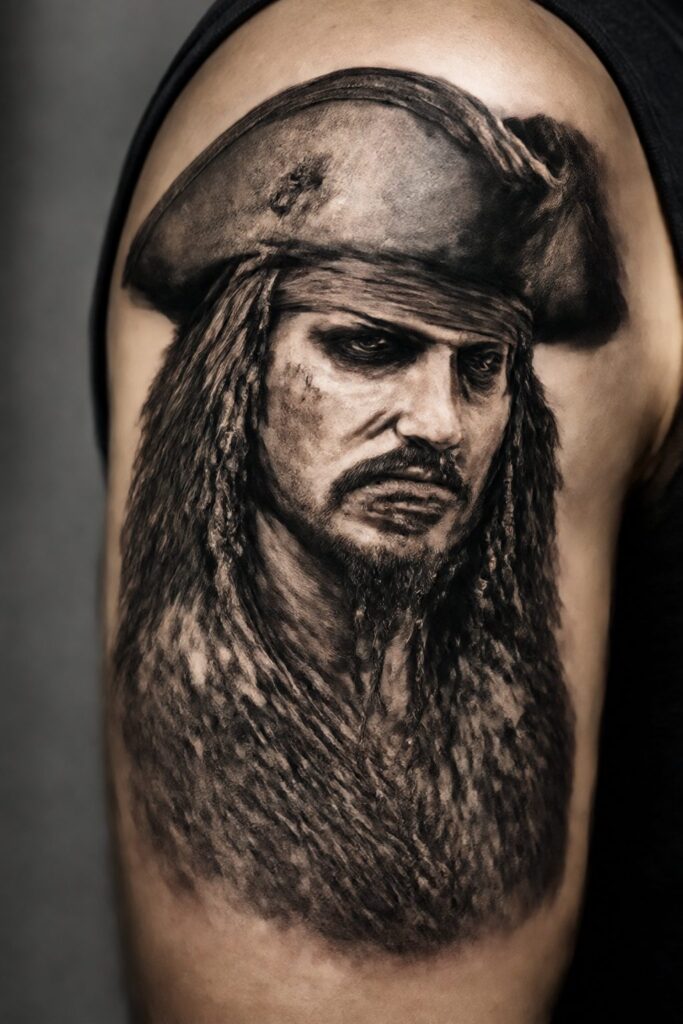
A Captain Jack Sparrow tattoo channels the chaotic charisma of the Pirates of the Caribbean character, freedom from societal rules, loyalty to a personal code, and the willingness to gamble everything for adventure. Most people who choose this design aren’t celebrating piracy itself; they’re drawn to the archetype of someone who operates outside systems they find suffocating. The tattoo works as a declaration of autonomy, often with a self-aware wink at the character’s glorious failures and stubborn survival.
Symbolism & Core Meaning
The meaning layers stack differently depending on which visual elements you include. A portrait emphasizes the man and his psychology; a symbolic arrangement, compass, jar of dirt, Black Pearl, points toward the broader themes he represents.
The Compass That Doesn’t Point North
Jack’s broken compass, pointing toward what you want most, makes for potent standalone imagery. As a tattoo, it resonates with people who’ve reoriented their lives around desire rather than obligation. The design works small on a wrist or ankle, or large across a chest or back with the needle spinning toward something personal, a name, a place, a date you keep private. Line-heavy versions age cleaner than shaded glass-and-brass realism, which tends to muddy after five to seven years.
The Tricorn, the Dreads, the Kohl
Portrait tattoos live or die on likeness accuracy. Jack’s specific visual chaos, dreadlocked hair with beads and coins, smudged eyeliner, the swaying drunken posture, gives artists a lot to work with, but also a lot to get wrong. The best portrait work captures his expression in a specific moment: the sly side-eye, the panicked grin, the rare flash of genuine betrayal. These pieces demand an artist who specializes in portrait realism; a generalist will flatten him into generic pirate.
Best Placements
Where you put this tattoo changes how it’s read. The character’s theatricality suits visible placements, but his deeper themes, internal freedom, private codes, also reward hidden ones.
- Forearm: The classic choice. Shows the face or a symbolic element at conversational distance. Inner forearm protects from sun better than outer, keeping blacks black longer.
- Calf or thigh: Room for narrative scenes, the Black Pearl in storm, the kraken’s tentacles, the escape from the gallows. Thigh fat holds detail well over decades; calf muscle movement can distort fine lines.
- Ribcage: Painful, but the vertical space suits Jack’s lanky posture. Good for a full-figure stance with coat flaring. Expect touch-ups; rib skin stretches and breathes constantly.
- Upper arm/shoulder: Traditional pirate territory. A Jack piece here reads as inheritance of that tradition rather than parody. The cap stabilizes aging better than spots near the elbow ditch.
- Behind the ear or neck nape: Small compass, single coin, or the sparrow silhouette itself. Intimate, easily concealed, but the skin turns over fast here, fine lines blur within a few years.
Common Variations & Styles
Not everyone wants Johnny Depp’s face on their body. The character’s iconography separates into distinct visual approaches, each with different technical demands.
Neo-Traditional & American Traditional
Bold outlines, limited color palettes, and simplified forms translate Jack’s complexity into timeless tattoo grammar. Traditional skull-and-crossbones gets updated with his specific hat, his beads, his drunkard’s grin. These age exceptionally well, the heavy black lines resist sun and time. Red bandanas, gold coins, and the occasional green flash of Caribbean water provide color anchors without overwhelming the design.
Black & Grey Realism
The most requested style for portraits, and the most unforgiving. Skin isn’t paper; subtle grey tones shift as ink settles and your body changes. A good black-and-grey Jack needs enough contrast in the eyes to maintain that alive, calculating look. Without it, he becomes a muddy smudge. Plan for a larger piece, realism needs room to breathe, minimum palm-sized for facial detail.
Illustrative & Sketch-Style
Loose linework, crosshatching, watercolor splashes behind the figure. Captures Jack’s unpredictability better than rigid realism. The style’s popularity means many artists default to generic “sketchy” execution without structural control; look for someone whose loose lines still describe form accurately. Watercolor backgrounds fade faster than linework, budget for color refresh every four to six years.
Design Tips & Pairings
Building around a Jack Sparrow motif requires balancing reference with originality. Direct movie stills reproduced exactly read as uncreative; too abstract, and you lose the recognizable hook.
- Pair with nautical tools: Sextant, astrolabe, or a tattered map with his route scrawled in. Grounds the fantasy in real seafaring history.
- The monkey: Jack the monkey, not Jack the man. Small, vicious, loyal, adds narrative tension and visual humor. Works as a separate small piece or perched on his shoulder.
- Quote integration: “Bring me that horizon” or “The problem is not the problem” work best as flowing script integrated into the image, not block text stamped underneath. Script ages poorly near joints and on hands; place it in stable skin with the letterforms tested at size.
- Negative space: Jack’s silhouette against a sunset, or his hat and hair emerging from black fog. Saves skin, reduces long-term maintenance, and often reads more sophisticated than full-color spectacle.
Avoid pairing with unrelated fantasy elements, dragons, anime characters, unrelated movie references. The pirate aesthetic is specific; mixing it with generic “nerd culture” collage dilutes both.
Mythology & Folklore
Jack Sparrow as a character draws from historical pirate archetypes and maritime folklore that long predates Disney. Understanding these roots deepens a tattoo’s resonance beyond film fandom.
The Historical Pirate as Social Rebel
Golden Age pirates operated democratically, elected captains, and included escaped slaves and indentured servants among their crews. The romanticized pirate, often linked to resistance against imperial power, gave marginalized people a symbol of self-determination. Jack’s constant escapes from the East India Trading Company echo this tradition. A tattoo can reference this lineage explicitly: include period-accurate ship details, historical flags, or the names of real vessels.
Maritime Superstition
Tattoos among sailors historically served as talismans. A pig and rooster meant you wouldn’t drown; a compass ensured you’d find land. Jack’s compass, pointing to desire rather than north, inverts this practicality, it’s useless for survival but essential for identity. Some trace this concept to older folklore about enchanted objects that reveal true character rather than external truth. The sparrow itself, his namesake, was a common sailor tattoo symbolizing safe return and distance traveled, every 5,000 nautical miles earned another.
Similar & Related Symbols
If a full Jack portrait feels too specific or too tied to a single actor’s likeness, adjacent imagery carries similar weight with more flexibility.
- Generic pirate archetype: Your own face or a loved one’s in pirate regalia. Removes celebrity association while keeping the symbolism.
- The Jolly Roger: Specifically Calico Jack’s flag, skull with crossed swords, associated with women pirates Anne Bonny and Mary Read. Adds gender rebellion to the freedom narrative.
- Davy Jones and the Flying Dutchman: The inevitable consequence of a pirate life, sacrifice and damnation. Pairs with Jack as counterweight, freedom’s cost.
- The sea itself: Storm waves, leviathans, empty horizon. Abstracts the pirate’s environment into mood and atmosphere without figure reference.
- Treasure chest with nothing inside: The anti-materialist reading of piracy, pursuit without destination, journey as reward.
The Bottom Line
A Captain Jack Sparrow tattoo succeeds when it captures the tension between the character’s ridiculous surface and his genuine philosophical stubbornness. The best versions don’t just reproduce a movie still; they use his specific visual language, compass, beads, swaying stance, impossible survival, to say something about the wearer’s own relationship with rules, risk, and self-definition. Choose an artist who understands either portrait realism or the stylized tradition you’re pursuing, not someone who promises they can “do anything.” Plan for the long game: bold lines last, subtle greys fade, and skin in motion needs different considerations than skin that stays still. The tattoo should feel like a flag you raise, not a costume you wear.
Frequently Asked Questions
Does a Captain Jack Sparrow tattoo look dated since the movies are older now?
The character’s archetype, rebel, trickster, survivor, transcends the specific films. Neo-traditional and symbolic treatments age better than photorealistic portraits tied to one actor’s appearance. Focus on the broader pirate imagery if longevity concerns you.
How much should I expect to pay for a quality Jack Sparrow portrait?
Expect several sessions for full realism, with pricing reflecting the artist’s hourly rate and experience level. Portrait specialists typically charge more than generalists. A small symbolic piece, compass, sparrow silhouette, costs significantly less and requires less time.
Will the detailed facial features blur over time?
Fine lines in small portraits do spread and soften. Go larger than you think you need, prioritize strong black contrast in the eyes and beard, and protect the tattoo from sun exposure. Plan for a touch-up in five to eight years.
Can I combine Jack Sparrow with other pirate or fantasy characters?
You can, but the aesthetic cohesion matters. Mixing Disney’s stylized pirates with hyper-realistic horror or anime creates visual confusion. Stick to one stylistic approach, traditional, realistic, or illustrative, across the entire piece.

Leave a Reply