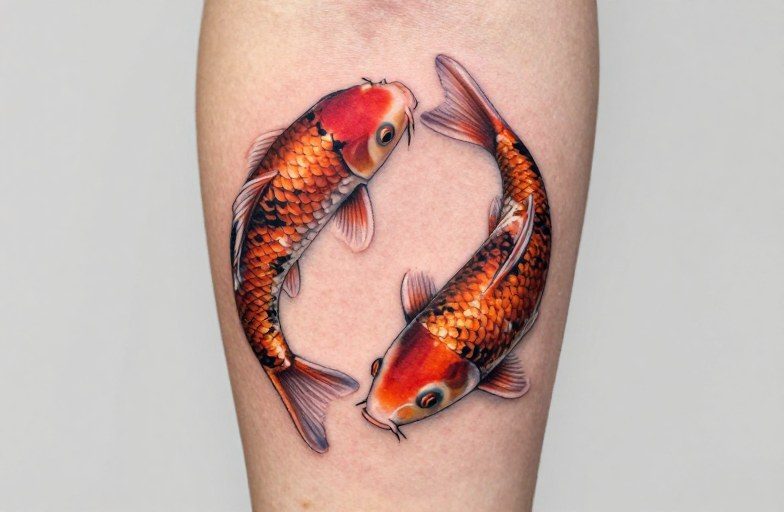
Two koi fish swimming together most commonly represent duality and balance, yin and yang, masculine and feminine, or the push and pull of life’s currents. In Japanese and broader East Asian tattoo tradition, the pairing amplifies the koi’s established symbolism of perseverance, transformation, and good fortune. The direction each fish swims matters: together upstream suggests mutual struggle and shared ambition; circling each other implies harmony and cyclical renewal.
Mythology & Folklore
The koi’s symbolic weight comes from centuries of accumulated story, not single-source doctrine. Multiple traditions contribute to what wearers now request.
The Dragon Gate Legend
The most widespread origin story, often linked to Chinese folklore and absorbed into Japanese tattoo culture, describes koi swimming upstream against fierce currents. Those that reached the top of a waterfall, called the Dragon Gate, transformed into dragons. Two koi together in this narrative suggest partnership through shared adversity, two beings raising each other through difficulty rather than competing. This interpretation dominates when clients request the design to mark marriages, business partnerships, or close sibling bonds.
Seasonal and Directional Variations
Some trace specific meanings to directional pairing. Koi swimming upward traditionally symbolize struggle and aspiration; downward-swimming koi represent having achieved one’s goals. When paired, one up, one down, the design captures a complete life cycle rather than a single moment. This configuration appeals to people who want their tattoo to acknowledge both where they’ve been and where they’re headed, without the design reading as static or finished.
How It Ages on Skin
Koi fish designs present specific aging challenges that simpler imagery avoids. Understanding these realities helps you choose wisely between elaborate and restrained versions.
Scale Detail and Line Work
Intricate scale patterns using fine single-needle lines look crisp at three months but often blur into muddy texture by year five. The fish’s curved body creates natural stress points, bellies and tails where skin stretches most, accelerating this degradation. For longevity, experienced artists recommend:
- Scales rendered with slightly heavier line weight than initially seems necessary
- Strategic omission of scales in high-movement areas (inner bicep, side of torso)
- Negative space between scales rather than dense crosshatching that closes up
Color Saturation Reality
Red and orange pigments, standard for traditional koi, retain vibrancy better than yellows, which fade fastest to a pale, sickly tone. Black outlines anchor the design as color drifts; all-color, no-outline koi pieces age poorly, losing definition within three to seven years depending on sun exposure and skin type. The two-fish composition doubles your color commitment; budget for touch-ups if you choose bright traditional palettes.
Who Chooses This Tattoo
Certain life circumstances reliably precede this request. Recognizing these patterns helps you decide if your own motivation aligns with the design’s established resonance.
Marriage and partnership anniversaries generate significant demand, particularly the tenth, twentieth, or twenty-fifth, when couples seek shared or complementary pieces. The two-fish format accommodates matching tattoos (each partner wears one fish) or single pieces containing both fish representing the union.
People navigating major professional or personal transitions also gravitate here. The koi’s upstream struggle resonates with career changes, recovery from illness, or geographic relocation. Two fish specifically suggests not doing this alone, having a partner, mentor, or internal dual strength.
There’s notable crossover with people who have existing Japanese-style work. The koi integrates naturally into larger sleeves or back pieces, maintaining thematic consistency while adding new symbolic layers.
Personal & Modern Meanings
Contemporary wearers frequently layer personal significance onto traditional foundations without displacing them.
Same-Sex Partnership and Chosen Family
For LGBTQ+ couples, two koi offer symbolic vocabulary that predates and transcends modern marriage iconography. The design’s emphasis on mutual effort and parallel journey resonates with relationships that have faced external opposition. Some wearers specifically request identical koi rather than gendered color variations, rejecting traditional masculine/feminine color coding in favor of equal partnership.
Parent-Child Representations
Two koi of noticeably different sizes, one dominant, one smaller following, represent parent and child without infantilizing imagery. This configuration works particularly well for parents of adult children, avoiding the teddy-bear aesthetic that clashes with mature presentation. Direction matters here: child koi following the parent’s path suggests guidance; swimming side-by-side indicates evolved friendship.
Best Placements
The two-fish composition demands horizontal or diagonal space; vertical arrangements (forearm, calf) force awkward compression unless you accept stacked or significantly overlapped fish.
- Upper back/shoulder blades: Ideal for fish swimming across the back, utilizing natural width. Allows full detail and color graduation. Easily covered for professional contexts.
- Outer thigh: Flat, stable skin with minimal distortion during movement. Excellent for larger scale pieces. Healing is straightforward; clothing friction is minimal.
- Side ribs: Painful and prone to distortion with breathing, but the curved canvas suits koi body shape naturally. Best for experienced collectors, not first tattoos.
- Inner forearm: Visible, moderate pain, but limited width forces design simplification. Works better for single koi or heavily stylized pairs.
- Chest, one fish each pectoral: Dramatic when planned together, but difficult to execute symmetrically. Requires artist experienced in bilateral design.
Stretching and weight fluctuation affect paired designs visibly, one fish distorting more than the other destroys the visual balance that makes the piece meaningful. The abdomen and lower back present this risk most acutely.
Color vs Black and Grey
This choice fundamentally changes the tattoo’s cultural signaling and practical maintenance.
Traditional Color Symbolism
Specific colors carry established associations:
- Red/orange: mother, strength, power
- Black: overcoming adversity, masculine energy
- White with red spots: career success, wealth
- Gold/yellow: prosperity (but fades problematically)
Color demands larger minimum size for readability, each fish needs roughly palm-sized dimensions or larger to prevent muddling. Budget implications are significant: color work requires more sessions and more frequent refresh.
Black and Grey Advantages
Monochrome execution prioritizes form over cultural color coding. Shading techniques, whip shading, smooth gradients, or dotwork, can distinguish two fish through texture rather than hue. This approach ages more gracefully, requires less maintenance, and suits professional environments where visible color might draw unwanted attention. The tradeoff is recognizability: without color, the design reads generically as “fish” to casual observers rather than specifically koi.
Some artists execute one fish in color and one in black and grey to represent different energies or individuals within the pair. This hybrid approach works visually but requires careful balance to avoid looking unfinished or mismatched.
The Bottom Line
Two koi fish carry genuine symbolic density that simpler couple tattoos lack, but that density requires thoughtful execution. The design rewards patience, in choosing an artist fluent in Japanese tattoo conventions, in planning for aging through strategic simplification, and in accepting that bold color demands ongoing commitment. Whether marking partnership, transition, or internal duality, this imagery persists because it accommodates personal meaning without collapsing into pure abstraction. Get it because the specific symbolism resonates, not because it photographs well or carries vague spiritual associations. The best two-koi pieces feel inevitable once complete: this particular pairing, this particular direction, belonging to this particular skin.
Frequently Asked Questions
Do the two koi fish need to be the same size?
No. Different sizes can represent parent and child, mentor and student, or any relationship with an experience gap. Equal sizing suggests peer partnership. The meaning shifts with proportion, so discuss intent with your artist before they draft.
Can two koi fish face the same direction, or must they oppose each other?
Same-direction swimming emphasizes shared purpose and mutual support. Opposing or circular arrangements create tension and dynamism, suggesting balance through difference rather than unity through agreement. Both are valid; neither is incorrect.
How much should a quality two-koi piece cost?
Expect $800, $2,500+ depending on size, color complexity, and artist experience. Japanese-trained specialists command premium rates. This is not flash-sale territory; the technical demands of proper scale rendering and color saturation reward investment in established skill.
Is it culturally appropriative for non-Japanese people to get koi fish tattoos?
Koi imagery has circulated globally through tattoo culture for decades, but respectful execution matters. Avoid combining koi with unrelated cultural symbols (dreamcatchers, Celtic knots). Choose artists who understand the tradition’s visual grammar rather than treating it as generic ‘exotic’ decoration. When in doubt, ask your artist about their training and approach.


Leave a Reply