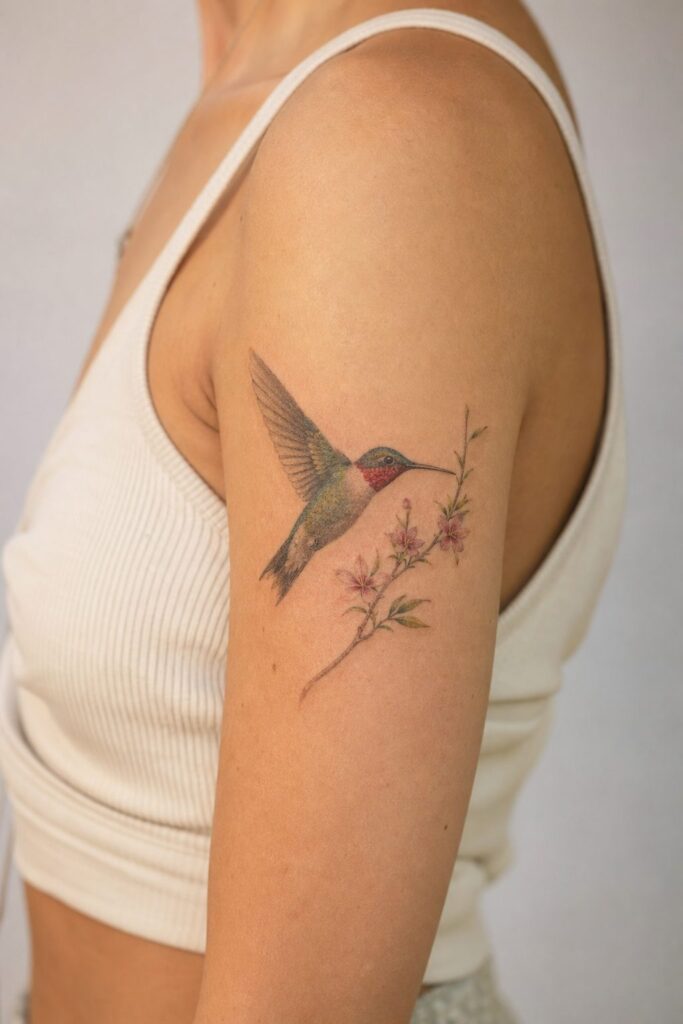
A hummingbird tattoo most commonly represents resilience, joy, and the ability to find sweetness in difficult circumstances. The bird’s mechanical impossibility, hovering, flying backward, beating wings up to eighty times per second, makes it a natural emblem of persistence and defiance of limitations. Beyond that, its attraction to nectar and bright color ties it to pleasure, beauty, and living fully in the present moment.
Similar & Related Symbols
Birds With Parallel Meanings
Swallows share the hummingbird’s association with safe return and navigation, though swallows lean more toward sailor tradition and homecoming. Sparrows carry similar small-but-tough energy, especially in old-school American tattooing. Phoenix birds cover the rebirth angle more dramatically, while doves handle peace and gentleness without the kinetic restlessness. The hummingbird sits uniquely between these, more delicate than a raven, more active than a dove, more approachable than a phoenix.
Floral Pairings That Shift the Meaning
Hummingbirds don’t exist in tattoos without context. Paired with a trumpet vine or hibiscus, the meaning stays tropical and pleasure-focused. Add a skull or timepiece, and the fragility of life becomes central. With geometric elements or mandala backgrounds, the design moves toward spiritual seeking rather than natural observation. The bird itself is a vehicle; the surrounding imagery drives where it goes.
- Single bird: independence, self-sufficiency, personal joy
- Two birds: relationship, duality, mutual sustenance
- Bird at a feeder: abundance, receptivity, trust
- Bird in flight only: motion, transition, refusal to settle
Who Chooses This Tattoo
Common Motivations
People drawn to hummingbird tattoos often have specific experiences they’re processing rather than vague aesthetic attraction. Recovery from illness or hardship shows up frequently, the bird’s impossible metabolism and constant motion mirror the effort of rebuilding. Others have lost someone who loved hummingbirds, or watched them at a window during a significant life period. The tattoo becomes a fixed point for something otherwise hard to hold.
There’s also a significant population who simply love the visual mechanics: the iridescent throat feathers, the helicopter precision, the way light fractures across the wings. These collectors often go for realistic or neo-traditional treatments rather than minimal line work, prioritizing the bird’s actual appearance over symbolic shorthand.
Gender and Cultural Notes
In tattoo shops, hummingbirds skew somewhat feminine in placement and styling, though the subject itself carries no inherent gender. Men often choose larger, more aggressive compositions, darker backgrounds, sharper angles, integration with daggers or script. Women more frequently select smaller pieces with watercolor backgrounds or fine-line detail. These are shop trends, not rules; the underlying symbolism remains available to anyone.
Best Placements
Where Detail Survives
Hummingbirds demand space for their defining feature: the wings. A piece smaller than two inches loses the wing blur entirely, becoming a generic small bird. The shoulder blade, outer upper arm, and thigh offer enough flat real estate for a hovering pose with visible wing structure. Ribs work for vertical compositions with trailing flowers or motion lines. The sternum and center chest allow for symmetrical spreads, both wings visible, which reads as openness and vulnerability.
Placement Pitfalls
Fingers and hands are poor choices. The skin there sheds and regenerates rapidly, blurring fine lines within a few years. A hummingbird’s primary identification, its beak length, wing position, throat color patch, requires precision that simply doesn’t hold on high-wear areas. Ankles and feet present similar problems, plus the distortion of walking and shoe friction. If you’re committed to a small piece, consider the bird at a feeder or flower rather than in full flight; the static pose needs less spatial information to read correctly.
- Best for detail: upper back, thigh, outer arm, calf
- Best for motion lines: forearm, side ribcage
- Avoid: hands, fingers, feet, inside lip
Personal & Modern Meanings
Beyond the Symbolism Books
Contemporary tattoo culture has layered additional meanings onto the hummingbird that older reference texts don’t capture. In recovery communities, it’s become a discreet marker for sobriety or eating disorder recovery, small, often hidden, referencing the daily effort of staying aloft. Among immigrants and children of immigrants, it sometimes signals transnational identity, the bird’s migration patterns mirroring their own.
Social media has also influenced execution. The “floating particles” or watercolor splash background, common since roughly 2015, creates a sense of dissolution and reformation that pure realism doesn’t achieve. Whether this enhances or dilutes the core meaning depends on execution; a skilled artist makes the abstraction feel like atmosphere, while a poor one produces visual noise that competes with the bird.
Color vs. Black and Grey
The ruby-throated hummingbird’s actual red gorget is so distinctive that color often feels essential. Without it, the species identification weakens, and the tattoo becomes “small bird” rather than specifically hummingbird. That said, black and grey treatments can emphasize form and shadow, creating a more somber, memorial tone. The choice between approaches should rest on what you’re actually trying to communicate, not on what’s currently popular in shop portfolios.
How It Ages on Skin
The Wing Problem
Hummingbird tattoos face a specific aging challenge: the thin lines representing wing motion blur faster than the denser body. What reads as energetic blur at year two becomes muddy confusion at year ten. Artists address this by building wing structure with slightly heavier line weight than seems necessary initially, or by using stippling and dotwork that holds better than pure line. Watercolor backgrounds fade and shift unpredictably; the pigments used for bright washes often break down differently than traditional blacks.
Maintenance Reality
The throat iridescence that makes these birds striking in nature is nearly impossible to replicate in ink. Artists simulate it through color packing and highlight placement, but no tattoo catches light like actual feathers. Touch-ups can restore saturation, especially in the red and green areas, but expect to revisit the piece every five to seven years if you want it to remain bold. Sunscreen on the area isn’t optional, UV exposure degrades the exact pigments that make this subject work.
Religious & Spiritual Angles
Indigenous and Latin American Connections
The hummingbird carries significant weight in several Indigenous traditions of the Americas, often linked to messengers between worlds or warriors reborn. Aztec associations with Huitzilopochtli are commonly referenced, though specific tribal meanings vary enormously and shouldn’t be treated as interchangeable. In some Central American folk Catholic practice, hummingbirds at windows are interpreted as visiting souls. These spiritual dimensions aren’t generic decoration; they carry obligations of respect and accuracy that flash-sheet copying doesn’t meet.
Contemporary Spiritual Use
Outside specific traditions, the hummingbird frequently appears in New Age and wellness symbolism as an emblem of “living in the moment” or “high vibration.” This usage is more recent and less culturally anchored, though no less sincere for individual wearers. The risk is superficiality: a hummingbird chosen because it “feels positive” without deeper personal connection often reads as generic, the spiritual equivalent of a live-laugh-love sign. The tattoo works best when it connects to something lived rather than something browsed.
Before You Decide
Ask yourself what specific moment or quality you’re anchoring. The hummingbird’s meaning is broad enough to accommodate many intentions, but broadness also means dilution. A tattoo that tries to mean everything often ends up meaning nothing in particular. Consider whether you need the bird in motion or at rest, whether color is essential to your purpose, and whether the surrounding imagery supports or competes with your central idea.
Look at your artist’s healed work, not just fresh photos. Wing detail and color saturation separate successful hummingbird tattoos from failed ones, and these qualities only reveal themselves over time. A portfolio heavy in bold traditional work may not translate to the delicate precision this subject demands. The right execution makes the symbolism visible; the wrong one buries it under technical failure.
Frequently Asked Questions
Does a hummingbird tattoo always have to be colorful?
No, but color strongly helps with species recognition. Black and grey can work beautifully for memorial or somber tones, though you’ll lose the throat iridescence that makes the bird immediately identifiable. Consider what matters more for your specific piece.
What’s the smallest size that still reads as a hummingbird?
About two inches in any direction. Below that, the beak proportion and wing structure blur into generic small bird territory. If you want something smaller, consider a feeder or flower with a tiny bird, where context aids recognition.
Do hummingbird tattoos have specific meaning in recovery communities?
Yes, they’ve become a discreet symbol for sobriety and eating disorder recovery in some circles, representing the daily effort of staying aloft. This isn’t universal, so don’t assume meaning from seeing one on someone else.
How do I keep the colors from fading too quickly?
Strict sun protection is non-negotiable, UV degrades the red and green pigments fastest. Plan for touch-ups every five to seven years, and choose an artist who packs color densely rather than relying on thin washes that vanish within months.
Related Tattoo Meanings
One response to “Hummingbird Tattoo Meaning: Joy, Resilience, and Motion”
[…] Hummingbird Tattoo Meaning: Joy, Resilience, and Motion […]
Leave a Reply