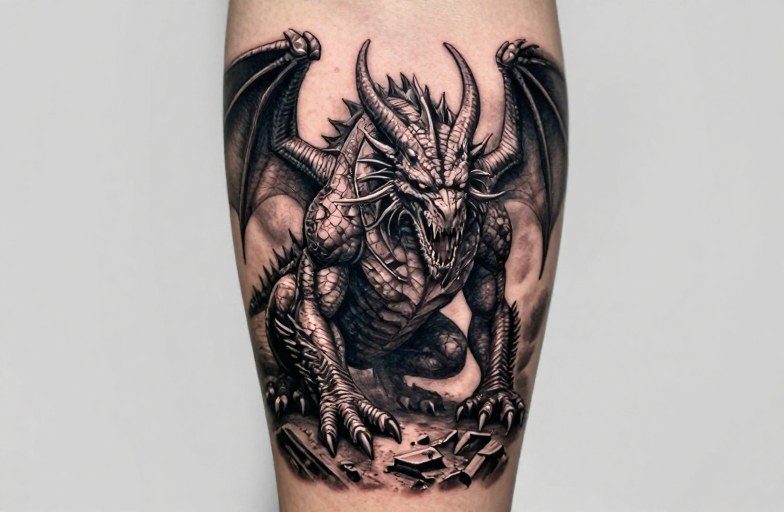
A Smaug dragon tattoo carries the full weight of J.R.R. Tolkien’s most famous wyrm: an ancient creature of immense power brought low by a single arrow to his one vulnerable spot. Most people drawn to this design aren’t celebrating the dragon’s gold-lust, they’re wrestling with what Smaug represents: the corruption of wealth, the blindness of arrogance, and the possibility that even the mightiest fortress of self-protection has a fatal flaw.
Symbolism & Core Meaning
The Fatal Flaw Beneath the Armor
Smaug’s glittering belly of embedded gems and gold isn’t just decoration, it’s his attempt to render himself invincible, and it’s exactly what fails him. The tattoo often functions as a personal memento mori: a warning against building walls so high you forget where the weak point sits. The missing scale, the “bare patch” that Bard’s black arrow finds, becomes the central symbolic element in many designs. Some render it as a deliberate gap in the scales, others as a contrasting color or texture, still others as a small human figure confronting the beast.
Wealth as Burden, Not Prize
Unlike Eastern dragons associated with prosperity, Smaug embodies wealth as paralysis. He does nothing with his hoard but lie on it. The Lonely Mountain isn’t a kingdom, it’s a tomb with better lighting. People who’ve clawed out of materialism, survived financial ruin, or rejected family patterns of accumulation sometimes choose this image to mark that departure. The dragon isn’t aspirational; he’s cautionary.
Mythology & Folklore
Tolkien’s Norse Synthesis
Smaug descends from a specific lineage: the Norse dragon Fáfnir, who transformed from dwarf to wyrm through greed, and the Beowulf dragon, a fire-drake guarding a cursed hoard. Tolkien, a philologist steeped in Anglo-Saxon literature, synthesized these into something new, a dragon who talks, who riddles, whose intelligence makes him more dangerous and more pathetic. The tattoo connects to this deep tradition without requiring the wearer to carry a full literary bibliography. The visual language of the Western dragon, bat-wings, serpentine neck, furnace breath, carries millennia of accumulated meaning about boundary-guarding and corruption.
The Hobbit’s Specific Arc
Within Tolkien’s own mythology, Smaug occupies a peculiar position: he’s not a cosmic evil like Morgoth or Sauron, but a territorial disaster. He destroys Dale and Erebor not from strategic malice but from draconic entitlement. This distinction matters for tattoo symbolism. Smaug represents systemic damage caused by individual appetite, not abstract evil. He’s relatable in his vices, which makes him more frightening and more personally useful as symbolic material.
Common Variations & Styles
The Coiled Hoard Composition
Most Smaug tattoos show the dragon wound around or emerging from treasure, coins, gems, the Arkenstone itself. This composition demands space: the forearm works for a single coiled loop, but the full body wrapping through gold requires a thigh, back, or ribs. Black-and-grey realism dominates, with selective gold ink for the hoard (note: metallic gold tattoo ink ages poorly, often shifting to mustard yellow or fading entirely; experienced artists simulate gold through warm yellows and strategic highlighting). Neo-traditional approaches simplify the scales into bold, readable patterns that hold up at smaller sizes.
The Confrontation Scene
Some designs split the composition: Smaug on one side, Bard with bow or Bilbo with Sting on the other. This creates narrative tension across the body, a shoulder piece might show the dragon’s eye opening to find the archer already drawn. Others isolate the dragon’s head in profile, emphasizing the ruined eye (from the thrush’s report) or the calculating intelligence in the surviving one. The eye specifically offers technical range: smooth gradients for reptilian depth, or hard black traditional style for immediate graphic impact.
Text Integration
The dragon’s own words, “I am fire, I am death”, appear frequently, usually in Tolkien’s invented scripts (Tengwar or Cirth) or in clean serif lettering that evokes the book’s first edition. The Desolation of Smaug film title treatment, with its cracked stone texture, also gets referenced. Text placement matters: wrapping around the dragon’s form reads as incantation; placed beneath as caption, it becomes editorial commentary.
How It Ages on Skin
Scale Detail and the Five-Year Fade
Smaug’s intricate scale patterns present a specific aging challenge. Fine individual scales, especially those drawn with single-needle work, blur together over 3-5 years into a generalized reptile texture. The visual distinction between “detailed dragon” and “lizard with attitude” depends on maintaining contrast between scale rows. Artists solve this through varied scale sizes (larger plates on the back, finer ones toward the belly), strategic negative space, and thicker outline weights on the scale edges than the centers. The belly’s embedded gems, often the most colorful element, are particularly vulnerable; without adequate saturation and proper depth placement, they fade to indistinguishable blobs.
Fire and Red Ink Considerations
Smaug’s breath weapon and the fire-lit environment of his scenes invite heavy red and orange use. Red ink has a documented tendency to fade faster than black, and in some individuals, to allergic reaction. The specific pigment formulation matters more than color family, carbon-based blacks and certain iron oxide reds prove stable, while organic reds (some naphthol derivatives) can degrade or provoke immune response. A skilled artist discusses this during consultation, often building fire effects through layered blacks and skin-tone negative space rather than solid red fills.
Similar & Related Symbols
Within Tolkien’s Universe
Glaurung, the first dragon of Middle-earth, offers a more serpentine, legless alternative with similar thematic weight, father of dragons, manipulator of minds rather than direct destroyer. Ancalagon the Black, largest of all, suits those wanting scale without the specific “hoard” narrative. The One Ring itself, with its inscription, sometimes appears alongside Smaug as parallel corruption imagery. For Elvish aesthetics without the dragon, the Doors of Durin or the White Tree of Gondor provide different entry points to Tolkien tattoo culture.
Cross-Cultural Dragon Comparisons
Chinese and Japanese dragons (lóng/ryū) diverge sharply: benevolent, associated with water and imperial authority, typically wingless and serpentine. The Western wyrm’s wings, fire, and malevolence are specific cultural inventions. A wearer mixing Smaug with Eastern dragon elements should understand the visual dissonance, it’s been done successfully, but requires deliberate artistic bridging, not accidental collision. Wyverns (two-legged dragons) and drakes (four-legged, wingless) offer related Western forms with different symbolic associations: wyverns as heraldic aggression, drakes as earth-bound stubbornness.
Who Chooses This Tattoo
The Recovering Accumulator
People who’ve recognized their own hoarding behaviors, of money, of grievances, of identity, sometimes use Smaug to mark a turning point. The tattoo functions as externalized self-accusation that has become, through artistic transformation, something beautiful. This isn’t self-flagellation; it’s integration. The dragon they might have become, acknowledged and rendered, loses some power.
The Literary Devotee with Edge
Not all Tolkien tattoos are pastoral Shire scenes. Smaug attracts readers who found the dragon’s chapters the most compelling, who recognized that Tolkien’s moral universe contains seductive evil as well as wholesome good. These wearers often pair the image with specific textual engagement, quotes in Elvish, compositional references to book illustrations, or deliberate departure from Peter Jackson’s cinematic design to claim the literary source.
The Technical Enthusiast
Some choose Smaug simply because dragon tattoos offer superb technical vehicles for skin art: complex form, dynamic pose potential, interplay of organic and metallic textures. These collectors may care little for Tolkien specifically, but recognize that the cultural familiarity of Smaug gives them access to artists who’ve developed genuine expertise in dragon rendering. The design’s recognizability becomes practical advantage.
The Bottom Line
A Smaug dragon tattoo works when the wearer has something specific to say about power, protection, and their costs. The image fails when treated as generic “badass dragon”, there are better dragons for that purpose, less burdened with specific narrative weight. The best Smaug tattoos embrace the burden: the gold that weighs down, the armor that conceals vulnerability, the ancient intelligence that couldn’t imagine being outsmarted. Whether rendered in meticulous black-and-grey realism or bold traditional color, the design demands technical skill and conceptual clarity in equal measure. What you’re marking isn’t the triumph of the dragon, but the moment before his fall, the accumulated weight of everything that made him magnificent and everything that made him doomed.
Frequently Asked Questions
Does a Smaug tattoo have to include the treasure hoard?
No, though the hoard completes the symbolic narrative. Isolated head or eye designs work well, especially at smaller scales, but lose the specific “wealth as burden” meaning that distinguishes Smaug from generic dragon imagery.
How painful is a Smaug tattoo on ribs or back compared to other placements?
Ribs and spine rank among the most painful placements due to proximity to bone and thin skin. The extensive shading Smaug typically requires means longer sessions. Thighs and outer upper arms offer more manageable alternatives with similar visual impact.
Can Smaug be combined with other fantasy elements without looking cluttered?
Yes, but with restraint. The dragon’s scale pattern already provides visual density. Adding the One Ring, a small figure, or text works; adding multiple competing elements turns the composition into illustrative overload. Negative space becomes essential.
What’s the difference between Smaug and a generic Western dragon tattoo?
Smaug specifically carries Tolkien’s narrative of intelligent greed, specific vulnerability, and hubristic downfall. Generic dragons can symbolize protection, chaos, or transformation without that particular moral architecture. The distinction matters most to the wearer, not necessarily to casual observers.
Leave a Reply