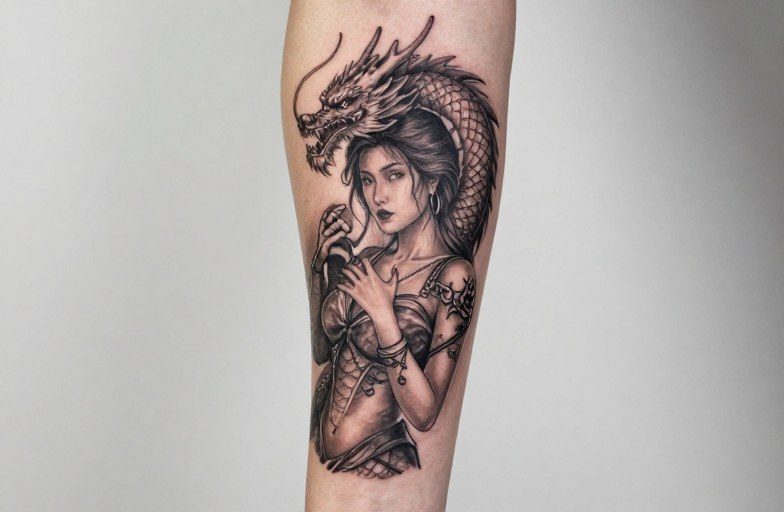
A dragon tattoo on a woman typically signals personal power, fierce autonomy, and protective energy rather than aggression. Across Eastern and Western traditions, the dragon occupies a liminal space, neither fully beast nor deity, and that ambiguity resonates with women who reject narrow definitions of femininity. The meaning sharpens or softens depending on cultural reference, placement, and artistic style, but the core thread remains: this is a creature that answers to no one.
History & Cultural Roots
The dragon’s footprint in tattoo culture stretches across continents with remarkably different temperaments. Understanding these roots prevents flattening a complex symbol into generic “strong woman” cliché.
Eastern Traditions: Benevolent Force
In Chinese and Japanese lineages, the dragon commands rain, rivers, and imperial authority. Unlike Western depictions, these dragons rarely hoard gold or kidnap princesses. They symbolize wisdom, prosperity, and cosmic balance. For women, this tradition offers a model of power that is nurturing and commanding simultaneously, the dragon guards, it does not merely destroy. Japanese irezumi often paired dragons with cherry blossoms or waves, creating tension between ferocity and transience.
Western & Nordic Depictions: The Adversary Reclaimed
European dragons, from Beowulf’s bane to Smaug, were obstacles for male heroes to conquer. Women who choose this imagery often invert that narrative: they become the dragon, not the rescued. Norse lindwurms and serpentine drakes connect to primordial chaos and earth energies. The reclamation is deliberate, taking a symbol coded as enemy and wearing it as avatar.
Who Chooses This Tattoo
The demographic is broader than stereotype suggests. You will find dragons on corporate attorneys, mechanics, mothers, and musicians. What unites them is rarely a single life event but a sustained orientation: these women tend to value self-definition over social approval.
Age and Life Stage Patterns
Younger women often gravitate toward stylized, pop-culture-influenced dragons, think Spirited Away Haku or game-inspired designs. Women over thirty frequently opt for more traditional or abstract renderings, sometimes marking a divorce, career pivot, or the end of a people-pleasing phase. The dragon becomes punctuation, not ornament.
Placement as Statement
- Full back or thigh: Maximum scale for detailed scales, claws, and atmospheric elements; the body becomes landscape.
- Forearm or calf: Visible daily, harder to conceal; signals that the symbolism is integrated, not hidden.
- Ribcage or sternum: Intimate, painful to execute, often chosen after significant personal transformation.
- Behind the ear or wrist: Small, stylized, sometimes matching a sister or friend, less about myth, more about private code.
Symbolism & Core Meaning
Strip away cultural packaging and several consistent meanings emerge. The dragon is liminal, of earth and sky, water and fire, creation and destruction. That liminality appeals to women who occupy contradictory social roles: professional and maternal, soft and armored, visible and guarded.
Protection and Boundaries
Dragons guard treasure. In tattoo context, the treasure is typically the self, time, energy, body, choices. The imagery functions as psychological boundary marker, a signal to others and reminder to the wearer that access is earned, not assumed. This resonates particularly for women recovering from boundary violations or workplace diminishment.
Transformation and Rebirth
Serpentine shedding translates cleanly to personal reinvention. Unlike the phoenix’s single catastrophic rebirth, dragon symbolism allows for iterative change, shedding, growing, repeating. The scales themselves suggest layered identity, each one built over time.
Common Variations & Styles
Style choice dramatically shifts how the dragon reads on skin. A delicate fine-line dragon whispers where a bold traditional piece shouts.
Japanese (Irezumi) and Chinese
These demand technical precision: flowing scales, specific claw counts, directional rules (descending versus ascending dragons carry different connotations). The background matters as much as the creature, waves, wind bars, or peonies complete the composition. On women, these often wrap limbs or traverse the back in dynamic munewari or donburi arrangements.
Neo-Traditional and Illustrative
Thicker outlines, limited but saturated color palettes, and stylized proportions. These suit women wanting recognizability without full cultural immersion. The dragon remains readable at smaller sizes and ages more gracefully than hyper-detailed realism.
Blackwork and Tribal
Silhouette or heavy black fill, sometimes referencing Polynesian or Celtic knotwork. The dragon becomes pattern rather than portrait. This approach minimizes aging concerns, solid black holds; fine detail blurs. On darker skin tones, blackwork dragon tattoos achieve striking contrast and longevity.
Color vs Black and Grey
The color question is practical as much as symbolic. Red dragons dominate Chinese-influenced work, associated with luck and vitality. Green and gold dragons read as earth-aligned or imperial. Blue and silver suggest water, cold intellect, or lunar energy.
Black and grey dragons age with more dignity. Color saturation in dragon scales requires dense packing; as skin changes, those saturated areas hold better than light washes, but reds and yellows fade fastest to muddy pink or mustard. If you choose color, commit to touch-ups every 5-8 years, sooner for sun-exposed placements.
Skin tone affects apparent vibrancy. What reads as vivid crimson on pale skin may deepen to burgundy on melanin-rich skin, neither worse, but plan with your artist for the actual result, not the fresh photo.
Similar & Related Symbols
Women considering dragons often cross-shop related imagery. Understanding distinctions clarifies choice.
- Serpents/snakes: More explicitly feminine-coded across cultures, more focused on cyclical renewal than protective ferocity. Less scale detail, more fluid line.
- Phoenix: Single-event rebirth, fire-specific, often chosen after acute trauma or loss. Less ambiguous than dragon energy.
- Tigers: Comparable power symbolism, more grounded, less mythic. Korean tradition pairs tiger and dragon as complementary forces.
- Koi becoming dragon: The Dragon Gate myth, perseverance rewarded with transformation. Narrative progression rather than static power.
Some women layer these: dragon and phoenix for balance, dragon and tiger for dynamic tension. The dragon typically dominates compositionally when paired.
Before You Decide
Dragon tattoos require commitment. The best pieces need multiple sessions, significant expense, and tolerance for prolonged discomfort. Scale detail demands large canvas; a thumbnail dragon loses every defining feature within years.
Research your artist’s specific dragon portfolio, not just their general skill. Japanese dragons require understanding of shading direction and scale overlap; Celtic dragons need knotwork precision; neo-traditional demands confident line weight. Ask to see healed photos, not just fresh work. Reds blow out. Fine lines blur. A dragon that looks crisp on day three may look bruised and indistinct at year three if executed poorly.
Consider visibility consequences. A dragon throat piece or hand tattoo remains professional-limiting in many fields despite shifting norms. The symbolism you want should not cost opportunities you need.
Finally, sit with the image. Dragon tattoos chosen impulsively often get buried under cover-ups. The ones that last, visually and personally, are chosen slowly, with understanding that you are not borrowing myth but joining it.
Frequently Asked Questions
Does a dragon tattoo on a woman have different meaning than on a man?
The core symbolism, power, protection, transformation, remains similar, but cultural reception differs. A dragon on a woman often reads as more deliberately subversive, reclaiming imagery historically reserved for masculine hero narratives. The personal meaning is individual, but the social statement carries extra weight.
How painful is a dragon tattoo compared to other designs?
Pain depends on placement and detail density, not subject matter. Dragons require extensive shading and linework, so session length increases discomfort. Ribcage, sternum, and spine placements rank among the most painful; outer arm or calf are more manageable. Expect multiple sessions for quality work.
Will a dragon tattoo look good as I age?
Large-scale, bold-line dragons age better than small, intricate pieces. Scale detail below dime-sized blurs within a decade. Black and grey holds sharper than color, especially reds and pastels. Sun protection dramatically extends clarity, tattooed skin is damaged skin, and UV exposure accelerates fading.
Is it cultural appropriation for a non-Asian woman to get a Japanese dragon tattoo?
This depends on execution and context. Researching the tradition, hiring an artist trained in that specific style, and avoiding mixed-symbol mashups shows respect. Treating a Japanese dragon as interchangeable “Asian aesthetic” is where problems arise. When in doubt, consult artists from that tradition and listen to their guidance.
Leave a Reply