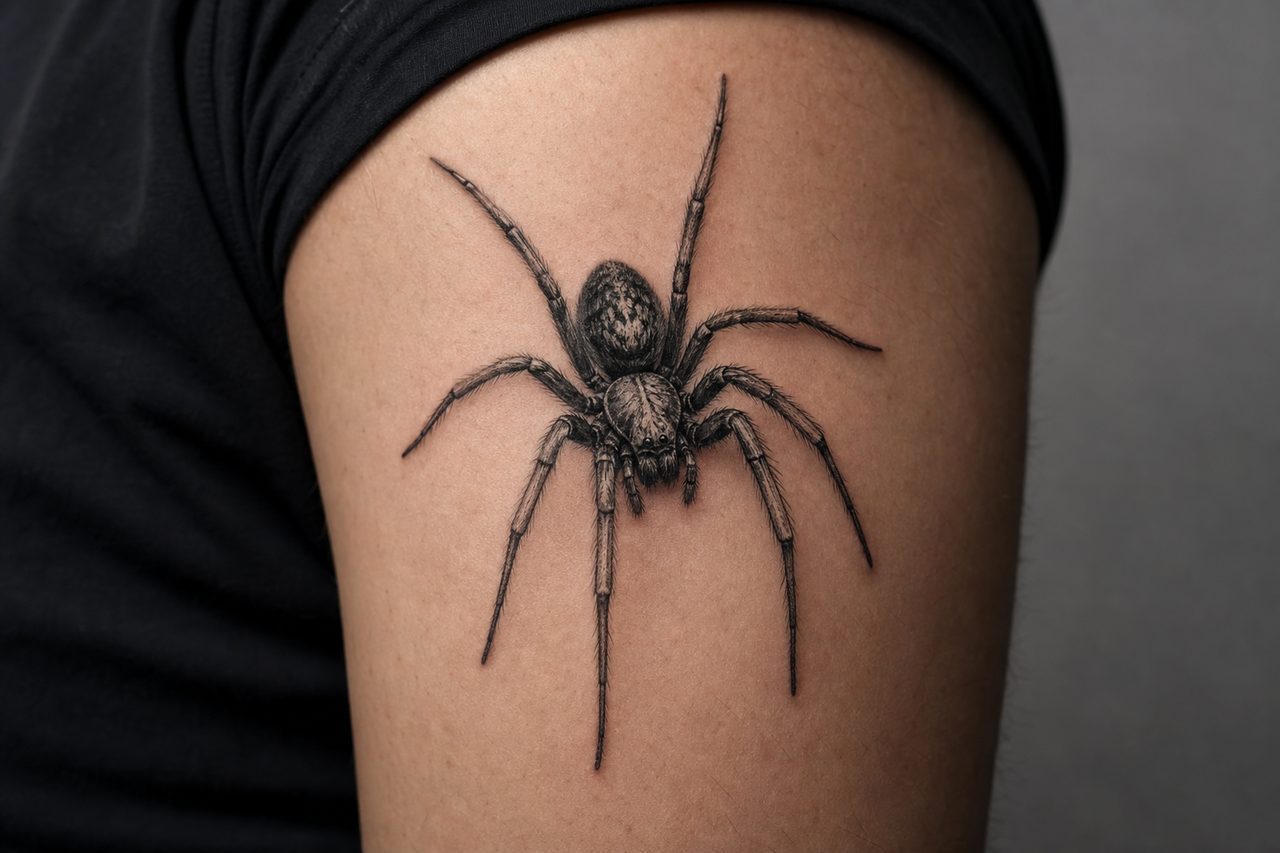
Spider tattoos most commonly symbolize patience, creative power, and the ability to weave one’s own fate. The meaning expands dramatically depending on cultural context, specific species depicted, and artistic style, from protective talismans to warnings, from feminine creative energy to cold predatory isolation. Below is a breakdown of how these symbols actually function in tattoo culture, not a vague list of possibilities.
Religious & Spiritual Angles
Weavers of Fate in Global Traditions
Many spiritual systems grant spiders significant cosmological roles. In West African traditions, Anansi the spider is a trickster and culture hero who outsmarts larger, stronger opponents through wit. Some trace the spider’s association with storytelling and wisdom to these oral traditions, which traveled to the Caribbean and Americas through the transatlantic slave trade. Native American cultures, particularly in the Southwest, often link Spider Woman or Spider Grandmother to creation and the teaching of weaving, both textile and metaphorical. The Hopi and Navajo specifically honor Spider Woman as a guide who taught humans to weave and to think strategically about their lives.
In ancient Egyptian symbolism, the spider was sometimes associated with the goddess Neith, a weaver and creator deity. The image of a spider spinning its web parallels the act of creation itself, something from nothing, order from chaos. This makes spider tattoos particularly resonant for people who work in creative fields or who have rebuilt their lives after disruption. The web becomes a visual metaphor for intentional construction, for patience as a form of power.
Christian and European Folk Interpretations
European Christian tradition offers more ambivalent readings. The spider sometimes appears as a figure of patience and industry, consider the nursery rhyme of the itsy-bitsy spider climbing the waterspout. But medieval European folklore also linked spiders to deception, entrapment, and the demonic. A spider descending on its thread was sometimes read as an evil influence lowering itself into human affairs. This dual reading, creative weaver versus venomous trapper, gives spider tattoos their particular emotional range. The same image can signal “I build carefully” or “I am dangerous to cross,” depending on execution and context.
Personal & Modern Meanings
Control, Entrapment, and Autonomy
Modern wearers often choose spider imagery to mark experiences of being trapped and escaping, or of deliberately constructing boundaries. The spider sits at the center of its web, everything that enters belongs to it. This maps onto personal narratives of establishing control over one’s space, relationships, or circumstances. A spider tattoo can mark the end of a period where someone felt caught in others’ expectations, or the beginning of a more self-directed phase. The web’s geometry also appeals to people drawn to mathematical precision, to sacred geometry, or to the visual satisfaction of complex patterns rendered in skin.
Isolation and Observation
Spiders are solitary predators. Unlike pack hunters, they operate alone, waiting, watching. For people who identify as introverts, as observers rather than participants, or who have chosen deliberate solitude, the spider offers an animal symbol that doesn’t read as pitiable or broken. The black widow’s particular reputation, female, solitary, lethal to mates, has been reclaimed by some women as an emblem of self-sufficiency that doesn’t require apology. This isn’t universal; some find the black widow’s associations too dark. But the option exists in the symbol’s range.
Who Chooses This Tattoo
Placement and style reveal a lot about intended meaning. Spider tattoos on the hand or neck tend to read as warnings or affiliations, particularly in certain subcultures. The spider on the web between thumb and index finger, sometimes called a “prison spider”, has specific associations with incarceration and time served that many outside those communities don’t recognize. On the upper arm, shoulder, or back, the same imagery functions more as personal symbolism, visible when chosen, concealable when needed.
Women choose spider tattoos at roughly comparable rates to men, but often with different stylistic emphases. More delicate linework, incorporation of web patterns into larger floral or mandala compositions, and smaller scale placements are common. Men more often choose bold blackwork, aggressive species like tarantulas or black widows, and larger pieces with high contrast. These are trends, not rules, plenty of exceptions exist in both directions. The point is that the symbol’s flexibility lets it serve very different personal statements without contradiction.
Common Variations & Styles
Species-Specific Choices
The black widow, with its red hourglass, is the most recognizable venomous spider in North American tattoo culture. The hourglass itself becomes a secondary symbol, time running out, mortality, the dangerous feminine. Tarantulas appear when the wearer wants to emphasize size, hair, physical presence over web-based subtlety. Orb-weavers with their circular, symmetrical webs suit geometric and mandala-influenced designs. Jumping spiders, with their large forward-facing eyes, have gained popularity in recent years for their almost personable, alert quality, less horror, more character.
Web-Centric vs. Spider-Centric Designs
Some designs foreground the web, with a small spider or none at all. Elbow web tattoos are a traditional staple in American and Japanese tattooing, often marking time inside or affiliation. A web without a spider emphasizes the structure, the trap, the environment, the systems people move through. A spider without a web emphasizes the agent, the individual, the predator or creator. Combining both allows narrative tension: the spider in relation to its creation, caught in its own structure, or master of it. Negative space webs, where the web is left as untattooed skin within a black background, create striking visual effects but require experienced execution to heal evenly and remain readable.
Similar & Related Symbols
Dreamcatchers share the web structure but carry specifically Native American cultural associations that many non-Native wearers don’t fully understand; the spider tattoo offers some of the same geometric appeal without the same cultural appropriation concerns. The scorpion provides another venomous arachnid symbol, but with more direct associations with astrology (Scorpio), desert environments, and military units. The octopus offers a similarly multi-limbed, intelligent predator symbol, but from marine rather than terrestrial ecology.
In Japanese tattooing, the spider and web appear in traditional irezumi, often linked to the Tsuchigumo, earth spider yokai, monstrous beings that fought legendary heroes. These designs carry specific narrative weight and are typically rendered in the established Japanese style with bold outlines, limited color, and background elements like wind bars or waves. Someone drawn to spider imagery but wanting Japanese traditional work should research this specific iconography rather than simply inserting a spider into an unrelated Japanese composition.
History & Cultural Roots
Spider imagery in permanent body marking appears across multiple continents and centuries, though direct historical continuity to modern tattooing is often hard to establish. Polynesian tattooing includes arachnid and web-like patterns in some regional styles, though these carry specific genealogical and protective meanings distinct from European or African spider symbolism. In ancient Mediterranean cultures, spider amulets and imagery appear in protective and healing contexts, sometimes linked to the myth of Arachne, the weaver transformed into a spider by Athena.
The modern popularity of spider tattoos in Western tattooing is often linked to the growth of blackwork, horror-influenced imagery, and gothic subcultures from the 1980s onward. Spider imagery also proliferated through prison and street tattooing, where limited color and simple equipment favored bold, readable designs. The spider’s basic form, round body, eight legs, radiating web, transfers well to these constraints. Understanding this history matters because it affects how designs read: a fine-line single-needle spider on the ribs carries different cultural weight than a heavy black spider on the elbow, even if both depict the same animal.
What to Remember
Spider tattoos work best when the specific species, style, and placement align with the meaning you intend. A generic spider without these choices risks becoming decorative noise rather than personal symbol. The web’s geometry will spread and soften over time, particularly on areas with frequent movement or sun exposure, plan for this in sizing and detail level. Black ink holds up better than color in spider designs, and heavy black saturation requires more sessions but ages more legibly. If you’re drawn to prison or gang-associated placements, research thoroughly; unintentionally adopting loaded imagery creates problems that good art can’t fix. Finally, the spider’s core symbolic tension, creator and destroyer, patient and lethal, solitary and connected through its web, gives it lasting power. The best spider tattoos don’t resolve this tension but live inside it.
Frequently Asked Questions
Does a spider tattoo on the hand mean someone has been to prison?
The web between thumb and finger, sometimes called a “prison spider,” has specific incarceration associations in some communities, but not all hand spiders carry this meaning. Placement, style, and regional context all matter. Ask your artist if you’re concerned about unintended signals.
Do spider tattoos hurt more than other designs?
Pain depends on placement, not subject. Spider tattoos on bone-heavy areas like elbows, hands, or ankles hurt more than those on fleshy areas like the upper arm or thigh. Web details with fine lines require steady, precise work that can extend session time.
How well do spider web tattoos age over time?
Fine web lines tend to blur and soften within 5-10 years, especially on mobile skin or sun-exposed areas. Bold blackwork spiders age more cleanly. Expect touch-ups, and size the web generously to maintain readability as lines spread.
What’s the difference between a black widow and generic spider tattoo meaning?
The black widow’s red hourglass adds specific associations: female lethality, sexual danger, time running out, and particular regional folklore. A generic spider emphasizes broader themes of patience, creativity, and weaving fate. The choice matters for personal alignment.