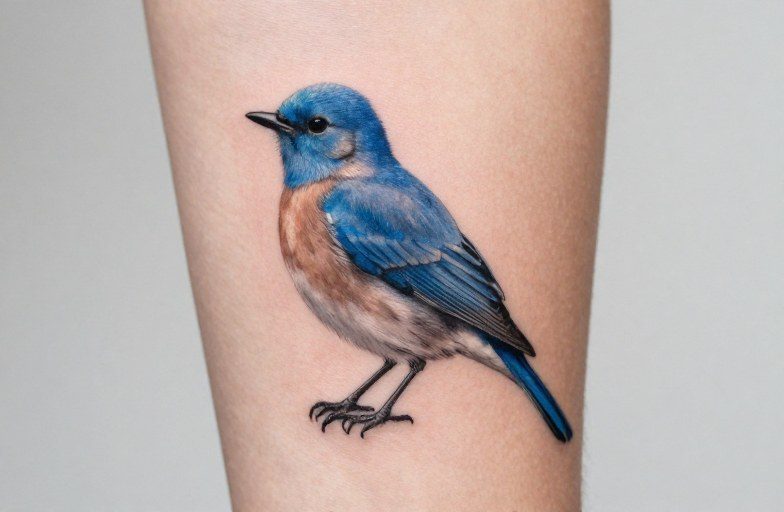
A blue bird tattoo most commonly signals happiness, good fortune, and the return of spring after hardship. Sailors long considered the first sighting of a bluebird at sea a promise of safe passage home. Today, people choose this design to mark recovery, new beginnings, or simply an affinity for open skies and unburdened movement.
Symbolism & Core Meaning
Unlike the raven’s darkness or the sparrow’s grit, the blue bird carries an unmistakably optimistic charge. Its symbolism clusters around several concrete ideas rather than drifting into vague positivity.
Freedom and Open Road
The blue bird’s migratory pattern, returning reliably after absence, made it a natural emblem for homecoming and liberation from confinement. A bird in flight, wings spread, reads differently than one perched on a branch. Flight suggests ongoing journey; perching suggests arrival, contentment, the journey completed. Both work, but know which you’re asking for.
Hope After Hardship
The phrase “bluebird of happiness” isn’t empty marketing. It grew from the bird’s actual behavior: appearing in early spring when winter still clings, when food remains scarce and nights stay cold. The tattoo often marks specific turning points, sobriety dates, the end of a bad marriage, survival of illness. The image doesn’t need text to carry that weight; the cultural association does the work.
- Single blue bird: personal hope, private milestone
- Pair of blue birds: partnership, mutual rescue, romantic or platonic
- Bird with key or open cage: liberation from something specific
- Bird carrying a banner or ribbon: names, dates, short phrases
Best Placements
Where you put this matters more than with some designs because the blue bird’s readability depends on color integrity and line clarity.
High-Visibility Spots
Forearms, collarbones, and upper shoulders show the blue well and allow the bird’s small details to remain legible. The collarbone specifically echoes the bird’s placement near the throat, there’s a visual rhyme that feels intentional rather than accidental. Wrist placement works for smaller designs but forces simplification; fine feather detail blurs faster there due to constant movement and sun exposure.
Hidden or Private Locations
Ribs, hips, and behind the ear suit the blue bird’s role as a private talisman. Rib placement allows a slightly larger design with spread wings, following the body’s natural curve. Behind the ear limits you to a tiny profile or silhouette, effective for minimalism, but you’ll lose the color impact that makes this specific bird recognizable.
- Forearm: best for medium detail, easy to show or cover
- Shoulder blade: accommodates wing spread, low sun damage
- Ankle: classic but prone to fading from shoe friction
- Sternum: centered, symmetrical, painful but striking
Who Chooses This Tattoo
There’s no single demographic, but patterns emerge. People selecting blue birds often want something recognizably positive without the sentimentality of hearts or infinity symbols. The design offers emotional content through a natural image rather than an abstract icon.
Men sometimes hesitate, associating birds with feminine tattoo tropes, but the blue bird’s nautical history and its appearance in traditional Americana (think Sailor Jerry flash sheets) give it masculine grounding. A bold-lined traditional blue bird with a dagger or banner reads entirely different than a watercolor wash on a shoulder.
Age-wise, this appeals across generations. Younger clients often want the bird as part of a larger nature scene; older clients frequently come with specific symbolic intent, a particular hardship they’re marking. The design accommodates both without strain.
History & Cultural Roots
The blue bird’s tattoo lineage is often linked to maritime tradition, though documentation remains spotty before the 20th century. Sailors tattooed swallows for miles sailed; blue birds served a related but distinct purpose as harbingers of land and safety. Some trace the specific “bluebird of happiness” motif to 1908, when a Belgian play of that name gained popularity and the image entered popular culture.
Native American Associations
Several Plains tribes associated blue birds with dawn and the sun’s return. The Navajo connect blue birds to fertility and the renewal of spring. These associations aren’t universal across all Native cultures, specificity matters, and claiming blanket “Native American meaning” flattens genuine diversity. If you’re drawn to this connection, research the specific tribe and region rather than borrowing a generic concept.
European and Early American
French folklore held that blue birds were transformed princes, a motif that occasionally surfaces in more elaborate tattoo designs incorporating crowns or human elements. In early American decorative arts, the blue bird appeared on pottery, textiles, and weather vanes, domestic symbols of contentment rather than wild freedom. This double heritage, wild and domesticated, gives the tattoo its flexible range.
How It Ages on Skin
Blue ink behaves differently than black. It fades faster, shifts color more dramatically, and requires more deliberate maintenance in the design itself.
Color Shifts Over Time
Bright cobalt blue often settles toward navy or slate grey within five to ten years, depending on sun exposure and skin chemistry. Lighter sky blues can muddy to a greenish-grey, especially if tattooed over warm undertones in the skin. A skilled artist accounts for this by building saturation slightly deeper than the final desired tone, knowing the fade curve.
Lines stay crisper longer than color fields. A blue bird with strong black outline and blue fill will remain readable decades longer than a watercolor-style bird with no line structure. The latter looks stunning fresh; the former endures.
Touch-Up Reality
Expect to need color refreshment eventually. Black and grey tattoos age gracefully through value contrast; color tattoos rely on hue saturation that simply diminishes. Budget for a touch-up at year seven to ten, sooner if the placement gets heavy sun. Sunscreen isn’t optional maintenance, it’s structural preservation for this particular design.
Color vs Black and Grey
The choice fundamentally changes what the tattoo communicates and how it survives.
Color: The Specific Bird
Color makes it a blue bird specifically, not just a bird. The Eastern Bluebird, the Mountain Bluebird, the Indigo Bunting, each carries slightly different cultural weight. Color allows accurate species representation, which matters to birders and to anyone choosing the image for a specific personal association with a particular bird. The downside: maintenance, fading, and the need for a larger design to hold the color complexity.
Black and Grey: The Universal Symbol
Black and grey shifts the emphasis from naturalistic representation to symbolic content. The bird becomes an idea rather than a specimen. This reads more timeless, less tied to a specific aesthetic moment. It also ages better and works at smaller scales. A tiny black bird behind an ear succeeds where a tiny blue bird would dissolve into indistinguishable color.
Some artists offer a middle path: black and grey body with a single blue accent, the eye, a wing patch, a small chest marking. This preserves the color’s impact while minimizing long-term maintenance. Ask if your artist has examples of this approach; not all comfortable with color will suggest it unprompted.
Final Word
The blue bird tattoo works because its symbolism is specific enough to carry weight and flexible enough to accommodate individual stories. It doesn’t require explanation to read as hopeful, yet it rewards closer attention with layered meaning. Choose color for the living bird and its immediate emotional punch; choose black and grey for endurance and quieter statement. Either way, prioritize line structure over trendy technique, this is a design you’ll want to recognize in the mirror thirty years from now, not just in the fresh photo your artist posts.
Frequently Asked Questions
Does a blue bird tattoo always mean happiness, or can it have darker meanings?
The blue bird’s core symbolism leans positive, but context changes everything. A bird in a cage, with a broken wing, or paired with darker imagery can signal loss of freedom or happiness deferred. The bird itself isn’t locked to one reading, surrounding elements and placement shape the tone.
How small can a blue bird tattoo be before it becomes unrecognizable?
Below two inches, color detail becomes nearly impossible to execute and even harder to maintain. If you want something very small, switch to black and grey with minimal detail. A clean silhouette or profile reads at smaller scales than a fully rendered bird with feather texture.
What’s the difference between a blue bird and a swallow tattoo?
Swallows carry specific maritime meaning, miles sailed, safe return, and are traditionally red-breasted. Blue birds emphasize happiness, spring, and hope rather than nautical achievement. The designs sometimes overlap in style, but the symbolism and coloration diverge clearly.
Can a blue bird tattoo work as a cover-up?
The blue bird’s color saturation can work in your favor for covering older black ink, but the bird’s open-wing poses and negative space requirements make it challenging over dense existing tattoos. A skilled artist can adapt the design, darker blues, added background elements, but it’s not an automatic solution for any cover-up situation.

Leave a Reply