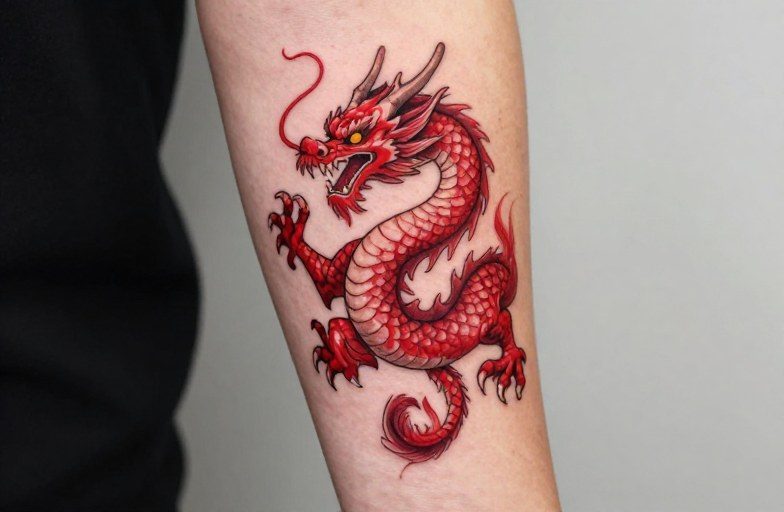
A red dragon tattoo typically signals raw power, fierce protection, and uncontrolled passion, energy that can’t be tamed or ignored. The color red amplifies everything the dragon already represents: in Eastern traditions, the red dragon guards the south and summer, associated with fire and vitality; in Western imagery, it leans toward danger, wrath, and the untamed beast. Combined, they create a symbol of someone who runs hot, protects what’s theirs, and isn’t afraid to make themselves known.
Who Chooses This Tattoo
People drawn to red dragons usually want their tattoo to announce something. Not necessarily to strangers on the street, but to themselves. The wearer tends to identify with intensity, emotional, physical, or creative, and wants that trait externalized rather than hidden.
Common Motivations
- Survivors of hardship who see the dragon as a guardian, not a predator
- Fire signs or those with cultural ties to Chinese, Japanese, or Korean dragon mythology
- Martial artists, gamers, or fantasy enthusiasts connecting to specific archetypes
- People marking a period of transformation where they “burned down” an old life
Less commonly, someone chooses it for pure aesthetic impact, the red dragon is visually arresting in a way a black silhouette simply isn’t. That’s valid too, though most artists notice these clients still gravitate toward specific poses (coiled, ascending, guarding) that carry implicit meaning.
Color vs Black and Grey
This distinction matters enormously for longevity and visual effect. A red dragon isn’t just a black dragon with color swapped in, the entire design logic changes.
How Red Ink Behaves
Red pigments, especially bright scarlet and vermillion, fade faster than black. They sunburn. A red dragon on a forearm that sees daily UV will need touch-ups within 3-5 years to stay crisp, where black line work might hold for a decade. The tradeoff: red dragons photograph dramatically, catch the eye from across a room, and carry emotional weight that black simply doesn’t.
Some artists solve the fading problem by designing the dragon primarily in black and grey, with red as accent, flames, eyes, or a single scale pattern. This preserves the “red dragon” identity while ensuring the piece ages gracefully. Others commit fully to red and accept the maintenance schedule.
Color Saturation Strategies
- Deep crimson and burgundy last longer than bright scarlet or orange-red
- Red over black grey-wash creates depth without relying solely on the color’s punch
- White highlights on red scales add dimension but require a skilled hand, bad white work on red looks like scar tissue
Design Tips & Pairings
The dragon’s pose determines the emotional register more than most people realize. A coiled dragon with head lowered reads defensive, protective, almost sleeping. One ascending vertically, claws extended, mouth open, classic “climbing toward the pearl”, reads ambition and spiritual pursuit. A dragon wrapped around a sword or skull shifts toward aggression and dominance.
Complementary Elements
Flames are the obvious pairing, but they’re also the most overdone. Consider instead:
- Clouds or wind bars (Japanese tradition) to give the dragon context and movement
- A single pearl or jewel, referencing the “dragon chasing the pearl” motif symbolizing wisdom or enlightenment
- Cherry blossoms or maple leaves for contrast, delicate against fierce, temporary against eternal
- Geometric framing or mandala backgrounds that contain the dragon’s chaos within order
Line weight matters tremendously. Dragons have scales, claws, whiskers, horns, too-fine detail in red will blur into mush within a few years. Bold outlines on primary forms, with finer detail reserved for larger scale areas, hold up better.
Personal & Modern Meanings
Traditional symbolism provides the vocabulary; personal meaning supplies the grammar. Someone with Welsh heritage might connect the red dragon to the national flag, representing cultural identity and resistance. A person in recovery might see the fire as purification, the dragon as what emerged from the burn.
Contemporary Interpretations
Modern wearers often detach the symbol from specific cultural claims and use it more loosely: creative fire, sexual energy, protective rage. This can feel appropriative to some, especially when mixed without understanding, Chinese dragon body with Western bat wings, for instance. Most artists recommend doing enough research to know if you’re claiming a specific tradition or creating something syncretic, and being honest about that distinction.
Video games and anime have also reshaped what clients request. Designs from Dark Souls, Sekiro, or specific card games circulate as reference images. These carry their own narrative weight, difficulty, perseverance, specific character identification, that exists parallel to older symbolic systems.
How It Ages on Skin
Red ink has a reputation for causing more reactions than other colors, though much of this traces to older formulations. Modern red pigments are generally safe, but they do spread differently under skin. A red dragon designed with tight packed color in small areas will look muddier faster than one with strategic negative space and black separation.
Long-Term Visual Changes
- Bright reds shift toward pink or orange as they fade
- Skin undertone affects appearance, cool undertones make red look more purple; warm undertones push it orange
- Areas with frequent movement (inner bicep, ribs) blur faster than stable placements (thigh, outer arm)
- Red over black heals more predictably than red alone on pale skin
Touch-up strategy: plan for them. A red dragon should be budgeted as a two-appointment minimum over its lifetime, not a one-and-done piece.
Best Placements
The dragon’s serpentine body invites wrapping and flow. Straight lines fight the form; curves enhance it.
High-Impact Locations
- Full back: allows complete coiled or ascending form with head at neck/shoulder
- Thigh to hip: vertical ascent with tail wrapping toward knee
- Outer arm (sleeve): dragon climbing from wrist toward shoulder, head at deltoid
- Ribcage: challenging but dramatic; dragon’s body follows the natural curve
Smaller Considerations
Red dragons don’t miniaturize well. Below 4-5 inches, scales become dots, claws become triangles, and the color field looks flat rather than dimensional. If you want a small piece, consider a dragon head only, or a single claw holding a pearl, rather than the full body. The forearm inner wrist can work for a head-and-neck composition with flames trailing toward the hand.
One placement to reconsider: the chest center. Dragons want to move; the sternum’s flat plane and limited width constrain them awkwardly. Better to let the body follow a shoulder across pec, or commit to a full torso piece.
Final Word
A red dragon tattoo commits to visibility and intensity. It won’t hide politely under a sleeve. The color demands maintenance, the form demands space, and the symbolism demands some self-awareness about what you’re claiming. Done well, it’s one of the most striking tattoos possible, living color that seems to generate its own heat. Done poorly, it’s a faded outline that looks like a lobster. Choose your artist for their color saturation work specifically, not just their dragon flash book. Ask to see healed photos of red pieces from two-plus years prior. The dragon you want is the one that still looks dangerous after the first fire has cooled.
Frequently Asked Questions
Does a red dragon tattoo have to be Chinese or Japanese style?
No, but mixing styles without intention usually looks disjointed. Celtic, Western fantasy, and tribal dragon forms all work in red, just commit to one visual language rather than Frankensteining elements together.
Why does my red dragon look pink after healing?
Red ink often settles lighter than it appears during application. Some initial brightness is swelling and plasma. Wait the full 6-8 weeks before judging; if it’s still too pale, a saturation pass can deepen it.
Can a red dragon work on dark skin tones?
Absolutely, but the approach shifts. Deeper crimsons and burgundies show better than bright scarlet, and more black line structure ensures the form reads clearly even where red pigment is subtler.
Is the red dragon specifically masculine or feminine?
Neither. The symbol crosses gender boundaries completely. Composition and accompanying elements steer the feel more than the core image, delicate wind bars and flowers versus heavy armor and flames create different registers.

Leave a Reply