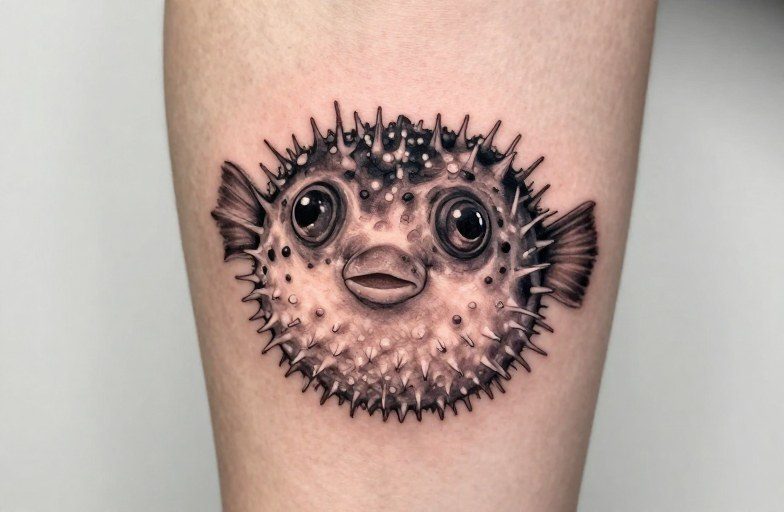
The puffer fish carries a layered meaning built on contradiction: a soft, almost comical body that can become a spiked fortress. Most people who choose this tattoo are drawn to that tension between vulnerability and defense, between being approachable and knowing exactly when to draw the line. The design also nods to transformation under pressure, literally inflating to survive threats, and carries cultural weight in Japanese tradition as a symbol of risk, delicacy, and mastery.
Symbolism & Core Meaning
Defense Without Aggression
Unlike predators that signal danger through claws or teeth, the puffer fish hides its weaponry until provoked. This makes it a natural emblem for people who don’t lead with hostility but maintain clear boundaries. The spines only deploy when the fish inflates, so the tattoo resonates with anyone who’s learned that softness and self-protection aren’t opposites, they’re sequential states. The message isn’t “stay dangerous.” It’s “know when to expand.”
Risk and Precision
In Japan, fugu preparation requires a licensed chef because the same tetrodotoxin that makes the puffer lethal is present in precise concentrations. That cultural association adds a secondary layer: the tattoo can represent navigating danger with skill, or respecting something beautiful enough to be deadly. Some trace this connection to Edo-period art where fugu appeared alongside warnings about hubris, though the modern tattoo wearer usually emphasizes the mastery aspect over the mortality one.
Playful Resilience
There’s genuine absurdity in a fish that bloats to survive. The puffer’s round, cartoon-adjacent shape keeps the symbolism from becoming overly grim. Many designs lean into this, big eyes, exaggerated cheeks, a almost toy-like quality that undercuts the threat of the spines. That duality, serious defense wrapped in silly packaging, is exactly the point for a lot of people.
Common Variations & Styles
Traditional Japanese (Irezumi)
Fugu in irezumi typically appear as part of larger water scenes, rendered with bold outlines and flat color blocks. The classic palette leans warm: orange-red bodies, cream underbellies, black spines. These designs work best at medium scale or larger, at least palm-sized, so the spines read as distinct elements rather than texture noise. The background often includes waves, bubbles, or seaweed to anchor the fish in motion.
Neo-Traditional and Illustrative
Contemporary takes push the expression further: puffed cheeks exaggerated to near-spherical proportions, spines rendered as fine linework or even replaced with symbolic objects (roses, knives, stars). Color freedom expands here, teals, purples, metallics that don’t exist in nature. These versions suit arms and thighs where the rounded form can occupy space without fighting the body’s geometry.
- Blackwork/dotwork: Spines become the star, with stippling creating depth on the body. Excellent for smaller scales.
- Fine line: Delicate, almost scientific illustration style. Best on inner forearms, collarbones, ribs, places where the viewer leans in.
- Cartoon/new school: Exaggerated features, bright gradients, often paired with anthropomorphic elements (tiny hats, cigarettes, human expressions).
Design Tips & Pairings
Placement and Scale
The puffer’s natural roundness makes it forgiving for curved body areas, shoulder caps, knees, elbows, hips. On flatter planes like the forearm or calf, consider adding motion lines or background elements to prevent the design from feeling like a floating sticker. For very small tattoos (under two inches), simplify aggressively: a puffed silhouette with minimal spine detail. At larger scales, the spines can become individual focal points, each one a chance for texture variation.
What Pairs Well
Water motifs are obvious but effective: bubbles, waves, kelp strands that wrap around the form. Less expected pairings include:
- Skulls or hourglasses: Leans into the fugu toxicity association without being literal.
- Japanese lanterns or sake cups: Cultural context for the culinary tradition.
- Empty hooks or broken nets: Emphasizes escape, survival, the one that got away.
- Contrasting sea creatures: Sharks or anglerfish for predator/prey tension; jellyfish for shared vulnerability.
Line weight matters significantly. Thick outlines hold up better over time but can overwhelm the puffer’s delicate features. A common solution: bold outer contour with finer interior lines for spines and facial details.
How It Ages on Skin
The Spine Problem
Those fine radiating lines that make puffer tattoos distinctive? They’re the first thing to degrade. On older pieces, spines often blur from sharp needles into soft fuzz, especially on areas with more movement or sun exposure (forearms, calves). Plan for this: ask your artist to build in slightly heavier spine bases than looks strictly necessary fresh. The contrast between body and spine needs to survive a 30% line spread.
Color Choices Over Time
Red-orange pigments, common in traditional fugu designs, are notoriously fugitive. They fade faster than blues and blacks, shifting toward a washed salmon within five to eight years depending on sun habits. If longevity matters, anchor the design with strong black structure, spines, eye outlines, mouth, so the piece reads clearly even as warm tones mute. Yellows and light greens on the underbelly face similar challenges; consider them accent rather than foundation.
White ink highlights on spines look crisp initially but often disappear entirely into lighter skin tones within two to three years. On darker skin, they may yellow slightly. Either way, don’t rely on white alone for critical detail.
Who Chooses This Tattoo
The puffer fish attracts a specific psychological profile more than a demographic one. People drawn to it often have histories of being underestimated, appearing gentle or accommodating while maintaining internal boundaries they’ve had to enforce explicitly. The tattoo functions as a kind of warning label they find funny rather than hostile.
It’s also surprisingly common among people in high-skill, high-stakes professions: surgeons, pilots, chefs, anyone whose work involves precision under pressure. The fugu preparation parallel isn’t always conscious, but the resonance with “one wrong move and this is dangerous” seems to land. Others come from backgrounds where they had to become larger than themselves to survive, emotional inflation as a genuine coping mechanism.
Less commonly, it’s chosen by divers and marine biologists with specific encounter stories, though this group tends toward more realistic renderings than symbolic ones.
Similar & Related Symbols
Within Marine Imagery
The porcupinefish, often confused with puffers, shares the inflation defense but has sharper, more permanent spines. Visually similar, symbolically more aggressive, less “don’t make me,” more “always ready.” Blowfish is the broader category; puffer is the specific family most commonly tattooed. The boxfish, with its rigid geometric armor, offers a fascinating counterpoint: permanent defense versus deployable defense.
Cross-Category Parallels
- Hedgehog/porcupine: Same inflation-as-defense, terrestrial equivalent. Less playful, more prickly.
- Balloon or bubble imagery: Shared roundness and tension, minus the biological threat.
- Oni masks: Japanese protective symbolism, similarly toggling between comic and menacing.
- Closed fist inside open hand: Abstract version of the same “peaceful but prepared” duality.
Some trace the puffer’s popularity spike to early 2000s anime and video game appearances, though tattoo adoption lagged by nearly a decade. The current wave seems driven more by the symbol’s fit with contemporary conversations about boundaries and emotional labor than by pop culture reference.
Key Takeaways
The puffer fish tattoo works because its meaning is structurally sound: a visible, almost silly exterior that conceals a serious defense mechanism. That maps cleanly onto real human experience without requiring elaborate explanation. For design, prioritize scale that lets spines read as individual elements, build in line weight that will survive blurring, and choose color knowing that warm tones fade fastest. The best versions don’t try to resolve the contradiction between cute and dangerous, they inhabit it fully.
Frequently Asked Questions
Does a puffer fish tattoo always mean something about being defensive?
Not strictly. Some people choose it for the Japanese culinary tradition, the pure visual appeal, or personal encounter stories. But the defense-through-inflation symbolism is the most common and culturally available reading.
What’s the difference between a puffer fish and a porcupinefish tattoo?
Porcupinefish have larger, permanently visible spines and a more rigid body structure. Visually, that reads as more aggressive and less playful. Puffers have smaller, deployable spines that only show when inflated, emphasizing the transformation aspect.
Is this tattoo culturally appropriative if I’m not Japanese?
The puffer fish appears across many cultures and isn’t a sacred symbol. However, specific irezumi styling, particular wave patterns, color palettes, accompanying motifs, does carry cultural specificity. A naturalistic or stylized puffer without those specific Japanese compositional elements generally raises fewer concerns.
How painful is a puffer fish tattoo compared to other designs?
Pain depends entirely on placement, not design. The puffer’s round shape suits curved body parts like shoulders or knees, which can be more sensitive. The fine spine details may require multiple passes, potentially increasing session time but not necessarily intensity per minute.

Leave a Reply