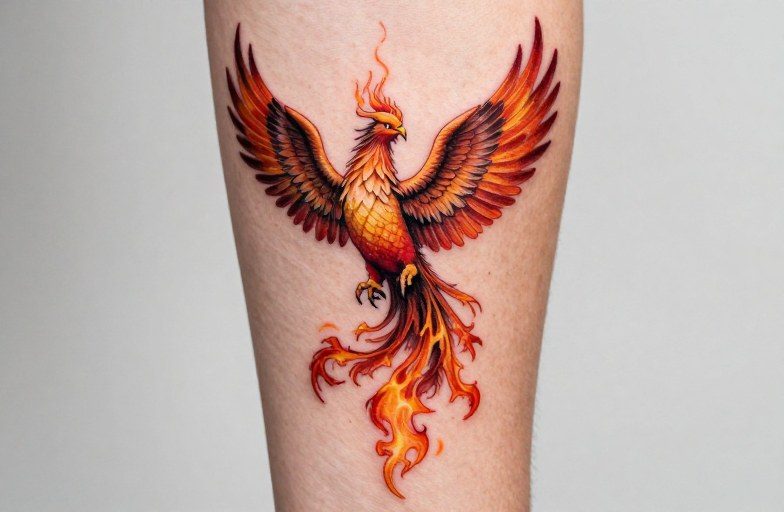
The phoenix rising from fire is one of the most direct visual metaphors in tattooing: total destruction followed by forced renewal. It represents surviving what should have killed you, addiction, divorce, illness, prison, war, and returning as something unrecognizable from the ashes. The fire is not decorative; it is the mechanism of change. Without the burn, there is no rebirth.
Common Variations and Styles
Not every phoenix tattoo looks like a fantasy paperback cover. The style you choose changes how the symbolism reads to others and how it ages on your skin.
Neo-Traditional and Japanese
Neo-traditional phoenixes favor bold outlines, limited but saturated color palettes, and stylized flames that read clearly from a distance. The bird itself often resembles an eagle or peacock hybrid with exaggerated tail feathers. Japanese phoenix (hou-ou) interpretations lean toward flowing, almost water-like plumage with specific directional rules, typically facing left, with paulownia or peony motifs. These hold up better over decades because the heavy line weight prevents the design from blurring into soup.
Realistic and Abstract Approaches
- Realistic: Feather detail requires large scale (thigh, back, ribs) and skilled shading; small realistic phoenixes become muddy grey blobs in five years
- Geometric/linework: The bird constructed from triangles, dotwork, or single-line techniques; the fire becomes negative space or minimal flame shapes
- Trash polka: Phoenix emerging from splattered black ink and red accent, chaos as the fire itself
- Watercolor: Orange, red, and yellow bleeding without outlines; high impact fresh, unpredictable aging
Abstract versions often communicate the concept more honestly than literal ones. A silhouette dissolving into flame particles says “I was destroyed and remade” without the costume drama.
Similar and Related Symbols
Clients often combine the phoenix with complementary imagery or choose alternatives when the phoenix feels overused in their social circle.
Direct Comparisons
The ouroboros (snake eating its tail) cycles endlessly; the phoenix cycles once with finality. Ouroboros suits ongoing self-work, phoenix suits definitive before-and-after moments. The lotus emerging from mud shares the “beauty from filth” narrative but lacks violence, better for gentle awakenings, worse for survival stories. The koi swimming upstream transforms into a dragon; the phoenix has no upgrade, only recurrence. That is either comforting or depressing depending on your worldview.
Common Pairings
- Clocks or hourglasses: Time as the fire, what burned you was duration itself
- Quotes in script: Usually redundant; the image already speaks
- Names or dates: Often the date of sobriety, diagnosis, release, or death of a loved one
- Roses or other flowers: Beauty specifically regrown, not inherent
Pairings work best when they complicate the meaning rather than underline it. A phoenix with a broken chain suggests liberation caused the destruction. A phoenix with an empty nest suggests the rebirth required sacrifice.
Best Placements
Where you put this tattoo affects how the fire reads, contained or consuming, visible or private.
Large Canvas Options
The full back remains the classic placement for a reason: the spine becomes the rising axis, shoulder blades spread into wings. A back piece allows the fire to start at the waist and the bird to emerge at the neck, creating actual vertical movement. Thighs offer similar scale with easier concealment. The rib cage follows the body’s natural flame shape, tapering at the waist, expanding at the chest, but hurts significantly more and limits session length.
Smaller and Strategic Spots
- Forearm: Daily reminder placement; the bird rises toward the elbow or hand
- Behind the ear or nape: Hidden emergence; only visible when you choose
- Chest over heart: The fire literally covers the organ that survived
- Hand or fingers: Aggressive visibility; the fire becomes what you reach with
Small phoenixes fail when they try to include everything. A single wing, an eye, or a feather aflame often communicates more clearly than a shrunken full bird.
Religious and Spiritual Angles
The phoenix predates Christianity but was folded into resurrection theology early. Church fathers often linked it to Christ’s three days, though this was symbolic appropriation rather than doctrinal origin. The bird’s self-immolation and voluntary return made it a useful teaching tool.
Christian Interpretations
Modern Christian wearers sometimes emphasize the fire as purifying rather than destructive, refiner’s fire, Malachi’s imagery. The phoenix becomes less about surviving trauma and more about sanctification through suffering. This shifts the emotional tone from triumph to gratitude. Crosses integrated into the wings or flames make this explicit, though they can feel pasted-on if the artist does not integrate the geometry.
Eastern and Pagan Frameworks
In Egyptian context, the bennu bird, often linked to the phoenix, was associated with Ra and creation cycles. Hindu garuda parallels share the solar connection but emphasize speed and service rather than rebirth. Contemporary pagan practice sometimes uses the phoenix in ritual tattooing to mark initiation or grade advancement, particularly in eclectic traditions. The fire becomes literal invocation, the tattoo a working tool rather than mere decoration.
Color versus Black and Grey
This choice changes the emotional temperature of the piece more than most subjects.
Color fire, orange, red, yellow, sometimes blue at the base, reads as energy, passion, warning. It photographs well fresh and attracts attention. The downside: warm colors fade fastest. Yellow often becomes skin-tone within several years. Red shifts to pink or grey depending on ink quality. Touch-ups are almost inevitable for a bold color phoenix to stay readable.
Black and grey fire, rendered through shading and whip-shading techniques, reads as smoke, ash, or night-fire. It is less immediately legible as “flames” to casual viewers, which some wearers prefer. The symbolism shifts from dramatic spectacle to somber endurance. Black and grey ages more predictably and requires less maintenance. For professionals in conservative fields, it is the practical choice.
Some artists split the difference: black and grey bird with limited red or orange accent in the fire base. This preserves the structure while adding heat.
Who Chooses This Tattoo
Certain life events often precede this request. Sobriety anniversaries, post-divorce, post-incarceration, cancer remission, military discharge after traumatic deployment. The phoenix offers a way to mark the boundary between before and after without naming the specific event for strangers.
Gender and Age Patterns
Men often want the bird aggressive, talons extended, beak open, flames violent. Women frequently prefer the emergence moment, wings still folding open, fire still parting, the instant of becoming rather than the fully realized form. These are trends, not rules. Both approaches work on any body.
Age matters for placement more than design. Younger clients choose visible spots as identity declarations. Older clients, having learned that identity shifts again, often choose concealability. The meaning does not change; the relationship to being seen does.
When It Works and When It Does Not
The phoenix fails as a tattoo when chosen too soon, during the fire rather than after the ash settles. Someone still in active crisis who gets a rebirth symbol often feels mocked by their own skin later. The image becomes a lie or a goal rather than a record. Most reputable artists will gently probe timing without playing therapist. If you are still burning, consider a temporary marker or a different symbol of endurance.
Covering Scars and Skin Changes
This is one of the most practical reasons people choose a phoenix, and it is rarely discussed openly. Fire imagery naturally incorporates texture variation. Raised scars read as heat distortion. Discolored skin becomes smoke. The bird rising from damaged tissue is not just metaphor; it is literal camouflage.
Not all scar tissue takes ink evenly. Burn scars, in particular, can be unpredictable. A consultation with an artist experienced in scar coverage is essential. They may need to work in stages, letting the first pass settle before adding the fire details that will hide the remaining texture. The phoenix is forgiving for this purpose because flames do not have a “correct” edge. A wobbly line in a feather would be a flaw; in fire, it is realism.
Skin Undertones and Fire Color
Cool undertones (pink or blue cast to veins) make orange read more red. Warm undertones (greenish veins) make red read more orange. This affects how the fire “reads” to the eye regardless of the ink formula. An artist who understands color theory will adjust the pigment mix rather than using the same orange on every client.
Dark skin does not mean avoiding color, but it does mean choosing saturation over lightness. A deep crimson will remain visible where a pastel orange disappears. Black and grey with strategic red accents often serves dark skin better than full rainbow fire, not because of limitation but because the contrast is more controlled.
What to Remember
The phoenix rising from fire tattoo works when the destruction is real and the return is demonstrable. It fails when borrowed for ordinary difficulty or chosen as generic inspiration. The best versions are specific to your actual fire: scale, style, placement, and pairing all chosen to match what actually happened, not what sounds dramatic.
The tattoo’s power comes from accuracy, not intensity. A small black and grey feather with a single red tip, placed where only you see it, carries more weight than a full back piece chosen from a shop wall because it felt inspiring that afternoon. The fire you survived is already specific. The art should be too.
Wait until the ash settles. Then mark what grew from it.
Frequently Asked Questions
How long does a phoenix tattoo take to complete?
A small single-session piece might take 2-4 hours. Full back pieces require multiple sessions over months, sometimes 15-30 hours total depending on complexity and color saturation.
Does a phoenix tattoo hurt more than other designs?
The pain depends on placement, not subject. Rib cage and sternum fire elements hurt significantly more than thigh or outer arm work. The design itself does not affect pain.
Can a phoenix tattoo be covered up later?
Fire and feather textures are difficult to cover because of the detailed linework. Black and grey versions offer slightly more options than saturated color. Plan for the original to be permanent.
Is the phoenix only for people who have survived extreme trauma?
No, but the symbol resonates most deeply when tied to genuine transformation. Using it for motivation alone is common but often feels hollow to the wearer within a few years.

Leave a Reply