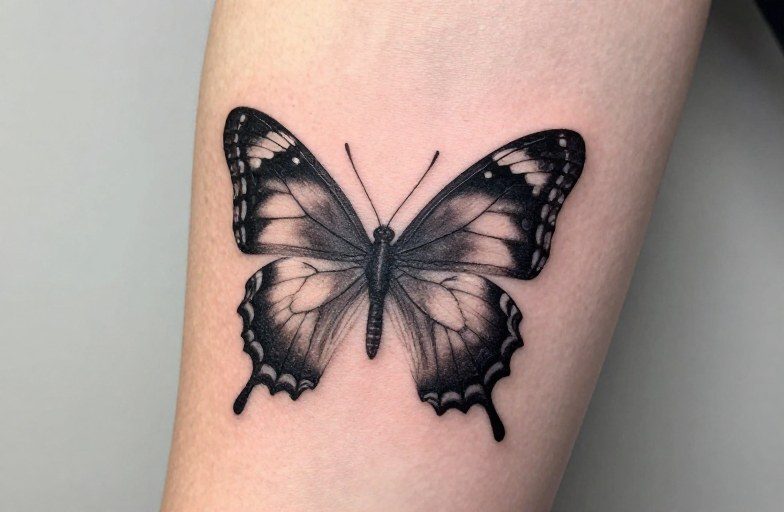
A butterfly tattoo most commonly signals transformation, freedom, and the acceptance of change. Beyond the obvious caterpillar-to-butterfly metaphor, the design carries weight across cultures as a symbol of the soul, rebirth after hardship, and the fleeting beauty of life. The specific meaning shifts with color choice, placement, and what the wearer has actually lived through, not every butterfly is about “new beginnings” in the sunshine-and-rainbows sense.
Who Chooses This Tattoo
Butterfly tattoos draw a broader cross-section than most motifs. You’ll see them on first-timers getting something small behind the ear, and on collectors with full sleeves who want a meaningful filler piece. The appeal cuts across age, gender, and style preference because the symbol is both universally recognized and personally adaptable.
Common Motivations
- Marking a major life transition, divorce, recovery, career change, coming out
- Memorializing a lost loved one, particularly in Mexican and Filipino communities where butterflies are often linked to visiting spirits
- Simply loving the visual form; the wing structure offers incredible artistic range
- Covering scars or older tattoos, since the wing shape camouflages irregular skin well
There’s no “typical” butterfly client. The 19-year-old getting a tiny blue morpho on her ankle and the 50-year-old getting a death’s-head hawkmoth across his chest are both drawn to the same core symbol for entirely different reasons.
Personal & Modern Meanings
Contemporary wearers rarely stick to dictionary definitions. A butterfly might represent surviving abuse, celebrating sobriety, or honoring a child who died in infancy. The modern tattoo culture allows, and expects, personal reinterpretation of classic symbols.
Color as Personal Code
Color choice carries more specific weight than many realize:
- Black and grey: Often chosen for memorial pieces, or by people who want the symbolism without the “girly” stigma some attach to bright colors
- Blue (especially morpho): Frequently tied to mental health awareness, depression survival, or calm after chaos
- Orange and black (monarch): Immigration journeys, Mexican heritage, or the specific resilience of the monarch’s multi-generational migration
- White or pale pastels: Sometimes signals purity or innocence, but increasingly used for visibility on darker skin tones where traditional bright colors can muddy
Two people with monarch butterflies might have opposite meanings, one celebrating a return home, another mourning a homeland left behind.
Symbolism & Core Meaning
The transformation narrative dominates, but the full symbolic range runs deeper. Butterflies embody fragility and strength simultaneously, their wings are tissue-thin yet carry them thousands of miles. This duality is what makes the symbol stick.
The Death Connection
In many cultures, butterflies are commonly associated with death and the soul’s journey rather than simple rebirth. Irish folklore often links them to the dead; Japanese tradition sees them as spirits of the living and the dead alike. A butterfly tattoo can mean “I carry someone with me” as much as “I became someone new.”
Freedom vs. Entrapment
The butterfly’s flight reads as freedom, but the chrysalis stage matters too. Some wearers emphasize the cocoon, the necessary isolation, the uncomfortable compression before change. Designs that show the chrysalis alongside the emerged butterfly tell a more complete story than flight alone.
Design Tips & Pairings
The butterfly’s shape makes it technically versatile but also easy to execute poorly. Understanding how the design functions on skin separates pieces that age well from ones that blur into indistinguishable blobs.
Placement & Scale
- Shoulder blade/upper back: Allows for full wing spread with natural muscle movement; the wings can “flutter” when you move
- Forearm or calf: Good for side-view compositions with body detail; flat planes show line work clearly
- Ribcage: Popular but challenging, thin skin and movement mean color saturation drops faster here
- Behind ear or wrist: Requires extreme simplification; intricate antennae and leg details will disappear within 2-3 years
Stylistic Choices That Matter
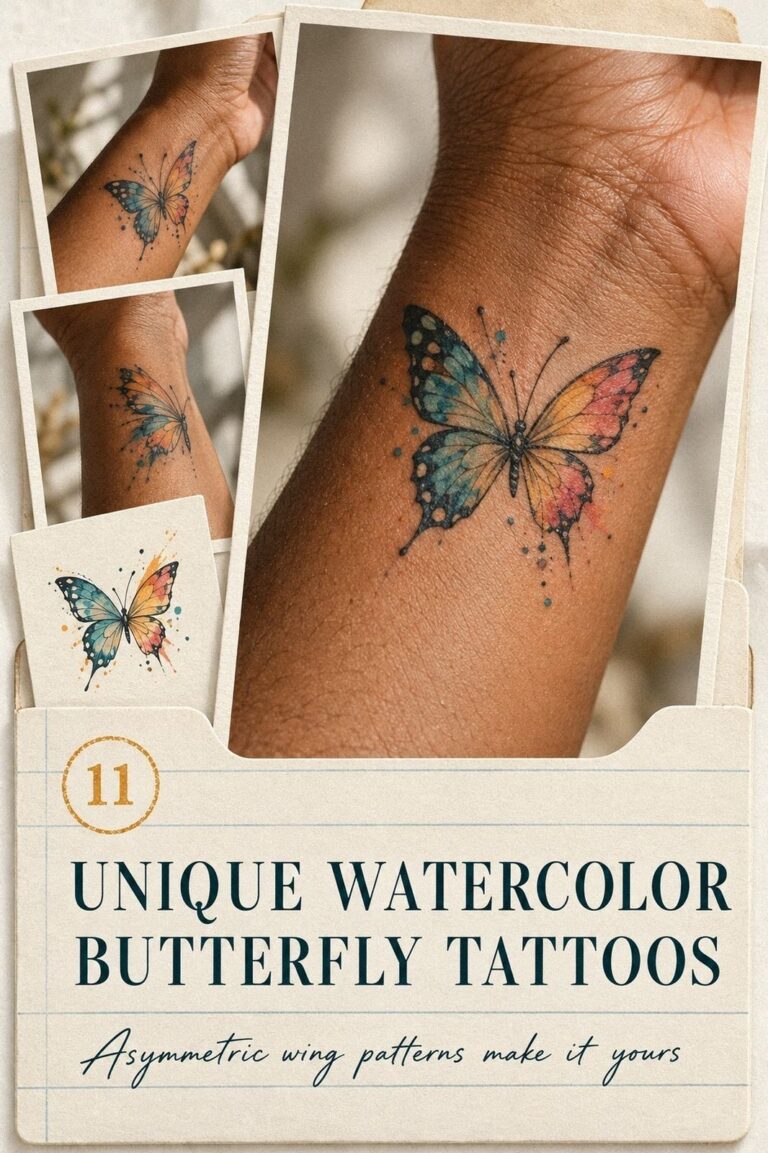
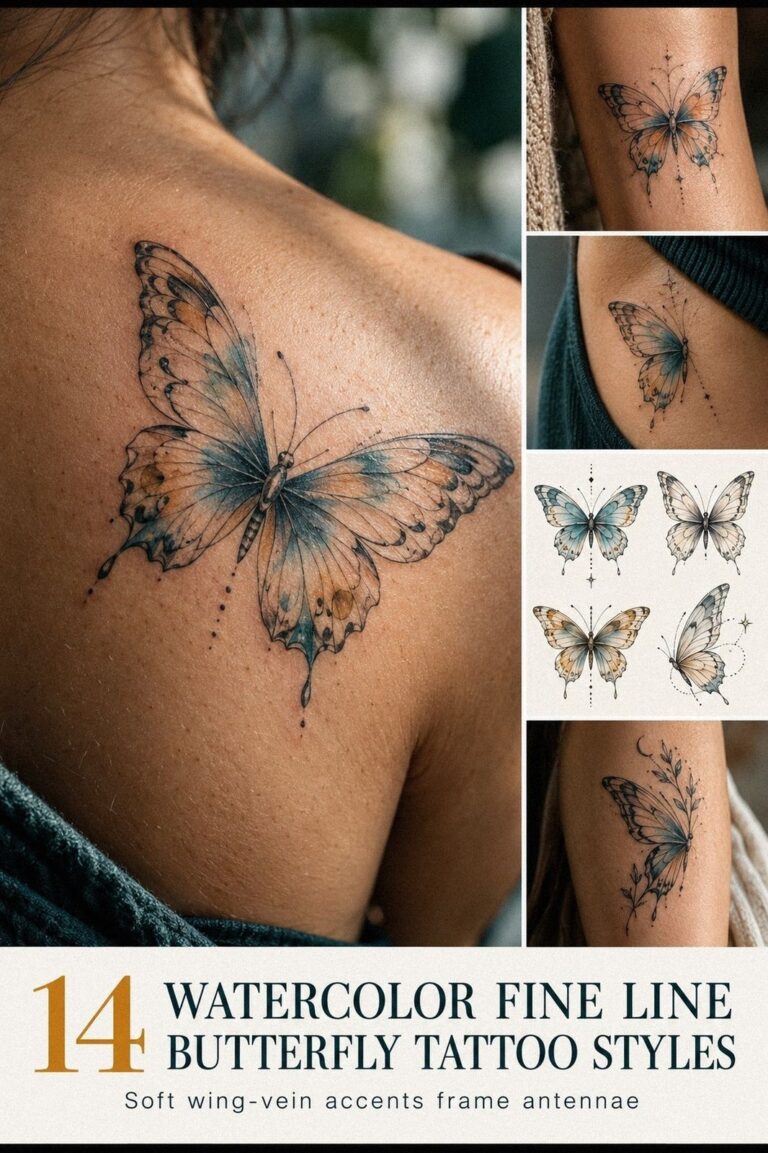
Line-only butterflies age faster than those with shading, but heavy black outlines can look harsh on delicate designs. The sweet spot is usually moderate greywash shading with strategic black accents on wing veins. Watercolor-style butterflies without any black structure are notorious for fading to unrecognizable color smears within five years, pretty on Instagram, disappointing in person.
Popular pairings include flowers (chrysanthemums for death, roses for love), skulls (memento mori), and geometric elements (sacred geometry framing). Each pairing shifts the meaning: butterfly with clock = time passing; butterfly with dagger = beauty and pain intertwined.
Religious & Spiritual Angles
Christian tradition sometimes links the butterfly to resurrection, though this association is more modern than biblical. The three-stage life cycle (caterpillar, chrysalis, butterfly) maps neatly onto life, death, and afterlife for believers who want a visually striking faith tattoo without crosses or script.
Eastern Traditions
In Chinese symbolism, butterflies are often linked to love and marriage, two butterflies represent a happy couple. Some trace Taoist associations to the philosopher Zhuangzi’s famous dream of being a butterfly, blurring the line between reality and illusion. A butterfly paired with Chinese characters or specific flowers (peony, plum blossom) signals this cultural context rather than generic transformation.
Hindu and Buddhist interpretations vary by region; some traditions see the butterfly as representing the soul’s reincarnation, while others focus on the impermanence of all forms, anicca in Pali Buddhism. The latter interpretation tends toward darker, more muted designs.
History & Cultural Roots
Butterfly imagery in permanent skin decoration has ancient precedent, though not always with the same meanings. Pre-Columbian Mesoamerican cultures used butterfly motifs in ritual and decoration, often linked to fire and warrior souls. The Aztec deity Itzpapalotl, the “Obsidian Butterfly,” was a fearsome skeletal warrior goddess, far from the gentle modern stereotype.
Modern Tattoo Culture Adoption
The butterfly became a tattoo staple in Western shops during the 1960s-70s alongside the broader hippie interest in nature symbolism. Early versions were often simple flash designs, heavy black outlines, minimal shading, quick to execute. The 1990s saw an explosion of lower-back butterflies that became cliché, then ironically reclaimed, then genuinely reclaimed by wearers who refused to let a placement joke ruin a meaningful symbol.
Contemporary artists have pushed the form into hyperrealism, abstract geometry, and mixed media approaches. The butterfly now functions as a test of an artist’s range: can they render translucent wing scales, or adapt the form into a trad-bold framework, or make it work as a negative-space design?
The Bottom Line
A butterfly tattoo means whatever the wearer has lived, but the symbol’s power comes from its built-in tension: beauty that is temporary, transformation that requires destruction of the previous form, flight that depends on fragile structures. The best designs honor this complexity rather than flattening it into generic positivity. If you’re considering one, spend time on the specific species, the color logic, and whether you want the full lifecycle or just the winged result. The difference between a butterfly that lasts twenty years as a meaningful mark and one that becomes a dated regret is usually in those details, not the symbol itself.
Frequently Asked Questions
Do butterfly tattoos only work on women?
Not at all. The symbol is universal, and modern tattooing sees plenty of men choosing butterflies in bold, dark, or aggressive styles. Masculine framing, skull integration, blackwork, larger scale, shifts the visual gender coding without losing the meaning.
Why do watercolor butterfly tattoos fade so badly?
Watercolor relies on dilute pigment without black structural lines to hold the shape. On skin, those soft edges blur outward over time, and bright colors break down faster than black. Without a skeleton of dark lines, the butterfly shape dissolves into a colored stain.
What’s the difference between a monarch and a swallowtail butterfly tattoo meaning?
Monarchs are commonly associated with migration, resilience, and Mexican cultural heritage. Swallowtails, with their distinctive tail extensions, are often linked to grace and airiness, and their more complex wing shape allows for different artistic composition. The species choice is usually personal or aesthetic rather than carrying fixed symbolic differences.
How much detail can a small butterfly tattoo actually hold?
Less than most people hope. Below two inches, leg details, individual wing scales, and thin antennae become solid black lines or disappear entirely within a few years. Small butterflies work best as silhouettes or simplified shapes with strong contrast rather than attempted realism.
Leave a Reply