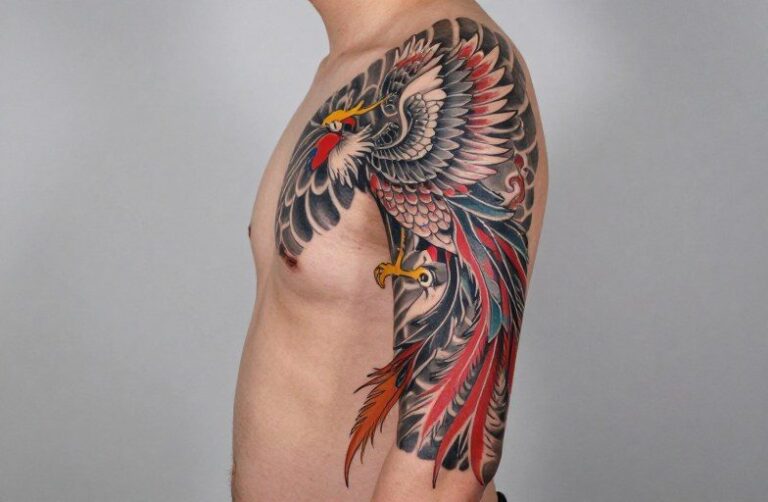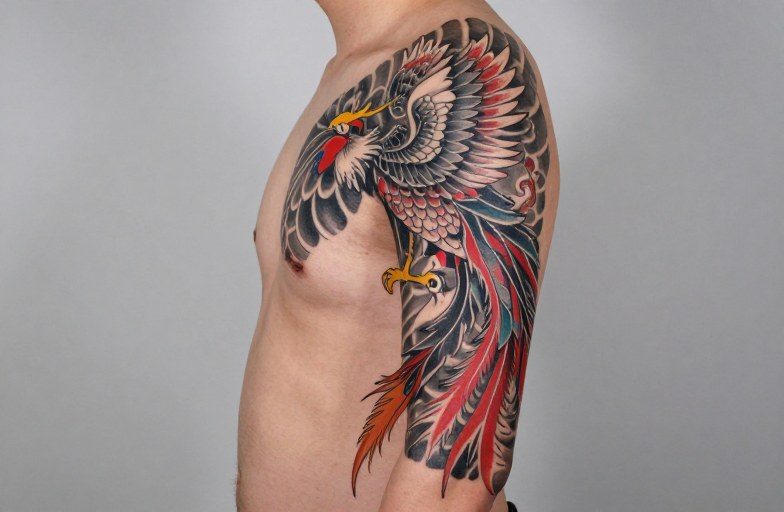
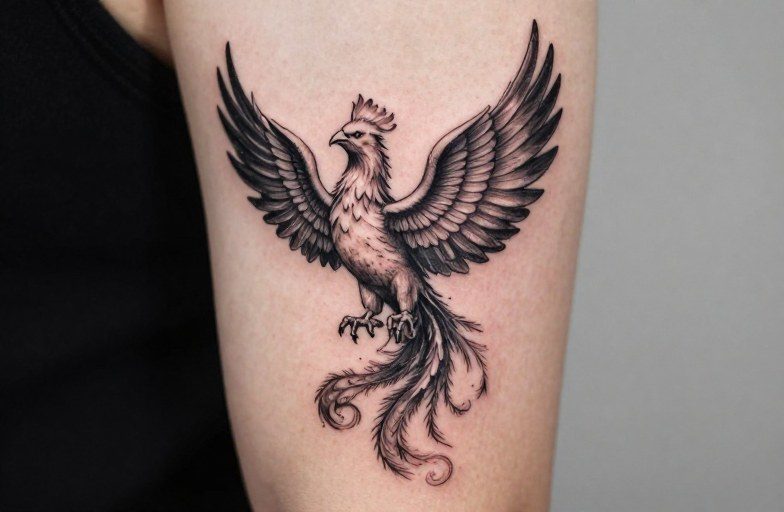
Phoenix tattoos carry built-in drama, fire, rebirth, rising from ash, but that doesn’t mean they need sprawling back pieces or six-hour sessions to land. Plenty of clean, straightforward approaches capture the essence without overwhelming your skin or your budget. The trick is knowing which visual shortcuts actually read as “phoenix” and which placements let a simpler design breathe.
For First-Timers
Starting with a phoenix doesn’t require committing to a full sleeve. The silhouette alone, curved wings, fanned tail, head thrown back, signals the myth clearly even in basic form.
Linework Over Color
Single-needle or fine-line black work keeps the session short and the healing straightforward. A phoenix outline, maybe with minimal feather texture inside the wings, heals faster than saturated color and needs fewer touch-ups over time. Ask for varying line weights: thicker contours on the body and wings, thinner strokes for feather details. This creates depth without shading.
Minimalist Silhouettes
A solid black or dark red silhouette, wings spread in that distinctive curved arc, reads instantly. No interior detail needed. These work especially well at smaller sizes where intricate feathering would blur together anyway. The negative space around the shape does as much work as the ink itself.
Best Placements
Not every spot suits a phoenix shape. The wingspan demands horizontal or diagonal space; cramming it vertically loses the rising motion that makes the image work.
Forearm and Wrist Flow
Inner forearm, running from elbow toward wrist, gives the natural wing stretch room. A small phoenix here, two to three inches, sits comfortably without wrapping awkwardly. Wrist placement works only if you rotate the design: wings sweeping up the forearm, tail trailing toward the hand. Straight across the wrist band-style fights the anatomy and ages poorly.
Behind the Ear and Ankle
These compact spots force creative simplification. Behind the ear, a tiny phoenix in profile, beak up, single wing visible, fits the curved space. On the ankle, wrapping the outer bone with a small rising figure follows the natural line of the leg. Both spots hurt more than you’d expect from the size, but the healing is manageable with proper aftercare.
Size & Scale
Small phoenix tattoos succeed when you respect how ink behaves. Lines spread slightly over years; details that look crisp at one inch become muddy at that same size after a decade.
For anything under two inches, stick to bold silhouettes or very simple line drawings. Medium sizes, three to five inches, allow feather texture, maybe a few flame accents, but still avoid heavy color packing. Large pieces, six inches and up, can support full color gradients, background elements, and detailed plumage.
- Under 2 inches: silhouette or single-line outline only
- 2, 4 inches: limited interior detail, no heavy black fill
- 4+ inches: room for color, shading, and secondary elements
Remember that yellow and orange inks fade fastest. A small phoenix relying on bright flame colors will look washed out sooner than one built on black and red.
Matching & Pairing Ideas
Phoenix imagery pairs naturally with certain symbols, but restraint keeps easy designs from becoming cluttered.
Complementary Symbols
A small sun or moon above the phoenix head reinforces the rising/rebirth theme without competing. Simple geometric shapes, triangle frames, thin circular borders, contain the energy and make the design feel intentional rather than accidental. Avoid pairing with other large mythological creatures; two dramatic figures fight for attention.
Text Integration
Short words or dates tucked beneath a small phoenix work if the lettering stays clean and small. Script below the tail, following its curve, integrates better than straight lines that ignore the composition. Keep it to a single word or a few numbers, anything longer dominates and turns the bird into an illustration for the text.
Standout Design Ideas
These approaches keep the phoenix recognizable while offering something slightly unexpected.
Continuous line: One unbroken line forming the entire bird, head to tail. Requires a steady-handed artist but produces an elegant, modern result that feels deliberate rather than simplified.
Dotwork gradient: Instead of smooth shading, build density with stippled dots. Creates soft transitions from dark body to fading wing tips. Heals more reliably than smooth gradients in small sizes.
Flame-negative: Solid black phoenix with small un-inked gaps suggesting fire within the wings. The negative space reads as glow, adding dimension without extra color.
Profile ascent: Side-view phoenix, beak pointed upward, one wing extended back. Takes less horizontal space than the spread-wing pose, fitting narrower placements like the side of the finger or along the collarbone.
Tips for Choosing
Reference material matters more than most people think. Bring images that show what you like, but also what you don’t, artists read visual preferences faster than verbal descriptions.
Artist Selection
Look for healed photos in their portfolio, not just fresh work. Red and orange especially shift as they settle; an artist who posts one-year-healed color pieces shows confidence in their aging predictions. For fine-line work, check that their lines hold at small sizes, some portfolios show beautiful fresh work that blurs within months.
Healing Reality
Color-heavy phoenix designs scab more noticeably during healing. The saturated warm tones (red, orange, yellow) often form thicker plasma buildup than black work. Don’t panic if day three looks rough; the brightness returns as the top layer sheds. Keep moisturizer minimal, over-lotioning pulls color out during the peeling phase.
Touch-ups are normal, especially for first tattoos in high-friction spots. Plan for a 15-minute session at six to eight weeks if any spots drop out.
Key Takeaways
Easy phoenix tattoos succeed through shape recognition, not detail density. The curved wings and uplifted head carry the symbol even in minimal form. Prioritize placement that follows natural body lines, size that matches your detail level, and ink choices that age well. Black and red outlast bright flame colors; simple linework outlasts intricate shading at small sizes. Bring clear visual references, check healed portfolios, and plan realistically for the healing process. The phoenix doesn’t need grandeur to resonate, it needs clarity of form and thoughtful placement on your specific skin.
Frequently Asked Questions
How much should a small simple phoenix tattoo cost?
Shop minimums typically run $80, 150 for small linework pieces, depending on your city. Color adds time and cost; expect $150, 300 for palm-sized work with saturated reds and oranges. Complex dotwork or continuous-line designs may fall between these ranges based on artist speed and experience.
Will a fine-line phoenix tattoo last, or will it blur quickly?
Fine lines hold if placed on low-friction areas and kept at a readable size. Avoid extremely tiny details, individual feather lines under an inch tall tend to spread together. A skilled artist using proper needle groupings and technique can produce lasting fine work, but the design must be adapted to the size, not merely shrunk down.
Can a phoenix tattoo be easily covered up later if I want something bigger?
Black silhouette phoenixes actually cover well since they’re dense and simple in shape. Outlined versions with lots of negative space offer less coverage potential. If you suspect you might want to expand later, place it where a larger wing or flame element could grow outward naturally, forearm inner or outer, upper arm shoulder area, or thigh.
What’s the most painful spot for a small phoenix tattoo?
The ankle bone, wrist bone, and behind the ear all rank high for small placements due to thin skin over bone or tendon. The inner forearm meatier area hurts less and heals more predictably. Finger phoenixes, while trendy, fade fast from daily abrasion and typically need frequent touch-ups to maintain readability.