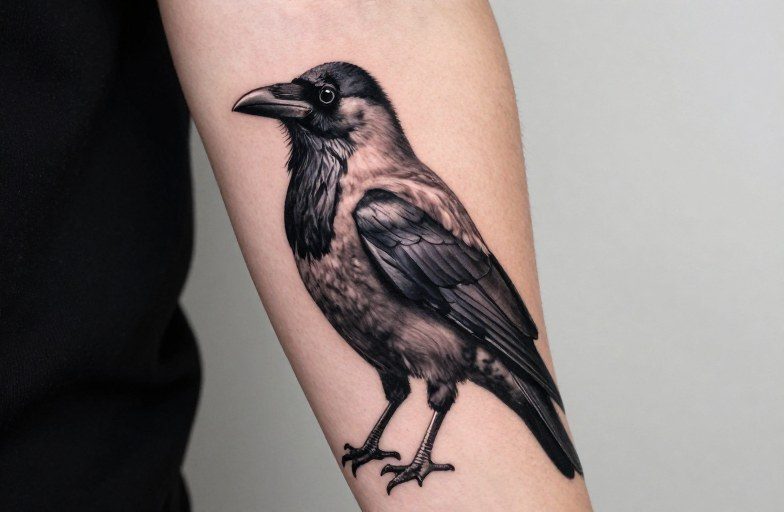
A realistic crow tattoo renders the bird with photographic accuracy: individual feather barbs catching light, the oily sheen of black plumage, the precise hook of the beak, the intelligent weight of the eye. Unlike stylized or tribal interpretations, this approach demands an artist who understands avian anatomy, how light falls on layered feathers, and how to build tonal depth without the image collapsing into a dark blob as it heals and ages.
What Makes or Breaks the Realism
Realistic crow work lives or dies in details specific to the subject. These are the visual challenges that separate accomplished pieces from amateur attempts.
Feather Texture and Layering
Crow feathers are not flat black. Under direct light, they reveal deep purple, navy, and emerald iridescence. A skilled artist builds this through subtle value shifts, cool blacks against warmer dark greys, fine highlight lines suggesting the central shaft of each feather. The wing structure matters: primaries overlap secondaries in a specific pattern, and getting that wrong breaks the illusion instantly. Most strong pieces focus either on a single spread wing showing this architecture, or a perched bird where breast feathers fluff and catch light differently than the sleeker back plumage.
The Eye and Common Compositions
The eye deserves particular attention. Crows have dark brown irises that read nearly black but catch pinpoint highlights. A dead, flat eye ruins realism. The best artists spend disproportionate time here, sometimes adding a subtle reflected landscape in the gloss.
Compositionally, you will encounter several approaches:
- Single portrait: Head and upper body, often turned three-quarter to show the eye’s intelligence and the beak’s curve
- Flight studies: Wings fully extended, demanding careful attention to anatomical accuracy in the shoulder joint and primary feather spacing
- Perched with environmental context: On a branch, skull, or weathered object, which anchors the bird and provides contrast for the dark tones
- Multiple crows: Two or three birds interacting, requiring consistent light source across all figures
Finding the Right Artist
Not every realism specialist handles animals well. Bird skin and feather texture differs enormously from human portraiture. You need someone with demonstrated avian work in their portfolio, not just general realism skill.
What to Examine
Look for healed photos, not just fresh pieces. Black realism is notorious for healing denser and losing subtle greys. Ask to see a crow or raven tattoo at six months or a year old. Does the feather definition hold, or did it muddy into undifferentiated dark areas? Check how the artist handles the transition from deep black shadow to mid-tone; harsh jumps indicate limited understanding of avian form.
Geographic proximity matters less than quality, but budget for travel if necessary. Strong concentrations of realism specialists exist in Los Angeles, New York, several European cities, and a growing scene in South Korea and Japan. Many top artists book six months to a year out.
Consultation Red Flags
- Reluctance to show healed work
- Portfolio containing only fresh, highly saturated photos (possibly overworked skin)
- No understanding of crow vs. raven anatomical differences: larger bill in ravens, shaggier throat feathers, different tail shape
- Insistence on adding color you did not request
Planning Your Piece
Realistic crow tattoos require significant investment. The dense black packing, fine detail work, and often large size to accommodate feather texture all drive time and cost upward.
Size, Placement, and Time
A small realistic crow, perhaps four to five inches, single bird, limited background, runs three to four hours minimum. Most substantial pieces fall in the eight to fifteen hour range, spread across multiple sessions. Large compositions with environmental elements can exceed twenty hours. Sessions typically max at four to five hours for skin and artist stamina; beyond that, swelling degrades precision and both parties fatigue.
Placement affects readability. Curved areas like shoulders and outer arms preserve feather detail well. Ribs and stomachs move and stretch, which can distort fine lines over time. Dense black on darker skin tones requires an artist experienced in adjusting value range to ensure detail remains visible; do not assume every black-and-grey specialist understands this adaptation.
Pricing and Scheduling
Pricing structures vary. Some artists charge hourly ($150 to $400+ depending on reputation and location), others quote per piece. Expect to pay premium rates for specialists. This is not flash work to price-shop. Multi-session pieces need four to six weeks minimum between sittings for the skin to settle. Rushing causes unnecessary damage and compromises the final result. Budget the calendar, not just the wallet.
Color Decisions
Most realistic crow tattoos stay black and grey, and for sound technical reasons. The subject is inherently dark; adding color risks muddying the values that create form. That said, strategic color has its place.
When Black and Grey Serves Best
Classic realism relies on a full value range from paper white to solid black. This approach ages most predictably: no color to shift or fade unevenly. The iridescence of crow feathers can be suggested through cool-warm grey manipulation rather than actual purple or green ink. For longevity and the most universally flattering result, black and grey remains the standard.
Selective Color Applications
Some artists add subtle blue or violet to the deepest shadows, or a touch of amber in the eye. Others use a muted red background, perhaps a desaturated sky or autumn leaf, to make the black bird pop without competing for detail attention. These choices require an artist with color theory discipline; too much saturation overwhelms the subject. Discuss specifically how the color will age. Bright reds tend to hold better than pastels, which can disappear into skin tones.
Understanding the History
Realistic animal tattooing emerged from the European hyperrealism movement of the 1990s and early 2000s, particularly in Germany and the UK, where artists began applying airbrush illustration techniques to skin. Photographic bird studies became feasible as machines, needles, and pigments improved. Smaller needle groupings allowed finer detail, and better black inks held saturation without the blue-grey fade common in older work.
Crows carry heavy symbolic weight across cultures, often linked to death, prophecy, and transformation. Norse mythology features Huginn and Muninn, Odin’s thought and memory, flying across the world as ravens. Celtic associations often connect to the battlefield and the afterlife. Indigenous traditions of the Pacific Northwest hold the raven as creator and trickster. These associations explain the subject’s persistence, though modern wearers choose crows for reasons ranging from personal loss to simple aesthetic appreciation of the bird’s form.
The realistic approach specifically gained traction as photography became ubiquitous. People wanted tattoos to match reference images they could now easily access. Platforms like Instagram accelerated aesthetic standardization, with healed detail shots spreading technical expectations rapidly.
Contemporary Directions
Current artists push realistic crow work in several directions while maintaining technical fidelity.
Double Exposure and Integrated Scenes
The crow’s silhouette or body containing a secondary scene, perhaps a forest landscape or architectural ruins visible through feather transparency, demands exceptional planning. The internal image must read clearly without destroying the bird’s form. Negative space techniques create the “windows,” requiring the artist to think in reverse, protecting light areas while surrounding them with dark.
Biomechanical and Urban Hybrids
Some pieces merge realistic crow anatomy with mechanical elements: gears visible through torn wing skin, or circuit patterns replacing feather structure. The contrast between organic accuracy and artificial intrusion creates unease when executed well. Another variation places the crow in explicitly modern contexts, perched on urban infrastructure, tangled in power lines, or against concrete rather than natural settings. This grounds the traditional subject in contemporary experience without abandoning realistic treatment.
Before You Decide
A realistic crow tattoo succeeds when the artist respects the subject’s specific demands: feather architecture that reads accurately, tonal range that preserves detail in deep blacks, and an eye that conveys alert intelligence. This is not a style for bargain hunting or rushed timelines. The best results come from specialists with demonstrated avian work, healed portfolios you can examine, and the patience to build the piece across multiple sessions with proper healing time.
Bring clear reference material. Photographs of crows in your desired pose, in lighting that shows the feather structure you want. Understand that the iridescence you see in a fresh tattoo will settle into something more subdued; discuss with the artist how they plan for this change. Ask about their specific needle groupings for feather detail, their black ink choices, and their approach to ensuring the piece does not age into a solid dark mass. The quiet confidence of a well-executed realistic crow comes from these technical foundations, not from dramatic composition or bold color. It is a difficult subject done well, and that difficulty is exactly what makes it worth doing.
Frequently Asked Questions
How do I know if an artist can handle the specific challenges of a realistic crow?
Ask to see healed photos of bird tattoos, specifically crows or ravens, at six months or older. Examine whether feather definition holds or muddies into dark blobs. Check their handling of the transition from deep shadow to mid-tone, and ask directly about their experience with avian anatomy versus general human portraiture.
Will the iridescent purple and green tones in my crow tattoo stay bold?
No, not exactly. Fresh tattoos often appear more saturated than they heal. Skilled artists suggest iridescence through cool-warm grey manipulation rather than relying on colored inks that may shift unpredictably. Discuss with your artist how they plan for the settled, healed appearance rather than the fresh one.
What is the minimum size for a realistic crow to hold detail?
Four to five inches is the practical minimum for a single bird with limited background. Smaller than this, feather barbs and eye detail become difficult to execute and age poorly. Most strong pieces are larger to accommodate the tonal range and texture that define the style.
How does dense black packing affect healing?
Dense black areas heal thicker and can lose subtle greys if overworked. This is why session length matters, swelling degrades precision. Proper aftercare is essential: keep moisturized but not saturated, avoid sun exposure during healing, and do not pick scabs that may form in heavily packed areas.

Leave a Reply