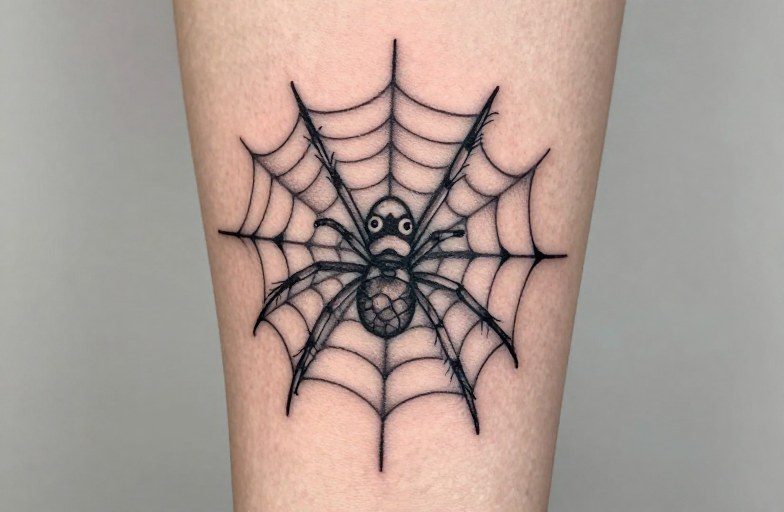
A traditional spider web tattoo is built on thick black outlines, saturated black fill between the radiating strands, and a limited accent color palette, usually red, blue, or green at the joints where lines cross. The web itself is rendered as a geometric wheel: straight lines from center to edge, connected by concentric rings that get tighter toward the middle. It’s a design that demands technical precision; wobble in those straight lines or uneven spacing in the rings, and the whole piece falls apart visually.
Best Placements
The elbow ditch reigns supreme for this design, and for good mechanical reason. The circular web mirrors the natural curve of the joint, and the skin there, thin, mobile, constantly flexing, keeps the image in motion. Knees work similarly. Shoulder caps, inner biceps, and the flat planes of the chest or thigh round out the common spots. Each location changes how the web reads.
High-Movement Zones
Elbows and knees stretch the web with every bend. That movement can blur fine detail over decades, but traditional spider web tattoos are built for this. The heavy black lines and solid fill hold up where delicate work would turn to mush. The trade-off: these spots hurt more, swell aggressively during healing, and require longer sitting times because the artist works around a joint that can’t stay perfectly still.
Flat Surfaces
Shoulder caps and thighs give the artist a stable canvas. The web stays perfectly symmetrical, the lines crisp and unbent. These placements age cleaner but lose some of the living quality that makes the elbow-ditch version iconic. A chest piece spreads across pectoral muscle, shifting slightly with breath and movement, somewhere between static and kinetic.
Who It Suits
This design favors collectors with existing traditional work. The heavy black and limited palette slot cleanly into a sleeve or patchwork collection. Solo, it can feel isolated, an icon without context. On pale to medium skin tones, the black reads as intended: stark, graphic, immediately legible. Very dark skin demands thicker lines and more negative space strategy to keep the web structure visible as the black settles and softens.
Body Type Considerations
Leaner arms and legs keep the web’s geometry intact. Significant weight fluctuation or muscle gain can distort the circular form, stretching the center or compressing the outer rings. The elbow ditch specifically works best on arms that aren’t heavily muscled; too much mass and the web warps into an oval even at rest.
How It Ages
Traditional spider web tattoos age better than most styles because the design is essentially error-proofing built into the aesthetic. Thick lines (8-14 needle groupings for outlines) spread slowly. The solid black fill doesn’t depend on subtle gradation that disappears as skin changes. The geometric structure remains readable even as individual lines soften.
The 10-Year Reality
After a decade, expect the black to have warmed slightly toward charcoal in sun-exposed spots. The rings may have thickened by a millimeter or two. On elbows and knees, the constant flexing accelerates this. What doesn’t happen: the web doesn’t become unrecognizable. The heavy saturation buys longevity. Touch-ups are straightforward, reblack the lines, sharpen the joints, done.
Color Retention
Those red or blue dots at the web joints? They fade first. Red pigment breaks down fastest under UV exposure. Many collectors plan for this, letting the color soften to a muted version of itself, or they return for periodic refreshment. Some skip color entirely, running pure black-and-grey for maximum durability.
Origins & History
The design is often linked to naval and military tattooing, particularly among sailors marking time served or miles traveled. Some trace it to prison culture, where the web on the elbow signified time done, each ring representing a year. The overlap between military and prison tattoo traditions complicates clean attribution. What’s verifiable: the design entered American tattooing’s visual vocabulary by the mid-20th century, carried by artists working in the bold, black-heavy style that became known as traditional or old school.
By the 1970s and 80s, the spider web had become a standard flash sheet offering in shops across the country, divorced from any single origin story. Today it’s collected primarily for its graphic strength, not its historical signaling, though some wearers still choose it as a nod to those roots.
Linework & Technique
The web’s structure is unforgiving. Straight lines must be straight. Concentric rings must maintain even spacing. Traditional tattoo machines, coils running at lower voltages, slower hand speed, give the heavy saturation this design demands. A single-pass line won’t hold; the black needs to be worked in for density.
Needle Groupings
- Outlines: 9-14 round liners for the thick structural lines
- Fill: 15-23 mag shaders for the solid black between strands
- Detail: 5-7 round liners for the small accent dots at joints
Artists often run the outline first, then fill toward it from both sides to avoid blowout at the edges. The web’s center, where lines converge, requires particular care; too much ink deposited too fast causes a muddy starburst instead of a clean meeting point.
Shading vs. Solid Fill
Pure traditional execution uses no greywash shading. The contrast comes from black against skin, period. Some contemporary artists blend traditional structure with neo-traditional technique, adding soft grey behind the web for depth. This reads as a hybrid style, not classic traditional, and ages differently, the greywash blurs faster than the solid black it surrounds.
Aftercare Notes
Elbow and knee placements complicate aftercare because you can’t immobilize the joint for two weeks. The skin there is thin, prone to scabbing thickly, and the constant movement can crack healing tissue. Expect a longer healing curve, three to four weeks rather than the standard two.
Practical Management
- Keep the joint minimally flexed for the first 72 hours; sleep with arm or leg extended
- Thin, frequent moisturizer application, thick layers trap bacteria in the ditch
- Loose clothing only; anything tight across the joint will abrade and pull ink
- Expect swelling that makes the web look distorted; it resolves
Saniderm or similar second-skin dressings help enormously for elbow and knee work, protecting the area from friction while allowing some movement. Not all artists use them; discuss beforehand if you prefer this method.
The Takeaway
A traditional spider web tattoo succeeds or fails on technical execution. The design offers no narrative complexity to hide behind, no color blending to distract from wobbly lines. It is pure structure: geometry, weight, placement. Choose an artist whose traditional portfolio shows consistent line quality and solid black saturation. Commit to the elbow or knee if you want the living, moving version, or select a flat plane for longevity and symmetry. Either way, this is a tattoo that announces itself, bold, immediate, unapologetically graphic.
Frequently Asked Questions
How painful is an elbow ditch spider web tattoo compared to other placements?
The elbow ditch ranks among the more painful spots, thin skin directly over bone and nerve bundles, with the added irritation of the needle vibrating against the joint. Most people find it manageable in shorter sessions, but the swelling afterward can be significant.
Can a spider web tattoo be easily covered up or modified later?
The heavy black fill makes cover-ups challenging but not impossible. A skilled artist can sometimes incorporate the existing web into a larger design, or blast over it with something equally saturated. Lightening via laser first opens more options.
Why do some spider web tattoos have a spider and others don’t?
The spider itself is optional in traditional flash. Some collectors prefer the pure geometry of the web alone; others add the spider for narrative focus or to fill a larger composition. Both are valid traditional approaches.
How do I know if an artist can execute clean straight lines for this design?
Examine their healed portfolio specifically for traditional work, look at elbows, knees, and geometric pieces. Fresh photos lie; healed work reveals whether lines held their weight and rings stayed even. Ask to see pieces that are at least a year old.


Leave a Reply