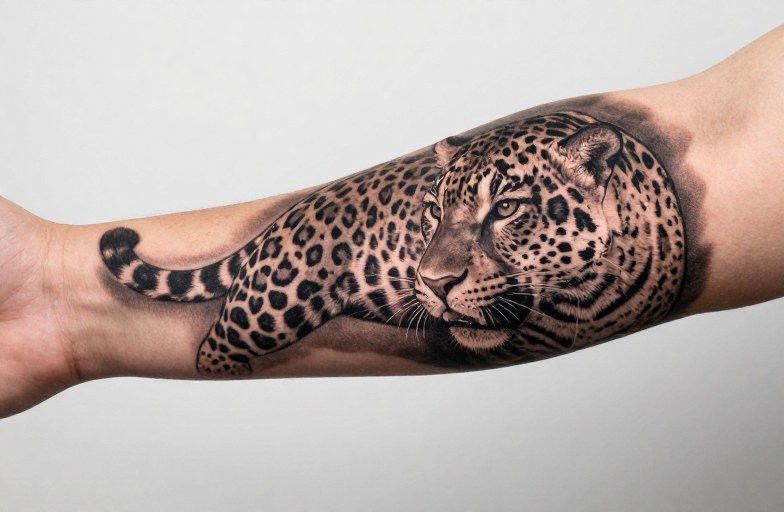
A realistic jaguar tattoo captures the animal’s weight, muscle tension, and predatory stillness with photographic accuracy. Done well, it should feel like you could reach out and feel the shoulder blades moving under fur. The style relies on smooth gradients, precise fur direction, and an understanding of how big-cat anatomy translates to the curves of a human body. This guide breaks down what separates a convincing piece from a generic cat portrait.
Key Characteristics & Motifs
Anatomy That Sells the Illusion
Jaguars carry mass differently than leopards or cheetahs. Their heads are broader, their necks shorter and thicker, their shoulders more pronounced. A realistic rendering needs that heavy, almost bulldog-like jaw and the rounded ears set lower on the skull. The rosettes, those broken circles with spots inside, must follow the body’s contour, not sit flat like wallpaper. On a rolled shoulder or outer thigh, the tattoo can wrap so the cat seems to move with the muscle beneath.
Common poses split into two camps: the stalking crouch, low to the ground with weight coiled in the haunches, and the direct frontal stare, which leverages the jaguar’s unusually wide-set eyes. The crouch works beautifully on forearms and calves where the limb’s length echoes the animal’s stretch. The frontal face demands more flat real estate, chest, upper back, or a full thigh panel, to keep the features from distorting when skin shifts.
Environmental Context
Some collectors anchor the jaguar in habitat: rainforest understory, riverbank mud, Mayan stone. Others isolate the animal against black or skin-tone negative space. Both approaches work, but the environmental route requires the artist to match detail levels, soft-focus ferns behind a razor-sharp cat create depth, while equally sharp background and foreground flatten the image. Water scenes are popular for the jaguar’s documented swimming behavior, and ripples give the artist a chance to break up fur patterns with reflected light.
- Rosettes with internal spots (never solid leopard spots)
- Gold-green eye color, often the only saturation in a black-and-grey piece
- Whisker pores, not just whisker lines
- Wet nose texture with highlight placement
- Torn ear or scar tissue for character without cartoonish battle damage
Origins & History
Realistic wildlife tattooing gained traction in the 1980s and 1990s as reference photography became accessible and artists studied animal anatomy with the same seriousness they brought to human portraiture. The jaguar specifically carries layered significance: in Mesoamerican cultures, the animal was often linked to rulership and the underworld, a nocturnal apex predator moving between worlds. Some trace this reverence to Olmec and Maya iconography where jaguar-human hybrid figures appear in ritual contexts.
The realistic style itself, however, is more recent. Early 20th-century animal tattoos tended toward bold, simplified designs suitable for sailors and soldiers. Photorealism required the technical advances of the 1990s, better needles for fine lining, improved greywash inks, and machines capable of the subtle voltage adjustments needed for smooth stippling. The jaguar’s complex coat pattern made it a proving ground for artists demonstrating fur texture.
Contemporary realistic jaguar work draws from wildlife photography and, increasingly, conservation awareness. Collectors sometimes reference specific subspecies, the larger, darker Pantanal jaguar versus the lighter Central American form, adding pressure for biological accuracy alongside artistic merit.
Modern Variations
Black-and-Grey vs. Full Color
Black-and-grey dominates this style for good reason. Jaguar fur reads as near-black in shadow, and the tonal range from charcoal to skin-tone highlight carries enough information to suggest the warm undertones without fighting the limitations of yellow ink on skin. When color does appear, it’s typically restrained: amber eyes, pink nose leather, the occasional green foliage accent. Full-color realistic jaguars exist but require an artist comfortable pushing saturation without crossing into illustrative territory.
Some artists split the difference with a “color-realistic” approach: black-and-grey body, full-color eyes that seem to glow against the monochrome. This creates immediate focal hierarchy and photographs well, though the eye color will shift during healing as the red and yellow settle.
Scale and Composition Shifts
Micro-realism has pushed jaguar tattoos into smaller territory than previously practical. A palm-sized face on a wrist or behind the ear can hold surprising detail with single-needle work, though the rosettes may simplify to suggestion rather than full mapping. At the opposite extreme, full back pieces incorporate the entire animal in habitat, sometimes with prey or water elements that double as cover-up work for older tattoos.
Double exposure and geometric framing are newer trends, jaguar silhouette filled with rainforest canopy, or the face bisected by clean lines that reference modern design. These hybrid approaches test the artist’s ability to maintain realism within conceptual constraints.
Cost & Sessions
A realistic jaguar tattoo is labor-intensive. A palm-sized black-and-grey face runs 3-4 hours minimum. A full forearm piece with environmental elements typically needs two sessions of 4-5 hours each. Back pieces or full sleeves can stretch across six to eight sessions depending on the artist’s pace and the detail density.
Pricing varies by region and artist reputation, but expect to pay for the time. Realistic wildlife specialists often charge hourly rates reflecting years of dedicated practice. Budget artists may offer flat rates that seem appealing but often result in rushed fur texture or blown-out darks. This is one style where the difference between adequate and excellent is immediately visible and permanent.
Consultation matters here more than with simpler designs. You’ll need to review the artist’s previous big-cat work specifically, not just their general portfolio. Ask how they handle fur direction on curved surfaces, and whether they work from a single reference or composite multiple images.
How It Ages
The Fur Texture Problem
Fine fur detail is the first casualty of time. Single-needle whisker lines and the thinnest rosette outlines blur within five to seven years, especially on high-movement areas like wrists and inner biceps. The underlying structure, major dark masses, eye placement, jaw definition, lasts much longer. Smart aging means building the tattoo so it reads as jaguar even when the micro-detail softens.
Sun exposure accelerates fading dramatically. The dark areas hold longer but can shift to blue-grey as the black ink disperses. Lighter fur tones, built from diluted greywash, often fade faster than the saturated darks, creating contrast loss that flattens the image. A touch-up at year three to five restores the tonal range before the original detail is fully lost.
Placement and Longevity
Upper back and outer thighs age most gracefully, stable skin, less direct sun, minimal stretching from weight fluctuation. Chest pieces spread with pectoral development or age-related skin thinning. Hands and feet, despite their visibility, are poor candidates for this level of detail; the rapid cell turnover and constant friction degrade fine work within a few years.
Color accents face different challenges. The amber eye that pops so dramatically at month one may mute to a brownish yellow by year five. Some collectors embrace this; others plan touch-ups specifically for the eyes.
Linework & Technique
Building the Foundation
Realistic jaguar work rarely relies on bold outline. Instead, artists use “soft line”, needle configurations that deposit ink with feathered edges, or skip line entirely in favor of tonal mapping. The initial stencil might show only major landmarks: eye placement, nose bridge, shoulder mass. Everything else emerges through shading passes.
Greywash is the workhorse. Multiple dilutions, often mixed on the fly, create the depth in black fur without the flatness of solid black packing. The artist works from dark to light, establishing the deepest shadows first, then pulling out highlights with negative space or extremely light passes. Fur texture comes last, with needle strokes following the hair growth direction, not random scribbling.
Specialized Approaches
Some artists incorporate whip shading for the soft transition between rosette and base coat. Others use stippling for the muzzle’s fine texture or the nose’s porous surface. Single-needle or three-needle tight linework defines whisker pores and the subtle ridge above the eyes. The best pieces combine these techniques so smoothly that the method becomes invisible.
Skin type affects execution. Oilier skin holds stippling poorly; the ink spreads slightly with each pass. Dry, mature skin takes smooth gradients beautifully but may not hold the finest single-needle detail. Experienced artists adjust their approach during the session, not from a fixed formula.
Final Thoughts
A realistic jaguar tattoo succeeds when the animal feels present, heavy, breathing, momentarily still. The technical demands are significant: fur direction, anatomical accuracy, tonal control across a complex surface pattern. But the result, done well, carries an impact that stylized or traditional approaches rarely match. Choose your artist based on their specific big-cat portfolio, not general realism skill. Plan for the long term with placement that respects how the work will age. And commit to the time and cost this level of detail requires, shortcuts show immediately in a style defined by its refusal to simplify.
Frequently Asked Questions
How do I tell if an artist can actually do realistic fur texture, not just smooth human skin?
Ask to see healed photos of their big-cat work, not just fresh pieces. Fur should show directional flow, not random shading. The transition from dark rosettes to lighter base coat should be gradual, not striped or blotchy. If they only have fresh photos, the detail may not hold.
Will a realistic jaguar tattoo work on darker skin tones?
Absolutely, but the approach shifts. Artists often use darker greywash bases and rely more on contrast between deep blacks and skin tone rather than light highlights. The rosette structure remains visible; the tonal range just compresses toward the darker end. Find an artist experienced with your specific skin tone.
Can I combine a realistic jaguar with tribal or geometric patterns?
Yes, but the realism suffers if the geometric element competes for detail attention. The most successful combinations use geometry as framing or negative space, keeping the jaguar itself fully rendered. Splitting the animal with hard lines tends to break the illusion of living form.
How soon after getting a realistic jaguar should I plan a touch-up?
Wait at least six months for full healing and ink settling. Most artists recommend evaluating at the one-year mark. If fur detail has softened or contrast flattened, a focused touch-up restores the piece without the full session commitment of the original.
Leave a Reply