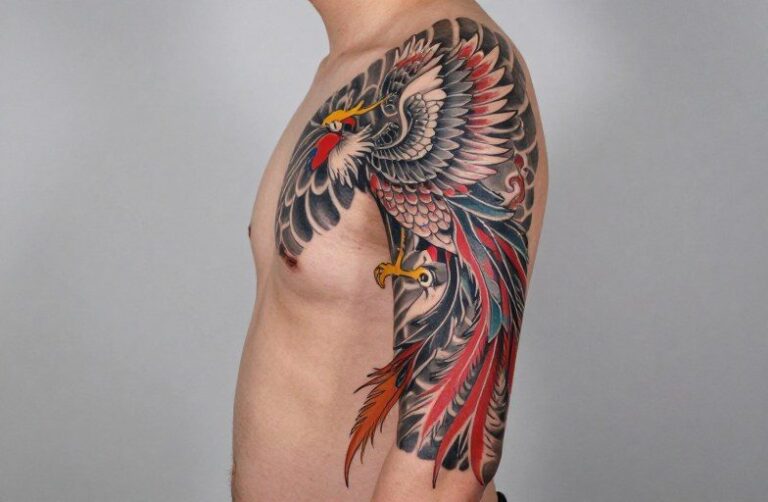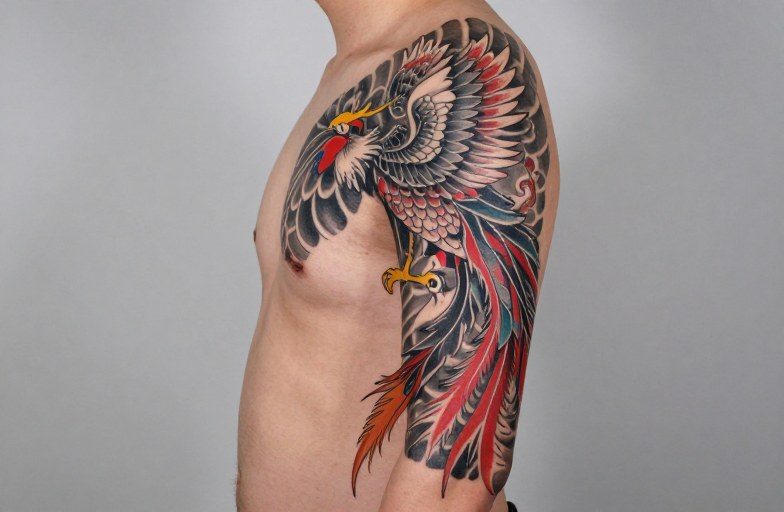
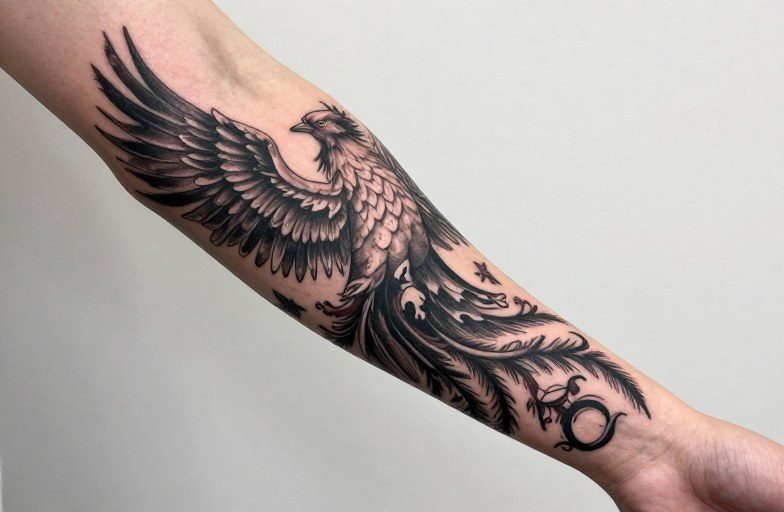
A phoenix sleeve tattoo means transformation through destruction, rising from literal ashes to become something stronger. On a full arm, this isn’t a small personal reminder; it’s a declaration that you’ve burned down some version of your life and rebuilt. The sleeve format matters: the phoenix needs vertical space to stretch, wingspan to spread, flames to wrap around the arm’s natural geometry.
Color vs Black and Grey
Color: Fire You Can Feel
Color phoenix sleeves live or die on saturation and contrast. The classic palette, crimson, gold, orange, touches of violet in the deepest feathers, reads immediately as fire. But here’s the practical reality: red ink fades fastest. Within five to seven years, those scarlet wing tips soften to pink unless you commit to touch-ups. Yellow and orange hold better but need a white base to pop on darker skin tones. The best color sleeves use the arm’s anatomy strategically: bright chest-facing panels that you see in the mirror, deeper burgundies and blacks on the outer arm where sun hits hardest.
Color also demands more sessions. A full sleeve with saturated fire effects runs 25-40 hours over months. The skin can only take so much trauma per sitting. Budget for this timeline realistically.
Black and Grey: Texture Over Spectacle
Black and grey phoenix sleeves rely on smoke, negative space, and feather texture. Without color, the flame becomes implied through whip shading, stippling, or smooth gradients that suggest heat without naming it. This approach ages more gracefully, black ink holds, grey washes settle into softer tones that still read as atmospheric. The trade-off: the phoenix can read as generic bird if the artist doesn’t nail the silhouette and flame integration. You need someone who understands how to make grey look hot.
- Color sleeves: higher maintenance, higher immediate impact, faster fade on reds
- Black and grey: longer clarity, depends on technique for fire suggestion, generally lower cost
- Hybrid approach: color core (chest/inner arm) with black and grey outer arm for longevity
Best Placements
Full Sleeve: The Standard
The full sleeve, from shoulder cap to wrist, gives the phoenix room to narrative. Wings span shoulder to elbow, tail feathers trail toward the wrist, the head and beak can turn at the inner bicep or outer forearm depending on pose. The arm’s cylinder shape lets flames wrap continuously, creating movement when you rotate. Key placement consideration: the elbow ditch. Phoenix sleeves often place a flame burst or eye detail here, but this skin stretches and moves constantly. Fine lines blur; plan for bolder elements in high-flex zones.
Three-Quarter and Extensions
Stopping at mid-forearm (three-quarter sleeve) keeps the phoenix torso and wings intact while leaving the wrist and hand clean for professional contexts. Some collectors start here and extend later, a phoenix head and wing on the upper arm, completed years after with tail and flame descending. This works if the original artist planned for it: consistent flow direction, leaving negative space for future integration. Otherwise you get two tattoos that happen to share an arm.
Hand and finger extensions from a phoenix sleeve rarely work. The bird’s scale breaks; a tiny flame on a finger looks like a smudge from distance. Better to end with tail feathers dissolving into ash or smoke at the wrist, suggesting continuation without forcing it.
Mythology & Folklore
The phoenix motif crosses cultures with surprising consistency, though origins are often linked to Egyptian and Greek sources separately. The Greek phoenix, described by Herodotus and later Ovid, cycles through death by fire and rebirth from ashes every 500 to 1,461 years depending on the source. Some trace it to the Egyptian benu bird, a heron-like solar deity associated with Ra and the cyclical flooding of the Nile. The overlap isn’t clean, scholars debate how directly these traditions influenced each other versus parallel development.
In Chinese tradition, the fenghuang pairs with the dragon as cosmic balance, more associated with virtue and prosperity than solitary rebirth. Japanese hou-ou imagery, common in tattooing, blends these streams: the bird’s body, pheasant’s tail, sometimes flames, sometimes not. For sleeve design, this matters because Japanese-style phoenixes (hou-ou) follow specific rules, certain tail feather counts, directional flow, pairing with paulownia or bamboo, that differ from Western fantasy interpretations. A sleeve mixing Japanese composition with European phoenix anatomy looks unintentionally, not interestingly, confused.
Common Variations & Styles
Neo-Traditional and American
Neo-traditional phoenix sleeves use bold outlines, limited but saturated color palettes, and stylized feather groupings that read clearly from distance. The bird often faces forward or three-quarter, beak open, flames as background elements rather than integrated body. This style holds up well because of its reliance on line weight and clear value separation. American traditional phoenixes exist but are rarer; the subject demands more detail than classic iconography typically allows.
Japanese (Irezumi)
Japanese phoenix sleeves follow body suit conventions: the bird flows with muscle direction, background elements (wind bars, clouds, flame wisps) fill space between main subjects, and the design often extends toward the chest or back. The hou-ou typically appears with specific floral pairings. This isn’t optional styling, it’s compositional grammar. A proper Japanese phoenix sleeve takes 40+ hours and requires an artist trained in the tradition, not just someone who owns some reference books.
Realistic and Biomechanical
Realistic phoenix sleeves attempt photographic feather detail, often with reference to actual birds of prey (golden eagles, red-tailed hawks) combined with imagined flame effects. These age poorly if over-detailed: fine feather barbs blur to muddy texture, what read as individual filaments become grey smear. Biomechanical variations, phoenix as machine, flames as fuel exhaust, feathers as metal plates, appeal to collectors wanting personal mythology merged with technology. The concept works better at larger scale; sleeve length helps.
Who Chooses This Tattoo
There’s no single profile, but patterns emerge. People who’ve survived concrete destruction, divorce, bankruptcy, addiction recovery, prison, medical trauma, often gravitate to phoenix imagery specifically because of the explicit death-and-rebirth narrative. The sleeve format signals commitment: this wasn’t a passing mood, the story covers the whole arm.
Placement timing matters. Someone getting a phoenix sleeve at twenty-two usually has a different relationship to the symbolism than someone at forty-five. Younger collectors often emphasize the fire, the dramatic destruction. Older ones focus on the rebuild, the feather detail, the bird’s composure after rising. Neither is wrong, but the design shifts accordingly: younger sleeves tend toward more flame, more chaos; older ones toward structured wings, calmer posture, integrated background elements suggesting stability.
Gender presentation in phoenix sleeves has loosened considerably. What read as masculine (aggressive pose, dark flames, biomechanical elements) or feminine (flowing lines, bright color, decorative tail) twenty years ago now mixes freely. The tattoo’s meaning remains personal; the visual language has become more neutral.
History & Cultural Roots
Phoenix tattooing in Western shops surged in the 1970s and 1980s alongside fantasy art popularity, Frazetta and Vallejo paintings, album covers, emerging comic book aesthetics. The bird offered a recognizable symbol that wasn’t military, wasn’t biker, wasn’t purely decorative. It occupied new space in American tattooing’s expanding vocabulary.
Earlier, in Japanese tattooing, the hou-ou appeared in Edo-period body suits as one of several sacred beasts, its symbolism tied to imperial virtue and cosmic order rather than personal rebirth. The meaning shifted when Western collectors adopted the imagery. Modern Japanese-style phoenix sleeves in Tokyo or Osaka still carry traditional associations; the same design in Los Angeles or London may read purely as personal transformation narrative. This dislocation isn’t necessarily appropriation, it’s standard evolution of migratory imagery, but collectors should understand the distinction if claiming cultural connection.
Contemporary phoenix sleeve popularity tracks with economic and social instability. After 2008, after 2020, shop books filled with rebirth imagery. The correlation isn’t causal but suggestive: collective anxiety produces individual symbols of resilience.
Final Thoughts
A phoenix sleeve succeeds when the fire looks like it belongs to the bird, not just sits near it. The worst examples paste flames around a generic raptor; the best integrate combustion into anatomy, feathers that are ash at the edges, wings that generate their own heat distortion, eyes that reflect the inferno survived. The meaning is straightforward: destruction, then return. But the execution determines whether anyone else feels that heat, or if it stays private ash.
Plan for the long timeline. A sleeve this complex, with this much symbolic weight, shouldn’t be rushed. The phoenix doesn’t actually rise in a day.
Frequently Asked Questions
How much does a phoenix sleeve tattoo typically cost?
A full phoenix sleeve runs $2,000-$6,000+ depending on style, artist reputation, and geography. Japanese-style work with proper background elements takes longer and costs more than simpler neo-traditional approaches. Budget for 6-12 sessions over 8-18 months, not a single marathon sitting.
Will a phoenix sleeve work with existing tattoos on my arm?
Existing tattoos complicate phoenix sleeves significantly. The bird needs continuous flow; random patches of old ink disrupt wing lines and flame continuity. Some artists can integrate old work into ash or smoke elements, but coverage often requires larger, darker design compromises. Start fresh skin if possible.
How painful is a phoenix sleeve compared to other tattoo placements?
The inner bicep, elbow ditch, and wrist bone rank among the most painful areas, and a full phoenix sleeve hits all three. The shoulder cap and outer forearm are more manageable. Fire details often require repeated passes for saturation, which intensifies sensation in already tender zones.
Can I add a phoenix sleeve to a half sleeve I already have?
Extension is possible but requires the original artist to have planned for it, or a new artist to skillfully bridge styles. The phoenix’s tail and lower wing need to flow naturally from existing work; mismatched line weights or incompatible color palettes create visual fracture rather than continuation. Consult specifically with artists experienced in sleeve extensions.