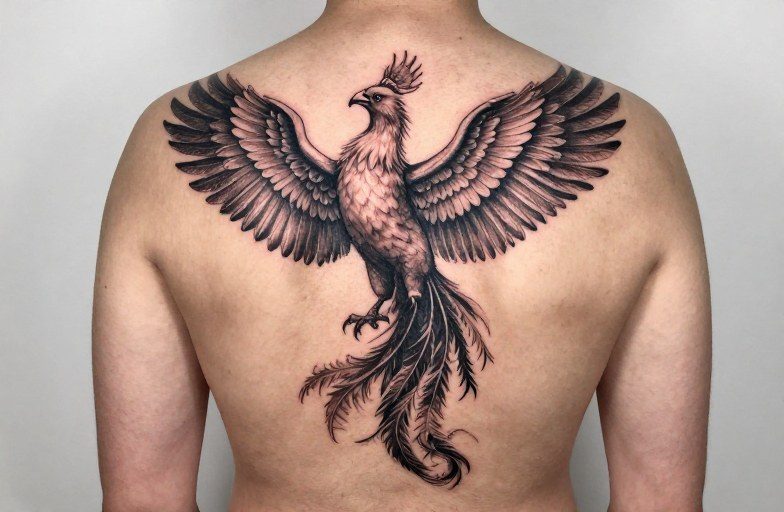
A phoenix bird back tattoo primarily symbolizes rebirth, resilience, and the cyclical nature of destruction followed by renewal. Across cultures, this mythical firebird represents rising from literal or metaphorical ashes, surviving trauma, addiction, loss, or major life upheaval to emerge transformed. On the back, the phoenix gains its fullest expression: wings spread across shoulder blades, tail feathers trailing down the spine, the entire narrative of burning and returning contained in one large canvas.
Who Chooses This Tattoo
People drawn to phoenix back pieces tend to have lived through something specific and measurable. Not vague hardship, divorce after decades, sobriety after years of dependency, surviving illness, leaving cults or abusive systems, rebuilding after financial ruin. The tattoo functions as a marker of a before and after, not a decoration.
Gender and Age Patterns
Women often request phoenixes during major transitions: post-mastectomy, after leaving marriages, following career reinventions in their forties and fifties. Men frequently choose the motif after prison release, military discharge, or recovery from addiction. The back placement appeals to those who want the option of concealment, professional settings, family events, while maintaining personal significance.
Timing and Motivation
Most clients arrive not at the crisis point but after stability returns. The tattoo marks survival, not ongoing struggle. There’s a difference between someone three months sober and someone three years sober requesting this image; the latter group dominates in actual shops. They want documentation, not aspiration.
Common Variations & Styles
Style choices dramatically alter how the symbolism reads. A photorealistic phoenix with individual feathers rendered in grayscale emphasizes dignity and solemnity. Traditional Japanese phoenix (hou-ou) with bold outlines and flat color fields reads as cultural homage or spiritual protection. Neo-traditional with saturated jewel tones and decorative elements feels more celebratory, less funereal.
Line Work vs. Heavy Shading
Line-dominant phoenixes age poorly on backs. The large surface area, combined with sun exposure when shirts come off, causes fine lines to blur within five to seven years. Heavy black shading in the wing joints, strategic whip shading in the flames, and solid saturation in the body hold definition longer. Watercolor-style phoenixes, popular since roughly 2010, require frequent touch-ups; the back’s movement and stretching accelerate pigment dispersal in those diffuse, unoutlined color fields.
- Japanese traditional: pairs well with cherry blossoms, wind bars, or peonies; often symmetrical
- Black and grey realism: focuses on texture, charred wood, ember glow, feather deterioration
- Neo-traditional: allows for purple, teal, or green flames instead of standard orange-red
- Tribal fusion: Maori or Polynesian patterning within wing structure; controversial if no actual heritage
Composition Approaches
Centered spine placement with wings extending to each shoulder blade remains standard. Some clients prefer asymmetrical designs, phoenix ascending from one hip diagonally across the back, flames concentrated lower, head reaching toward one shoulder. This creates movement but complicates future additions. Full back pieces incorporating the phoenix within larger scenes (burning city, forest, ocean) require multiple sessions and significantly higher cost but offer narrative density.
Mythology & Folklore
The phoenix appears independently across multiple civilizations, though connections between these traditions remain debated among scholars. Greek sources, particularly Herodotus and later Pliny the Elder, describe the Egyptian benu bird, a heron-like solar deity associated with rebirth and the flooding Nile. The Greek phoenix proper, often linked to Phoenicia or Arabia, acquired its self-immolation narrative in Roman-era texts, notably Ovid’s Metamorphoses.
Eastern Parallels
Chinese fenghuang and Japanese hou-ou represent different concepts: paired feminine and masculine principles, imperial virtue, cosmic order. These birds do not burn and regenerate; they appear during prosperous reigns. Western clients frequently conflate these traditions, requesting “phoenix” imagery while describing hou-ou aesthetics. A competent artist should clarify whether the client wants the destruction-rebirth cycle or the auspicious-omen tradition.
Medieval and Christian Adaptations
Early Christian writers, including Clement of Rome and Tertullian, adopted the phoenix as resurrection symbolism. This medieval Christian phoenix appears in illuminated manuscripts with cruciform halos, flames rendered as holy light rather than destruction. Some contemporary clients with Catholic backgrounds specifically request this iconographic tradition, distinguishing it from secular or pagan rebirth narratives.
History & Cultural Roots
Phoenix tattooing on the back emerged prominently in American and European shops during the 1980s and 1990s, though individual examples certainly predate this. The full-back Japanese piece tradition, imported through artists like Don Ed Hardy who studied in Japan, provided the technical framework: large-scale, single-subject back work with specific compositional rules about flow and negative space.
Western Adaptation
American traditional tattooing initially favored smaller phoenix designs on arms or chests. The migration to full backs accompanied the rise of custom tattooing as fine art in the 1990s, shops moving away from flash sheets toward client-specific designs. The phoenix, with its natural wing span and vertical tail, anatomically suits the back’s proportions in ways that other subjects struggle to match.
Contemporary Global Spread
Chinese tattoo artists in the 2000s began producing fenghuang back pieces for domestic clients, reversing earlier patterns where Chinese nationals sought Western-style tattooing abroad. South American neo-traditional scenes, particularly in São Paulo and Buenos Aires, developed distinctive phoenix color palettes, more magenta, less orange, reflecting local art movements. These regional variations matter for clients researching artists; a Brazilian neo-traditional phoenix and a Japanese traditional hou-ou require fundamentally different technical expertise.
Symbolism & Core Meaning
At its base, the phoenix communicates: something ended, something began. The specificity of that transition determines the tattoo’s personal weight. Generic “rising from ashes” messaging, without lived experience behind it, produces hollow imagery. Good artists probe during consultation: what burned? What returned? The answers shape compositional choices.
Fire as Active and Passive
Flames can consume or purify depending on rendering. Aggressive, forward-reaching fire suggests active struggle against external forces. Self-contained, enveloping fire implies internal transformation. Charred remains at the composition’s base, twisted metal, skeletal trees, ash piles, ground the rebirth in actual loss rather than abstract concept. Clients often underestimate how much they want the destruction visible, not just the ascent.
Wing Position and Emotional Register
Wings spread wide in flight read as triumph, completed transformation. Wings partially folded, still burning at the edges, suggest ongoing process. One wing raised, one damaged, communicates survival with cost, popular among veterans and trauma survivors who reject clean redemption narratives. The head’s direction matters too: upward and forward (future-oriented), backward (acknowledging what was lost), or eyes closed (interior focus).
Best Placements
The full back offers maximum impact but commits the client to extensive sessions and significant expense. Upper back/shoulder blade placement allows wing spread without covering the lower back, practical for those who want visibility in tank tops but concealment in standard shirts. This truncated version sacrifices the tail’s narrative flow, concentrating impact in the wing arc.
Spine and Symmetry Considerations
Centering the phoenix along the spine creates natural symmetry but risks emphasizing any existing spinal asymmetry, scoliosis, muscle development differences, posture issues. Experienced artists account for this in stencil placement, sometimes deliberately offsetting the composition by centimeters to visually correct the client’s frame. The lower back, despite its reputation, functions well for phoenix tail feathers trailing downward, though this placement ages poorly as skin elasticity decreases.
Session Planning
Full back phoenixes typically require 15-30 hours across 5-8 sessions, depending on style complexity and client pain tolerance. The shoulder blade area and spine directly over bone generate highest discomfort; many artists schedule these for middle sessions when endorphins are active but adrenaline hasn’t depleted. Healing between sessions demands strict back-sleeping avoidance for weeks, clients should plan accordingly.
Final Word
A phoenix back tattoo succeeds when the symbolism is earned, not borrowed. The image carries weight because the mythology genuinely resonates with lived experience of loss and return. Technical execution matters enormously, the back’s size tempts artists toward overcomplexity, but the strongest pieces often simplify, letting the bird’s natural form and the client’s actual history carry meaning. Choose an artist with specific experience in your preferred style tradition, not just general “custom” work. The difference between a competent phoenix and a powerful one lies in those specific feathers, those particular flames, rendered by hands that understand what burned and what rose after.
Frequently Asked Questions
How much does a full back phoenix tattoo typically cost?
Full back pieces range from $2,000 to $8,000+ depending on artist reputation, geographic location, and style complexity. Japanese traditional work often commands premium rates due to specialized training. Budget for touch-ups separately.
Can a phoenix back tattoo be covered up later if I change my mind?
Covering large black-and-grey or full-color back pieces is extremely difficult. The size and saturation that make phoenixes visually striking also limit cover-up options. Laser removal is possible but expensive and incomplete for backs this size.
Do phoenix tattoos have negative meanings in any cultures?
In some East Asian contexts, the fenghuang/hou-ou specifically symbolizes imperial virtue and feminine power; Western-style burning phoenixes may read as ignorant appropriation if mixed carelessly. Research your artist’s cultural fluency.
How well do phoenix back tattoos age over 10-20 years?
Heavy black outlines and solid color fields age best. Fine-line realism, watercolor effects, and excessive detail blur significantly. The back’s skin movement and sun exposure when uncovered accelerate aging compared to covered areas.

Leave a Reply