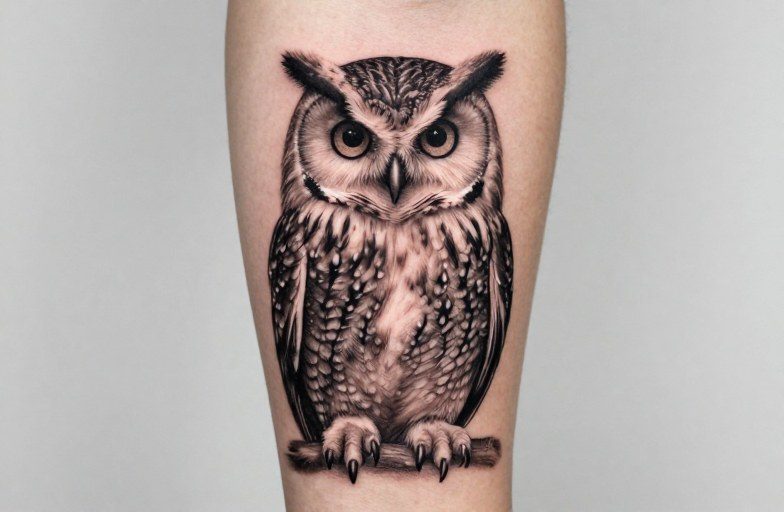
Owl tattoo drawings most commonly represent wisdom, intuition, and the ability to navigate darkness, literal and metaphorical. Across cultures, the owl’s night vision and silent flight have made it a symbol of hidden knowledge, spiritual sight, and the threshold between life and death. The specific meaning depends heavily on style, accompanying elements, and whether the bird is rendered as watchful predator, solemn guardian, or something more abstract.
Symbolism & Core Meaning
The owl’s symbolic weight comes from biology, not just mythology. Nocturnal hunters with asymmetric ear openings that locate prey in complete darkness, owls literally perceive what other creatures cannot. That physical trait translates naturally into metaphor: seeing through deception, understanding what remains hidden, possessing knowledge that arrives obliquely rather than through daylight logic.
Wisdom vs. Death
Western tradition, particularly Greek association with Athena, emphasizes wisdom and scholarly pursuit. Eastern European and some Indigenous American traditions lean toward death, transition, and communication with spirits. Many contemporary designs deliberately hold both meanings in tension, a skull beside an open eye, a feather dissolving into smoke. The owl becomes a figure who knows endings intimately without being destroyed by them.
The Silent Observer
Unlike eagles or hawks rendered mid-screech, owls in tattoo drawings often appear still, watching. This quality suits people who identify as observers rather than performers, those who gather information before acting, who value discretion. A forward-facing owl, with both eyes visible, amplifies this; the binocular stare is unsettling precisely because it suggests judgment without reaction.
Best Placements
Owl drawings adapt to several body areas, but the shape of the bird, broad wings, rounded head, relatively compact body, creates specific opportunities and constraints.
- Thigh or calf: The rounded form sits naturally on these curved surfaces. Wings can wrap slightly around the muscle, creating movement without distortion.
- Upper arm/shoulder: Classic placement for medium-sized pieces. The shoulder cap accommodates a forward-facing owl especially well; the curve mirrors the bird’s own dome-like head.
- Back, between shoulder blades: Ideal for symmetrical compositions with spread wings. Provides flat, stable skin that ages predictably for detailed line work.
- Forearm: Works best for profile or perched poses rather than full wingspan. The narrower canvas favors single-eye compositions or close-up portraits.
- Ribcage: Painful and prone to shifting with breath, but the vertical space suits a descending owl or one clutching a symbolic object.
Skin movement matters. Areas that stretch significantly, inner bicep, stomach, above the knee, will distort fine facial details over years. An owl’s expression, often the emotional anchor of the piece, degrades faster in these spots.
Design Tips & Pairings
Successful owl drawings balance recognizable form with personal specificity. The most forgettable owl tattoos treat the bird as generic clip art; the strongest add something that complicates or narrows the symbolism.
Line Weight and Detail Concentration
Owl faces carry the design’s emotional weight. Heavy linework around the eyes, thick orbital rings, dense feather patterns framing the gaze, draws viewers in immediately. Wings and body can support lighter treatment or even negative space without losing impact. This hierarchy of detail also ages better; faces with strong dark lines remain readable as surrounding softer shading blurs.
Feather texture demands strategic choices. Every feather drawn is a line that will spread. Stippling or smooth gradient shading in the body, with individually rendered feathers only at wing edges or head, often outlasts attempts at photorealistic plumage coverage.
Common Pairings and Their Effects
- Clock or hourglass: Time, mortality, the night watch. Works best when the owl interacts with the object, perched atop, reflected in an eye, rather than floating nearby.
- Keys: Access to hidden knowledge, secrets kept or revealed. Skeleton keys add historical weight; modern keys feel more personal, less archetypal.
- Moon phases: Natural companion that reinforces nocturnal identity without redundancy. Crescent moons behind the head create recognizable silhouette; full lunar cycles in the background add narrative scope.
- Floral elements: Night-blooming flowers (moonflower, evening primrose) maintain thematic coherence; roses or traditional botanicals create deliberate contrast between soft organic growth and predatory bird.
- Skulls or bones: Direct death association. Risk of cliché unless handled with specific stylistic commitment, perhaps a particular cultural tradition, or the skull integrated into the owl’s own form rather than simply adjacent.
Color vs Black and Grey
The color question for owl drawings isn’t merely aesthetic; it changes symbolic temperature.
Black and Grey
Monochrome emphasizes the owl’s association with night, shadow, and solemnity. Grey wash can achieve remarkable softness in feather transitions, creating that powder-down texture real owls possess. The limitation to value rather than hue forces stronger composition, if the drawing works in black and grey, it works fundamentally. This approach ages with dignity; there’s no color to shift or fade unevenly.
Color Applications
Actual owl species provide reference points with built-in meaning. Snowy owls suggest rarity, harsh environments survived. Great horned owls, with amber eyes and warm brown patterning, carry fiercer energy. Barn owls, pale and heart-faced, read more ethereal, almost ghostly.
Strategic color accents, amber eyes in an otherwise black piece, a single moonlit highlight, often outlast full color saturation. The eye color becomes the emotional focal point, drawing attention precisely because it’s the only warmth in a cool composition.
One practical note: yellows and soft oranges in eye details tend to fade faster than darker pigments. Expect touch-ups if the gaze’s intensity matters to the design’s success.
Mythology & Folklore
Cultural associations provide depth without requiring explicit depiction. Understanding these traditions helps avoid unintentional appropriation or hollow pastiche.
Mediterranean and European
Athena’s owl, often depicted on ancient Athenian currency, established the wisdom connection that dominates Western understanding. Roman tradition, however, viewed owls more suspiciously, omens, witches’ companions, birds of ill portent. This split persists: the same image carries radically different valences depending on which tradition you invoke.
Indigenous North American
Many Plains and Southwest nations associate owls with spirits of the dead, sometimes as messengers, sometimes as dangerous entities to avoid. Some Pacific Northwest traditions treat them more neutrally or positively as skilled hunters. These associations are specific to particular nations and not interchangeable; generic “Native American owl meaning” collapses important distinctions.
East Asian
Japanese folklore often links owls to protection from suffering, the wordplay between “fukurou” (owl) and “fuku” (luck, no hardship) makes them popular protective symbols. Chinese tradition is more mixed, with some regional associations to dark yin energy. Korean folklore sometimes connects them to death omens, particularly screech owls.
Drawing from these traditions works best with specific knowledge rather than vague exoticism. A Japanese-influenced piece might incorporate specific wave patterns or family crest conventions; a Greek-referenced design could engage with actual red-figure pottery conventions rather than generic “ancient” signifiers.
Similar & Related Symbols
Owl drawings often exist within broader symbolic ecosystems. Understanding adjacent imagery clarifies whether the owl is the right choice or whether a related symbol might serve your intention more precisely.
- Raven or crow: Also intelligent, also associated with death and mystery, but more chaotic, more trickster. Where the owl is patient observer, corvids are active manipulators. Choose owl for stillness and penetration; raven for transformation and cunning.
- Cat: Shares nocturnal territory, independence, and occult associations. Cats read more sensual, more domestic despite their wildness; owls remain fundamentally other, never fully tamed in symbolic terms.
- Moth or butterfly: Night-flying like the owl, but drawn toward light rather than navigating darkness. Moths suggest vulnerability, compulsion, attraction to destruction. Owls suggest mastery of the dark itself.
- Wolf: Pack animal despite lone-wolf mythology; the owl is genuinely solitary. Both predators, but wolf carries social and territorial weight the owl lacks.
- Third eye or all-seeing eye: Abstracts the owl’s perceptual gift into pure symbol. More direct but less narratively rich; loses the animal’s specific character.
Combining owl with any of these creates tension worth exploring. Owl and moth together might represent the tension between navigating darkness and being destroyed by attraction to false light. Owl and wolf suggests different models of solitary power.
The Takeaway
Owl tattoo drawings endure because the bird’s symbolic range is genuinely broad without being vague. Wisdom, death, night vision, silent judgment, each carries enough specificity to anchor a meaningful design, enough overlap to allow personal combination. The most successful pieces don’t attempt to include every possible meaning. They choose a direction, perceptual acuity, or mortality awareness, or protective vigilance, and render it with technical decisions that will hold up: strong eye detail, strategic placement on stable skin, color choices that serve the emotional temperature rather than defaulting to either monochrome safety or color spectacle.
Start with what draws you to the owl specifically, not to tattoo symbolism generally. The answer shapes everything that follows.
Frequently Asked Questions
Do owl tattoos always mean death or can they represent something positive?
They absolutely carry positive associations, particularly wisdom, protection, and sharp intuition. The death connection is strong in some cultures but not universal. Your specific design choices, expression, accompanying elements, style, steer the meaning toward whichever resonance you intend.
Which owl species works best for a realistic tattoo style?
Great horned owls and barn owls translate most successfully due to their distinctive facial structures and recognizable eye colors. Snowy owls offer striking white plumage that challenges technical execution but rewards with unusual visual impact. Choose based on which species’ actual characteristics align with your symbolic intent.
How well do detailed owl faces hold up over ten or fifteen years?
Facial detail degrades predictably based on line weight and placement. Heavy black outlines around eyes and beak remain readable; fine whisker-like feather lines around the face blur into soft texture. Expect the bird to become slightly more “impressionistic” rather than maintaining crisp photorealism. Thighs and upper arms age best; hands, feet, and ribs show faster deterioration.
Is it culturally insensitive to get an owl tattoo with Indigenous-style design elements?
Specific tribal styles, Northwest Coast formline, Southwest geometric patterns, Plains beadwork conventions, belong to particular nations and require permission or proper commissioning from artists within those traditions. Generic “tribal” owl designs appropriate without honoring. If you lack personal connection to a specific tradition, stick to styles from your own cultural background or universally accessible approaches like botanical realism or geometric abstraction.
Leave a Reply