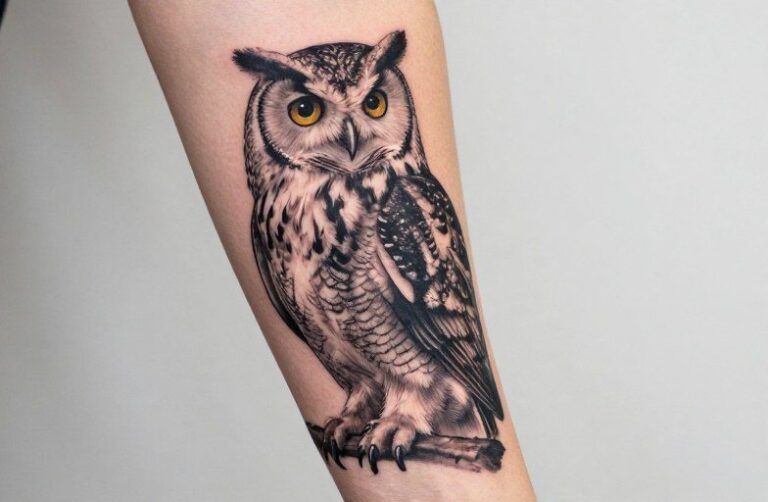
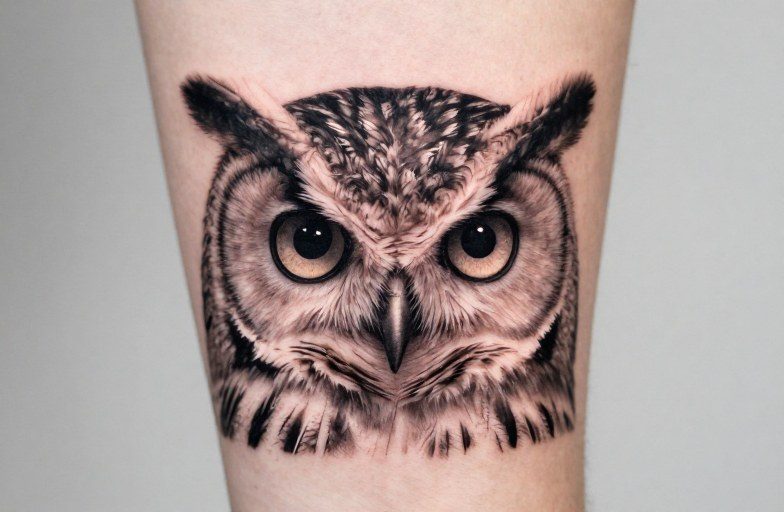
An owl eyes tattoo centers on the bird’s most arresting feature: two wide, unblinking orbs that seem to pierce straight through whatever they fix upon. The meaning boils down to perception, intuition, and the capacity to detect truth where others see only darkness. Unlike a full owl portrait, isolating the eyes strips away everything decorative and leaves only the gaze itself, making this a more psychological, almost confrontational design.
History & Cultural Roots
Ancient Associations
The owl’s visual dominance has registered across cultures for millennia. In Greek tradition, the bird accompanied Athena, goddess of wisdom and strategic warfare, though the connection was more about keen-mindedness than book learning. Some Native American nations viewed owl eyes as particularly potent, associating them with night vision in both literal and spiritual senses. Across Mesoamerican cultures, the owl often occupied liminal territory: a messenger between living and dead, its eyes supposedly able to track souls moving through darkness.
What’s worth noting: many of these associations weren’t uniformly positive. Fear of the owl ran parallel to reverence. The eyes specifically carried that dual charge, protective watchfulness, but also an unsettling sense of being seen, being judged, being found out.
Modern Tattoo Adaptation
The isolated owl eyes motif emerged more distinctly in Western tattooing during the late twentieth century, as black-and-grey realism matured and artists began fragmenting traditional animal portraits into cropped, almost cinematic close-ups. The design dovetailed with growing interest in psychological symbolism over literal representation. Rather than showing the whole owl perched on a branch, the eyes alone became shorthand for interior qualities: vigilance, discernment, the refusal to be fooled.
Who Chooses This Tattoo
People drawn to owl eyes usually aren’t after an obvious, readable symbol. The appeal tends to be more private. You’ll see it on individuals who’ve developed sharp intuition through difficult experience, survivors of betrayal, people in high-stakes professions requiring constant threat assessment, or those who simply trust observation over noise.
The design also attracts night owls in the literal sense: bartenders, musicians, programmers, emergency workers. There’s a stubborn identification with functioning clearly while others sleep. The tattoo becomes less about wisdom in the abstract and more about competence in conditions others find disorienting.
Some choose it after periods of deception or self-deception, marking a commitment to clearer sight going forward. The eyes face outward, but the meaning often faces inward: a reminder to trust one’s own perception when external voices conflict with felt truth.
Color vs Black and Grey
Black and Grey Realism
The majority of owl eyes tattoos execute in black and grey, and for sound technical reasons. Owl eyes naturally contain extraordinary tonal range, deep blacks in the pupil, complex greys in the iris, subtle highlights that give the wet, living quality. Black and grey ink handles this range with nuance that color sometimes flattens. Healing also tends to be more predictable; blacks settle reliably, whereas color saturation in small, detailed areas can soften or shift unpredictably.
Aged black-and-grey owl eyes maintain their impact longer. The high contrast between pupil and iris preserves readability even as lines slightly spread and highlights settle. This matters because eye tattoos rely on that spark of life, lose the highlight, and you have dead glass instead of watching intelligence.
Color Approaches
When color does appear, it usually serves specific purposes. Amber or gold tones reference the great horned owl and its particular cultural associations. Striking blue or violet, found in some species, creates an otherworldly, almost alien effect that shifts meaning toward the mystical or supernatural. Full color realism demands more space; the design needs adequate room for the color transitions to breathe, otherwise healing turns them muddy. Expect more frequent touch-ups with color, especially in the yellow-orange spectrum that fades fastest in skin.
Common Variations & Styles
- Single eye vs. paired: One eye creates a more confrontational, almost talismanic effect, like carrying a protective watch. Two eyes suggest binocular vision, depth perception, the full capacity to read a situation. Compositionally, single eyes work better on narrow placements (forearm inner edge, rib vertical); pairs need horizontal real estate.
- Human eye hybrid: Some designs merge owl and human eye anatomy, round human iris with owl-like golden coloration, or the bird’s characteristic facial disc framing a more human gaze. This creates uncanny valley tension, deliberately unsettling.
- Geometric framing: Sacred geometry surrounding or intersecting the eyes adds structural order and can reference the owl’s reputation for mathematical or pattern-based intelligence. The geometry also provides tattoo stability; straight lines age more predictably than organic curves alone.
- Negative space highlights: Leaving skin uninked for the eye’s reflective spot requires precision. Too small and it vanishes during healing; too large and the eye looks cataract-clouded. Experienced artists map these relative to the pupil’s black, not the iris edge.
- With surrounding feathers: Adding partial feather texture around the eyes softens the intensity and connects back to the complete bird. This variation ages well because feathers provide textural interest even if fine detail blurs slightly.
Similar & Related Symbols
All-seeing eye imagery shares obvious territory, though the tone differs. The traditional Eye of Providence carries institutional, often religious or surveillance-state connotations that owl eyes typically avoid. Cat eyes compete as nocturnal seeing symbols, but read more predatory, more sensual, less contemplative. Third eye tattoos overlap in the intuition register but tend toward explicit spiritual or psychedelic associations rather than the owl’s grounded, almost wary watchfulness.
Raven or crow eyes offer the closest parallel, another dark bird, another night feeder, another intelligence symbol. Ravens read more trickster, more adaptable, more socially complex. Owl eyes feel more solitary, more fixed, more patient. The distinction matters for people choosing between them: corvids move, owls wait.
Some combine owl eyes with moon imagery, doubling down on nocturnal association. Others pair with keys, locks, or doors, emphasizing the seeing-through, the access to hidden knowledge. These combinations can work but risk becoming illustrative, almost clip-art, if the artist doesn’t integrate them with genuine compositional purpose.
Best Placements
High-Impact Locations
The chest, centered or slightly off-center over the sternum, gives owl eyes commanding presence. The natural curvature of the ribcage creates slight distortion that can actually enhance the living, following quality, subtle movement as the person breathes. This placement suits larger designs with surrounding detail.
Upper outer arm (deltoid to mid-bicep) provides the flat, stable canvas that eye tattoos need for proper proportion. The cylindrical shape means the eyes watch outward regardless of arm position. Visibility is controllable with sleeve length.
Intimate or Concealed Options
Inner bicep and inner forearm offer personal visibility, seen by the wearer more than the world, which suits the introspective quality many want from this symbol. The inner forearm’s relatively thin skin and stable fat layer heal well and hold fine detail longer than, say, the wrist or hand.
Thighs accommodate larger compositions and allow the eyes to sit in a naturally horizontal alignment. The muscle movement there is less dramatic than calf or forearm, so the image stays relatively stable. Covering with clothing is simple when desired.
Neck and hand placements have become more common, but the eyes’ confrontational quality intensifies to the point of aggression in these highly visible zones. Consider whether you want that level of unreadable stare directed at every stranger interaction.
Final Thoughts
An owl eyes tattoo succeeds when the gaze actually seems to function, when technical execution preserves that wet, alert, evaluating quality that makes the symbol resonate. The meaning isn’t complex: seeing clearly, refusing deception, maintaining watch when others drop their guard. But the emotional weight depends entirely on whether the eyes look alive or merely decorative.
Choose an artist with demonstrated eye realism in their portfolio, not just animal work generally. The anatomy differs. Ask to see healed photos; fresh tattoos always look sharper. The eyes you live with will be the settled, healed version, and that’s where patience in artist selection pays off. This design doesn’t need embellishment. Two eyes, properly rendered, do all the work themselves.
Frequently Asked Questions
Do owl eyes tattoos have negative meanings in any cultures?
In some traditions, owls symbolize death or ill omen rather than wisdom. The isolated eyes can intensify this association, being watched by unseen forces. Most contemporary Western wearers don’t intend this, but it’s worth researching if you have personal ties to cultures where owl symbolism remains ambivalent.
How big should an owl eyes tattoo be to hold detail?
For readable iris texture and a believable highlight, plan on at least two inches in height per eye. Smaller than that, and the pupil risks becoming a solid black blob, the highlight a misplaced white dot. Single-eye designs can be slightly larger since they don’t need to match a pair.
Can owl eyes be covered up or modified later if I change my mind?
Solid black pupils limit coverup options, they’re dense and don’t take new pigment well. The surrounding iris offers more flexibility for modification. If you’re uncertain, avoid oversized pupils and keep feather or geometric framing that could be expanded into a different composition.
Why do some owl eyes tattoos look creepy rather than wise?
The uncanny effect usually stems from proportion errors, pupils too large or small relative to iris, highlights placed inconsistently between two eyes, or excessive symmetry that reads artificial. Living eyes have slight irregularities. Artists who copy photographs rather than understanding eye structure often produce technically accurate but emotionally flat results.