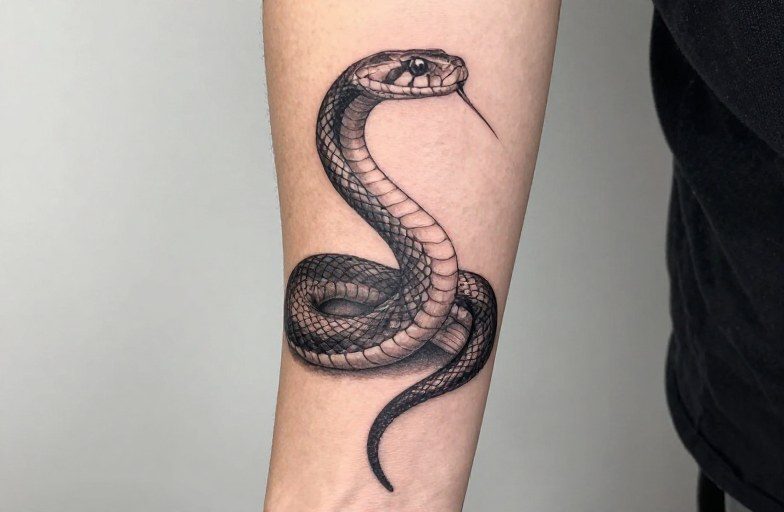
A snake tattoo most commonly symbolizes transformation, rebirth, and the cyclical nature of life, shedding skin as literal renewal. Depending on context, it can also signal danger, wisdom, healing, or primal power. The meaning sharpens dramatically based on how the snake is rendered, where it sits on the body, and what cultural lens you or your viewer brings to it.
Best Placements
Where you put a snake changes how people read it. A coiled snake on the bicep reads as contained strength, something muscular and ready. Wrap it around a forearm and it becomes a sleeve element with motion, the head often placed near the wrist or inner elbow for maximum visibility when you gesture.
High-Visibility vs. Hidden Spots
Neck and hand placements broadcast the symbol immediately, there’s no casual reveal. These work best when the snake is rendered bold and clean, usually black-and-grey with strong line weight, because fine detail blurs faster in high-wear zones. Ribs, thighs, and upper back offer more real estate for coiling, multiple loops, or pairing with other elements like flowers, daggers, or moons. The spine itself makes a natural vertical canvas for a serpent’s S-curve.
Flow With Anatomy
Snakes excel at wrapping joints. A knee or elbow bend becomes the snake’s pivot point; the body flows above and below. This requires your artist to design for movement, skin stretches and compresses differently across a joint than on flat muscle. A snake that looks perfect with the arm straight can distort grotesquely when bent if the flow isn’t planned.
How It Ages on Skin
Snake tattoos age predictably based on two factors: line density and how much black is packed in. Fine scales drawn with single-needle lines soften into grey mush within five to seven years. Heavy black silhouettes with minimal interior detail hold their graphic punch for decades.
Line Work vs. Shading
- Outline-heavy designs: Thin contour lines around scales blur fastest. The eye reads a snake by its silhouette first, so losing scale definition hurts less than losing the overall shape.
- Black-and-grey realism: Smooth gradients on snake bodies age well if the black is saturated enough to create contrast. Faded grey snakes look like bruised ropes.
- Color neo-traditional: Greens and reds fade to muted earth tones. Yellows disappear almost entirely. Plan your palette knowing the ten-year version, not just the fresh photo.
Scale Detail Reality
Hyper-detailed individual scales are a trap. Each scale is a tiny island of ink surrounded by skin; as the ink spreads microscopically, those islands shrink. What starts as crisp reptile texture becomes lumpy snake-skin pudding. Better approach: suggest scales through selective placement of dark clusters near the head and along the spine, letting the body read as smooth.
Personal & Modern Meanings
Contemporary wearers often choose snakes for personal transformation narratives, recovery, leaving relationships, career pivots. The shedding metaphor translates cleanly. Others lean into danger and edge: the snake as predator, unapologetic and self-contained.
Feminine and Masculine Coded Variations
There’s no inherent gender to a snake, but styling shifts perception. Floral-wrapped snakes with soft color palettes and flowing lines currently dominate feminine-coded tattoo spaces. Heavy black traditional snakes with dagger pairings or skulls read masculine by default. These are market trends, not rules, plenty of cross-over, and the best pieces ignore the binary entirely.
Pairing With Other Symbols
Snakes plus roses balance danger and beauty, a visual tension that holds meaning without needing explanation. Snakes consuming their own tail (ouroboros) loop the rebirth theme into infinity. Paired with a skull, the message shifts to mortality and the natural cycle. Each combination narrows the symbolism from the broad “snake = transformation” into something specific to the wearer.
Similar & Related Symbols
Dragons occupy overlapping symbolic territory, reptilian, powerful, associated with wisdom in Eastern traditions and destruction in Western ones. A dragon offers more explicit fantasy and cultural specificity; a snake stays earthbound, more visceral, less mythic.
Serpents vs. Other Reptiles
Lizards share the cold-blooded, scale-skinned visual language but lack the cultural weight of transformation. Crocodiles and alligators read as ancient, patient, territorial, different temper entirely. The snake’s limbless, fluid form allows compositions impossible with legged creatures, wrapping and threading through other elements.
The Ouroboros as Distinct Symbol
Circular and self-devouring, the ouroboros separates from generic snake imagery through its closed loop. It carries philosophical weight, eternal return, cycles of creation and destruction, the hermetic concept of all-in-one. As a tattoo, it works exceptionally well as a band around the arm, leg, or finger, the circular form echoing the body’s cylinder.
Religious & Spiritual Angles
The Garden of Eden association persists: serpent as tempter, knowledge-bringer, or both simultaneously. Christian iconography often uses the snake negatively, but Gnostic traditions invert this, the serpent as liberator, offering awareness that the divine withheld. Your personal belief system determines which resonance you activate.
Hindu and Buddhist Contexts
Nagas are serpent deities, often multi-headed, guardians of water and treasure. Shesha, the cosmic serpent, serves as Vishnu’s bed. Kundalini energy is visualized as a coiled serpent at the spine’s base, rising through chakras during spiritual awakening. These meanings require respectful engagement, casual appropriation of specific iconography reads as ignorance, not depth.
Ancient Greek and Roman Threads
The Rod of Asclepius, one snake wrapped around a staff, remains the symbol of medicine. Hermes’ caduceus carries two snakes, often confused with the medical symbol but originally signaling commerce and negotiation. Hypnos and Thanatos, sleep and death, were sometimes depicted with serpents. The Greek snake is rarely purely evil; more often, it’s intermediary, moving between realms.
History & Cultural Roots
Snake imagery in tattooing stretches back to maritime traditions, where a sailor with a snake might have visited the Far East or simply sought protection. The specific “Don’t Tread on Me” rattlesnake entered American tattoo vocabulary through Revolutionary iconography, later adopted by various political and military subcultures.
Japanese Irezumi Lineage
In Japanese tattooing, snakes often appear as secondary elements in larger compositions, paired with peonies or chrysanthemums, sometimes battling toads. The hebi (snake) carries associations with jealousy, protection against fire, and feminine wiles in folklore. These pieces demand technical mastery, the snake’s body must flow through the background without fighting the main subject, usually a dragon, koi, or phoenix.
Indigenous Americas
Rattlesnakes held sacred status in numerous tribes, associated with rain, fertility, and lightning. The feathered serpent, Quetzalcoatl in Mesoamerica, merges snake and bird into a creator deity. Modern tattoo references to these traditions should be made with understanding of their living cultural contexts, not as aesthetic sampling.
Key Takeaways
A snake tattoo’s meaning is never fixed, it compresses or expands based on style, placement, and what you pair it with. The core symbols (transformation, danger, wisdom, cycle) are durable, but your specific combination makes it yours. For longevity, prioritize bold silhouette over fine detail, especially in high-wear spots. For cultural depth, research the tradition you’re referencing rather than borrowing surface imagery. The snake has slithered through human symbolism for millennia; your version joins that long lineage, but only if you build it with intention rather than defaulting to the first Pinterest result.
Frequently Asked Questions
Does a snake tattoo always mean rebirth or can it have negative meanings?
Rebirth is the most common reading, but snakes equally signal danger, deception, or primal threat depending on context. A coiled rattlesnake reads very differently than a snake shedding its skin beside a blooming flower. The surrounding imagery and your personal intent shape which meaning dominates.
What style ages best for a snake tattoo, traditional, realism, or blackwork?
Bold black traditional and solid blackwork hold their shape longest. Realism requires more maintenance as subtle grey tones fade and fine scales blur. If you want realism, commit to touch-ups every few years or accept the softened version as part of the piece’s life.
Is it cultural appropriation to get a Japanese snake tattoo if I’m not Japanese?
Appreciation vs. appropriation hinges on context and respect. A generic snake in a Japanese-influenced style is generally acceptable; copying specific sacred imagery without understanding, like a deity’s exact attributes or clan-specific patterns, crosses into extraction. Talk to a Japanese-trained artist and learn the lineage.
Why do snake tattoos on fingers and hands fade so fast?
Hands are high-friction, high-sun, constantly washing zones. The skin regenerates faster here, and the ink particles disperse more quickly from all that movement and exposure. Finger snakes often need annual touch-ups to stay readable, and some artists won’t do them knowing the inevitable fade.
Related Tattoo Meanings
One response to “What Does A Snake Tattoo Symbolize: Meanings, Placements & Aging”
[…] What Does A Snake Tattoo Symbolize: Meanings, Placements Aging […]
Leave a Reply