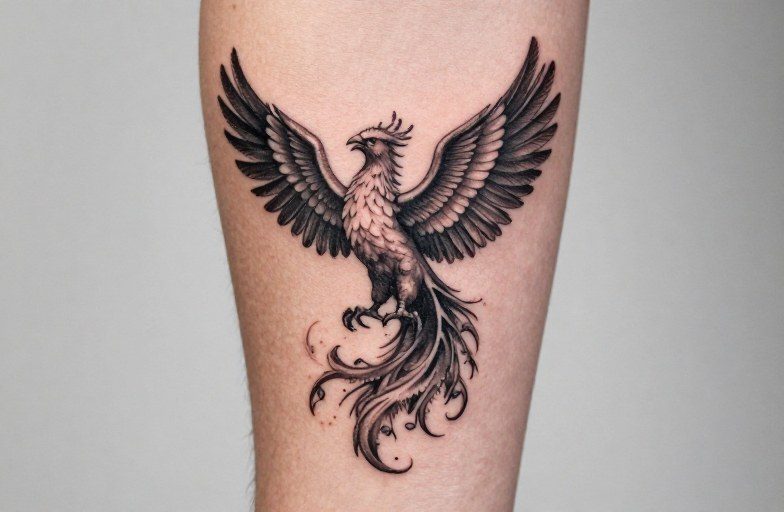
The phoenix rising from ashes tattoo represents rebirth after destruction, surviving something that should have ended you and emerging changed. Most people who choose this design have walked through fire, literally or figuratively: addiction recovery, divorce, career collapse, health crises, or the death of someone close. The image isn’t about returning to who you were; it’s about becoming something new from what remains.
Similar & Related Symbols
Not everyone wants a full bird in flames. Several symbols carry overlapping meanings and work well alongside or instead of the phoenix.
Direct Alternatives
- Ouroboros, the snake eating its tail, representing cycles of destruction and renewal
- Scarab beetle, ancient Egyptian symbol of rebirth and the sun’s daily return
- Three-headed phoenix, occasionally seen in alchemical texts, representing past, present, and future selves
- Fire itself, flames without the bird, often simpler and more abstract
Complementary Imagery
Some designs pair the phoenix with contrasting elements to complicate the narrative. A phoenix rising from a clock or hourglass adds mortality to the rebirth theme. Pairing it with a skull acknowledges that transformation often requires loss. Water imagery, waves, rain, can create tension with the fire element, suggesting balance between destruction and renewal. These combinations work best when the elements are given equal visual weight, not when one dominates as mere decoration.
How It Ages on Skin
Phoenix designs age unevenly because of their inherent complexity. The finest details, individual feathers, flame tendrils, ash particles, blur fastest. Within five to seven years, what read as sharp feather edges often soften into indistinct texture. This happens faster on high-movement areas like ribs, stomach, and inner arms where skin flexes constantly.
Placement Realities
- Upper back/shoulder blade, stable skin, good for larger compositions with spread wings
- Thigh, excellent for vertical rising compositions, ages well with proper aftercare
- Forearm, visible, but fine details in flames suffer from sun exposure and movement
- Ribcage, painful, and the stretching from breathing accelerates aging of delicate linework
- Chest over heart, popular for personal meaning, but chest hair (if present) obscures detail over time
Large-scale pieces with negative space hold definition longer than dense, all-over shading. Leaving skin tone to represent highlights in flames and feathers gives the tattoo room to breathe as it ages. Heavy black saturation in the ash bed at the bottom can be touched up more aggressively than the delicate wing tips.
Color vs Black and Grey
The choice between color and black and grey fundamentally changes what the tattoo communicates.
Color Approaches
Traditional red, orange, and yellow flames read immediately as fire and passion. More contemporary approaches use cool colors, blues, purples, greens, to suggest a phoenix of a different element, or to personal the color story. Color saturation varies enormously by artist; some pack solid, opaque pigment while others work in translucent washes that resemble watercolor. The latter looks striking fresh but fades faster and requires more frequent refresh sessions. Yellow and orange pigments are particularly prone to fading to a mustard or brown tone within a few years.
Black and Grey
Black and grey phoenixes carry a more somber, serious tone. The ashes read as actual ash rather than decorative counterpoint. This approach suits the memorial aspect of the symbol, grief, survival of trauma, better than celebratory rebirth. Skillful use of grey wash can create temperature variation: warm greys for surviving flames, cool greys for the ash bed. Without color, the composition’s structure becomes more important; weak drawing can’t hide behind bold pigment.
Common Variations & Styles
The phoenix adapts across tattoo traditions, though some styles serve the subject better than others.
Japanese (Irezumi)
Japanese phoenixes (hou-ou) differ significantly from Western depictions. Long, flowing tail feathers, often paired with paulownia flowers or flames in specific arrangements. The hou-ou traditionally represents the emperor and virtue, not personal rebirth. When rendered in Japanese style, the composition flows with the body’s contours, around the arm as a sleeve, or across the back with the tail wrapping toward the ribs. This requires an artist specifically trained in Japanese composition, not merely someone who can copy reference images.
Neo-Traditional and Illustrative
Contemporary approaches often simplify the form for readability. Bold outlines, limited color palettes, graphic flame shapes. These age better than hyper-realistic versions because the essential forms remain recognizable even as details soften. Some artists render the phoenix as geometric or abstracted, angular wings, flame as pattern rather than naturalistic element. This works when the abstraction is intentional and complete, less so when it reads as a detailed bird that simply wasn’t finished.
Realistic/Portrait Style
Attempting photorealistic feathers and flames demands enormous technical skill and commits the wearer to significant maintenance. The contrast between soft feather texture and hard flame edge is genuinely difficult to render in skin. When successful, the effect is arresting; when unsuccessful, it becomes muddy within months. This approach works best at larger sizes (thigh, back) with an artist whose portfolio specifically demonstrates this combination.
Mythology & Folklore
The phoenix myth appears across multiple traditions, though the details shift significantly.
Classical Sources
Greek and Roman accounts describe a bird that lives for centuries, builds a nest of aromatic wood, and ignites it at life’s end. From the ashes, a new phoenix emerges, or the same one reborn, sources disagree. Herodotus, Pliny the Elder, and Ovid all describe versions, with Pliny noting the bird’s rarity: one exists in the world at any time. The Christian Middle Ages adopted it as a resurrection symbol, appearing in bestiaries and church decoration.
Eastern Parallels
The Chinese fenghuang and Japanese hou-ou are often conflated with the Western phoenix but have distinct origins. The fenghuang represents virtue, grace, and prosperity, historically associated with the empress rather than personal transformation. It appears in pairs with the dragon (emperor). The Slavic firebird, found in Russian fairy tales, shares the flaming plumage but is a creature of quest and capture, not cyclical rebirth. These distinctions matter when choosing imagery; a fenghuang with dragon pairing communicates something quite different from a solitary Western phoenix in flames.
History & Cultural Roots
The specific image of rising from ashes, rather than merely the bird itself, developed gradually.
Early Visual Tradition
Ancient Egyptian bennu bird, often linked to solar rebirth and the god Ra, provided visual precedent. The Greek phoenix likely borrowed from this tradition through contact and trade. However, the emphasis on fire and ashes as the specific mechanism of rebirth intensified in Roman and early Christian writing. By the medieval period, the phoenix had become a standard funerary symbol in European art, carved on tombstones and woven into memorial textiles.
Modern Tattoo Adoption
Phoenix imagery entered Western tattooing primarily through Japanese influence in the mid-20th century, then expanded as custom work became standard. The specific “rising from ashes” composition, bird ascending, flames below, sometimes visible skeletal remains, crystallized as a tattoo trope in the 1990s and 2000s alongside increased interest in personal narrative and “meaningful” tattoo choices. Earlier phoenix tattoos more often depicted the bird perched or in flight without the destruction element. The contemporary emphasis on ashes and ruin reflects broader cultural preoccupation with trauma and recovery narratives.
What to Remember
The phoenix rising from ashes is a durable symbol because it accommodates genuine complexity. It doesn’t require that your recovery be complete, that your fire be past, or that your rebirth be triumphant. The image holds space for ongoing process, still rising, still burning, still figuring out what comes next.
Choose placement with aging in mind. Prioritize structural clarity over decorative detail. Find an artist whose specific approach to fire, feathers, and composition matches your vision, not merely someone who says they can do it. And recognize that the tattoo’s meaning will accumulate over time, layering personal history onto the mythological foundation. What begins as marking a specific turning point often becomes, years later, a reminder that you have survived more than you once thought possible.
Frequently Asked Questions
Does a phoenix tattoo always mean someone went through trauma?
Not necessarily. Some people choose it for general resilience, major life transitions like graduation or relocation, or simply for the visual power of the image. The meaning is personal, though the symbol does carry heavy association with survival.
How big does a phoenix rising from ashes tattoo need to be?
Minimum six to eight inches for the composition to read clearly with both bird and flames. Smaller designs lose the ashes element or simplify the phoenix to near-abstraction. Thigh, back, or upper arm work best for the full narrative.
Can a phoenix tattoo be covered up later if I change my mind?
Covering a large, saturated phoenix is difficult because of the dense black and red pigment. The wings and flames spread across significant skin area. Laser removal prior to coverup is often necessary, making this a design to commit to rather than experiment with.
What’s the difference between a phoenix and an eagle or hawk tattoo?
Eagles and hawks represent power, vision, and dominance without the destruction-rebirth cycle. They face forward, hunt, claim territory. The phoenix looks upward, emerges from ruin, and implies prior loss. The posture and context, flames, ashes, skeletal remains, make the distinction clear.
Leave a Reply