A rose paired with a butterfly carries a layered, widely understood meaning: the butterfly represents transformation, rebirth, and the soul’s journey, while the rose embodies beauty, passion, and the thorny reality that love and life carry pain alongside pleasure. Together, they speak to growth through difficulty, beauty that emerges from struggle, and the temporary nature of both bloom and flight. This combination resonates across cultures and generations because it mirrors an almost universal human experience: becoming something new after hardship.
Mythology & Folklore
These two symbols have traveled separate but occasionally overlapping mythic paths. Understanding their traditional associations adds depth to why they work so powerfully together.
The Butterfly’s Soul Journey
In Greek tradition, the word for butterfly, psyche, also meant soul, and the insect was often linked to the psyche’s departure from the body at death. Aztec beliefs associated butterflies with fallen warriors and the spirits of women who died in childbirth, figures reborn as butterflies or hummingbirds. Japanese folklore sometimes saw butterflies as visiting ancestors or spirits of the living. The common thread: metamorphosis as something more than biological, a passage between states of being.
The Rose’s Dual Nature
Rose symbolism is equally ancient and contradictory. Greek mythology often links it to Aphrodite and beauty, but also to silence and secrecy (the sub rosa tradition). In Christian tradition, the red rose became associated with the Virgin Mary’s purity and Christ’s blood. The thorn remains central to virtually all rose mythology, beauty that defends itself, love that hurts. This duality makes the rose an unusually honest symbol; it refuses to be purely pretty.
Symbolism & Core Meaning
When combined, these symbols create specific meanings that neither achieves alone. The pairing suggests several interconnected ideas:
- Transformation through love or loss: The butterfly’s emergence parallels the rose’s brief blooming period, both are temporary, both require preceding struggle. A caterpillar dissolves to rebuild; a rose pushes through thorned stems to open.
- Beauty as process, not endpoint: The butterfly doesn’t stay a butterfly long; the rose drops petals quickly. The tattoo can mark acceptance of impermanence rather than resistance to it.
- Feminine resilience: Both symbols have been culturally gendered female, though this association has loosened considerably. The combination specifically evokes strength that appears delicate, survival that looks like grace.
- Memorial and continuation: The pairing frequently marks someone’s passing, with the butterfly representing the departed soul and the rose representing love that outlasts death.
Placement affects how these meanings read. Over the heart, the memorial interpretation strengthens. On the forearm or shoulder, the transformation aspect typically dominates. Behind the ear or on the wrist, the design reads more as personal reminder than public statement.
Common Variations & Styles
The rose-and-butterfly combination adapts to virtually every tattoo style, though some approaches serve the symbolism better than others.
Neo-Traditional and American Traditional
Heavy black outlines, limited but saturated color palettes, and stylized rather than realistic forms dominate these approaches. American traditional typically renders the butterfly with bold wing patterns and the rose as a simplified bloom with prominent leaves. Neo-traditional allows more detail, softer shading, and sometimes incorporates ornamental elements like jewels or banners. These styles age well, the bold lines hold, and the symbolism reads immediately from across a room.
Realism and Fine Line
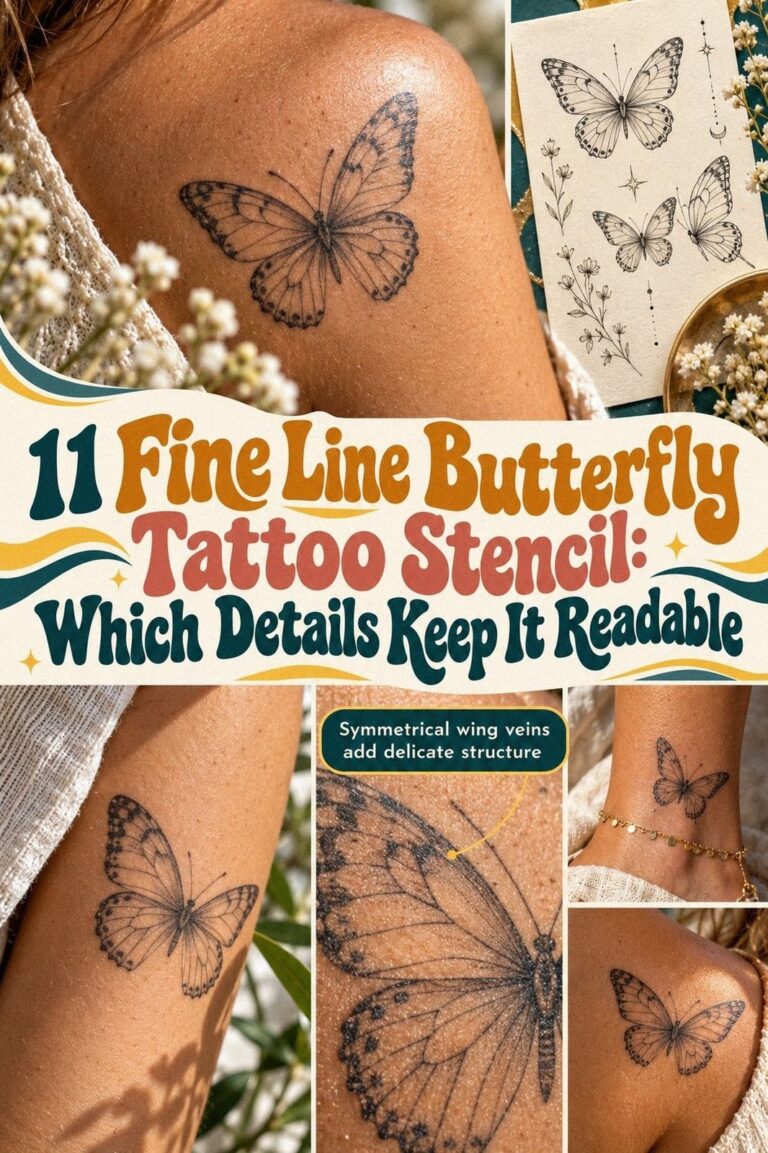
Photographic realism captures the butterfly’s wing texture and the rose’s velvety petal gradients with extraordinary precision. Fine line approaches use single-needle work for delicate, almost illustrative quality. Both demand larger sizing to execute properly, too small, and the detail muddles within a few years as ink spreads slightly in the skin. Realism particularly suits the memorial interpretation, where capturing a specific rose variety or butterfly species matters.
Watercolor and Abstract
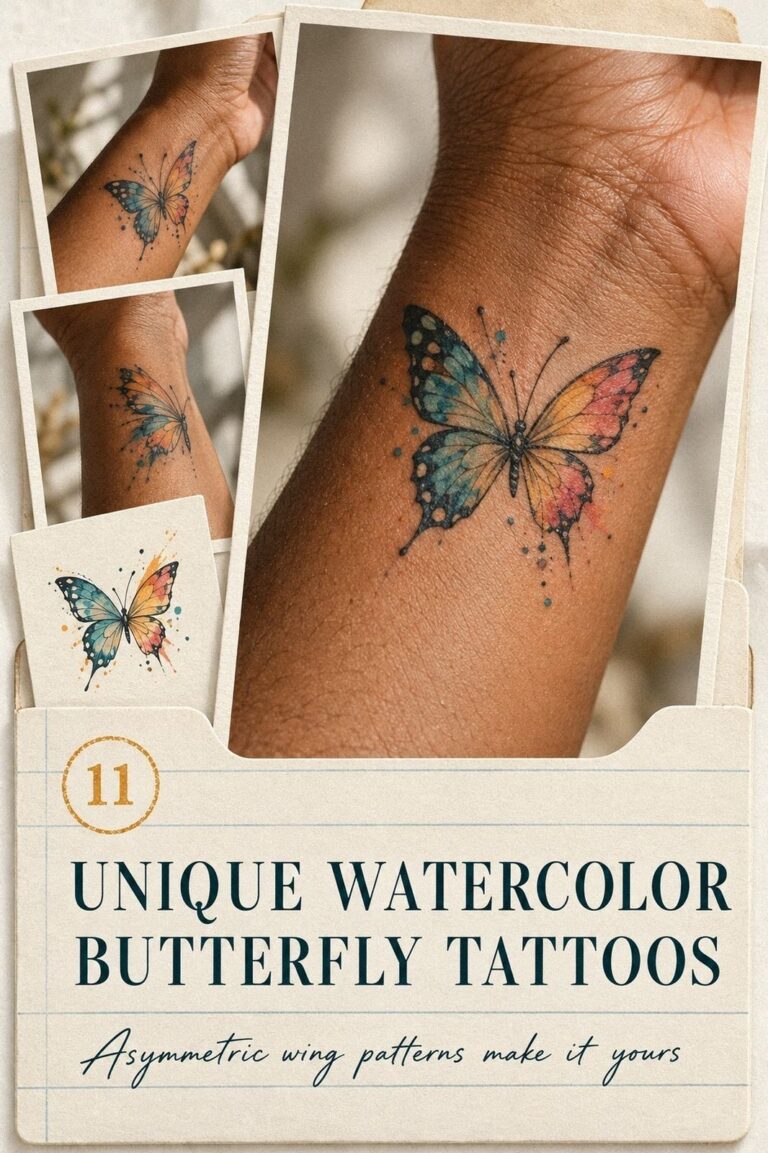
Splashed color behind or around more defined linework creates movement and emotional immediacy. Pure watercolor without strong outline structure tends to blur and fade faster, especially on high-movement areas. The most successful watercolor rose-and-butterfly tattoos anchor the main subjects with solid line or heavy black in key areas, letting color flow around that structure.
Religious & Spiritual Angles
The combination carries specific resonance in several spiritual frameworks, though practitioners vary enormously in how explicitly they invoke these associations.
Christian iconography sometimes pairs the rose with the Virgin Mary (the Rosa Mystica) and the butterfly with resurrection. Together, they can represent spiritual rebirth through divine love, or the soul’s purification. Catholic traditions particularly favor this pairing for memorial tattoos, sometimes incorporating dates or names.
In various Buddhist-influenced interpretations, the butterfly’s brief adult life embodies impermanence (anicca), while the rose’s cycle of bloom and decay reinforces the same teaching. The tattoo becomes a meditation on non-attachment rather than a celebration of any specific transformation.
Wiccan and pagan practitioners often associate the butterfly with the element of air and the rose with water or earth, creating a balance-of-elements reading. The combination might mark a seasonal celebration, a handfasting, or dedication to a deity associated with either symbol.
Many wearers hold no specific religious affiliation but find the pairing spiritually meaningful, what anthropologists sometimes call “lived religion,” personal symbolism that doesn’t require institutional validation.
Color vs Black and Grey
This choice fundamentally changes how the tattoo communicates and how it ages.
Color Symbolism and Practicality
Red roses with monarch-orange butterflies create the most immediately recognizable version, with color associations that feel almost hardwired: red for passion, blood, courage; orange for energy and warmth. Pink softens the rose toward gentler love or youth; yellow or white shifts toward friendship, purity, or new beginnings. Blue butterflies (morpho species) introduce rarity and the extraordinary, something almost impossible made visible.
Color tattoos require more maintenance. Reds and oranges generally hold well; lighter yellows and pinks fade faster and may need refreshing. Sun exposure accelerates fading across all colors, so placement on frequently sun-exposed skin (hands, forearms, lower legs) demands more committed aftercare long-term.
Black and Grey Depth
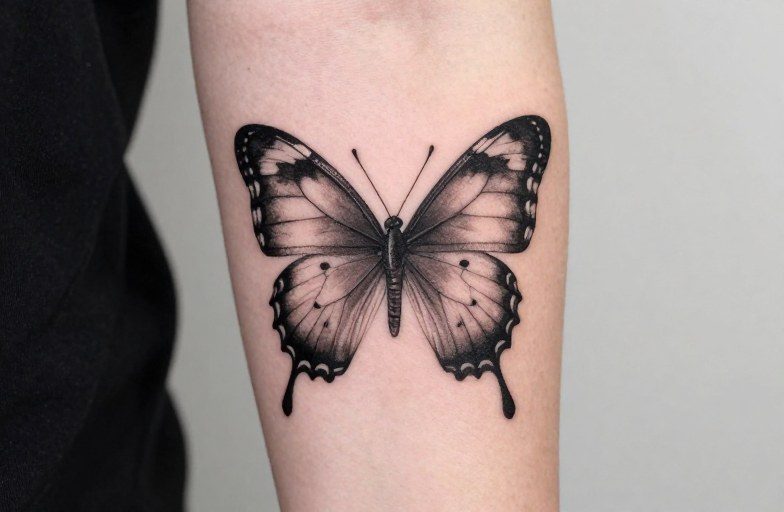
Without color, the tattoo relies on contrast, texture, and composition. Black and grey excels at showing the butterfly’s wing veining and the rose’s petal layering through careful shading gradation. The mood shifts toward solemnity, timelessness, and sometimes gothic or Victorian sensibility. Healing tends to be more predictable, no color to shift or fade unevenly, and the tattoo often reads as more “classic” decades later.
Many artists recommend black and grey for smaller pieces where color would need to be simplified to the point of symbol rather than image. At larger sizes, color’s impact justifies its demands.
Who Chooses This Tattoo
Certain life circumstances and personal tendencies draw people to this specific combination.
People marking significant personal change, recovery, surviving illness, leaving relationships, starting new chapters, often gravitate here because the symbolism doesn’t require explanation. The tattoo announces transformation without demanding conversation about its specifics.
Those processing grief frequently choose this pairing, particularly when the departed loved roses or butterflies specifically. The butterfly’s association with the soul’s journey provides comfort without explicit religious commitment.
First-time tattoo clients sometimes select this design because its symbolism feels accessible and its imagery familiar. The combination offers emotional weight without obscurity, meaningful to the wearer, legible to observers.
Interestingly, this tattoo crosses typical gender associations more than either symbol alone. Men choosing roses have become unremarkable in contemporary tattooing, and the butterfly’s transformation meaning increasingly overrides its feminine coding. The combination works for anyone who identifies with its core themes.
The Takeaway
A rose with a butterfly tattoo succeeds because it layers two ancient, visually striking symbols into something greater than either alone. The meaning isn’t mysterious or exclusive, transformation, beauty’s cost, impermanence, resilience, but its accessibility is its strength. You don’t need to explain it, yet it rewards attention when someone asks.
The design demands thoughtful execution: size large enough for detail, style appropriate to your skin’s aging and your aesthetic, color choice that serves the meaning you intend. Work with an artist who understands how these elements interact compositionally, not just someone who can render each separately. The butterfly’s flight path across or around the rose, the negative space between them, the direction each faces, these choices determine whether the tattoo feels dynamic or merely assembled.
Most importantly, this tattoo carries its weight without heaviness. It acknowledges pain and loss while insisting on beauty’s persistence. That balance, honestly struck, is what keeps people returning to this combination decade after decade.
Frequently Asked Questions
Does a rose with a butterfly tattoo always mean someone died?
No. While the combination is frequently chosen for memorials, the butterfly’s broader association with transformation and the rose’s with love and beauty make it equally common for marking personal growth, recovery, or major life changes. Context and placement usually reveal the specific intention.
What’s the best size for a rose and butterfly tattoo?
At least palm-sized for any detail work, smaller, and the butterfly’s wing patterns and the rose’s petal layers blur together within a few years. For realism or heavy detail, forearm-length or larger preserves the imagery’s integrity as the tattoo ages.
Should the butterfly be landing on the rose or flying away?
Compositionally, both work. Landing suggests arrival, connection, or finding beauty. Flying away emphasizes departure, release, or transformation complete. The direction of flight, upward, toward the viewer, off-frame, adds further nuance worth discussing with your artist.
How well does this combination age compared to simpler tattoos?
Moderately well if executed properly. The detailed wing patterns and petal edges are vulnerable to spreading and fading over decades. Bold-lined traditional styles age most reliably; fine-line realism requires larger sizing and eventual touch-ups to maintain clarity.
Leave a Reply