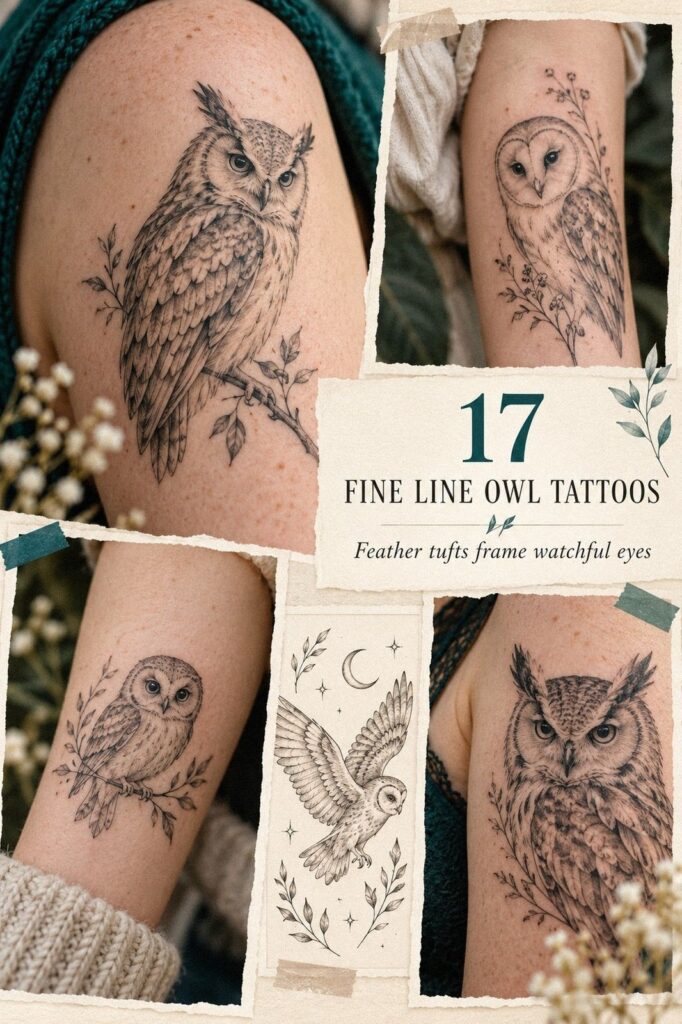
Fine line owl tattoos can stay private without losing their meaning. I learned that placement matters more than size after choosing a visible piece too quickly, then wishing I’d considered work clothes and daily habits first. These ideas keep the delicate linework personal and easy to cover. Start here!
Editor’s note: The most striking hidden owl tattoos usually rely on one clear gesture, not a crowded collection of symbols. Choose the placement first, then let the owl’s posture, scale, and expression carry the story.
Small Fine Line Owl Tattoos Behind The Ear
Behind-the-ear placement gives you a discreet canvas with a sharp reveal when your hair moves. A fine line owl with rounded eyes and hair-thin feathers can look striking without becoming loud, especially if you want your first piece hidden at work.
I call this the Behind-the-Ear Privacy Rule: keep the widest point close to 1 inch, then let the ear guide the shape. Your artist can use single-needle linework for feather marks, but you shouldn’t pack every space with detail.
You’ll want to consider your usual haircut before booking. Longer hair can hide the tattoo, while a short cut may make it visible overnight. For another private animal idea, compare these small owl tattoos.
Fine Line Owl Tattoos With Crescent Moon Details
A crescent moon gives your owl a symbolic companion without turning the design into a crowded celestial scene. On the wrist, a crescent moon beside a small owl can feel elegant, meaningful, and quietly dramatic.
I call this the Crescent-Anchor Method. Let the moon create open space, then position the owl slightly below it so your eye travels through the design. Three tiny dots can work, but you don’t need a full star field.
A black ink crescent with one open section may age more clearly than several filled marks. If symbolism matters to you, decide whether the moon represents protection, intuition, night work, or change before choosing the pose. You can also browse fine line bird tattoos for wing-and-moon ideas.
Unique Fine Line Owl Tattoos On The Wrist
A wrist owl doesn’t need to look like every other tiny animal tattoo. Try a three-quarter profile with one visible eye, a folded wing, and a slightly uneven feather edge. That asymmetry feels personal, while the profile owl looks more alive than a perfectly mirrored symbol.
Every detail needs to earn its place at wrist scale. Your artist can suggest feathers with a few narrow strokes, but miniature realism may not be worth the cost if the design has nowhere to breathe.
The inner wrist feels softer and more private, while the outer wrist reads bolder and catches attention. A watch can cover either placement, though the outer side gets more friction. For a scale comparison, look at these tiny owl tattoos.
Fine Line Owl Tattoos With Botanical Linework
Botanical details can soften an owl’s fierce gaze without making the tattoo feel overly sweet. A fine line owl among thin stems and small leaves creates a graceful vertical flow while keeping the owl clear.
Your artist could curve olive branches, fern fronds, or one winding vine around the owl. I’d pick one botanical language and stay with it. Mixing roses, leaves, stars, and vines can make a delicate tattoo look busy.
I call this the One-Stem Boundary. Keep the stem moving around the owl instead of crossing through its eyes or beak.
Botanical linework should guide attention, not compete with the face. These small fine line butterfly tattoos offer another example of wings and plant shapes sharing space.
Tiny Fine Line Owl Tattoos On The Finger
Finger designs demand restraint because there isn’t much uninterrupted skin. A tiny owl flash design with a round head, small wings, and almost no interior shading will read more clearly than an intricate miniature scene.
I’d choose a simple front-facing owl rather than a detailed side profile. Your knuckles bend, the skin gets washed often, and small lines can soften sooner than they would on an upper arm.
A black outline with two or three feather marks can still feel bold. Ask your artist whether the chosen finger has enough flat space, and don’t squeeze the design into a spot that distorts when you move.
The side of a finger can disappear when your hand is relaxed, while the top remains more visible. If you like compact animal symbols, compare these tiny fine line butterfly tattoo references before deciding.
Fine Line Owl Tattoos With Geometric Eyes
Geometric eyes give a soft owl a sharper, more expressive edge. A geometric owl with open angles around the eyes and fine feather lines can feel fierce, symbolic, and more graphic than a naturalistic design.
You’ll want to discuss contrast with an artist who has healed examples on skin tones close to yours. Clean spacing matters when negative space forms part of the eyes, especially if the design uses dark accents.
I call this the Two-Shape Eye Rule. Give each eye one strong geometric form, then keep the surrounding feathers quieter. I’d skip intricate polygons across the entire face because they can make the owl look mechanical.
The spine is easy to cover and makes a powerful vertical placement, but it can feel intense because it sits close to bone. If you’re comparing animal symbolism, these small eagle tattoos show how stronger shapes can still look refined.
Fine Line Owl Tattoos Across The Collarbone
A collarbone owl can follow the body’s natural sweep, giving the design a flowing look without requiring a large scale. A collarbone owl with narrow wings and fine feather marks can stay visible in a tank top while disappearing beneath a shirt collar.
Your artist should place the stencil while your shoulder rests naturally. If you tense your neck or pull your shoulder back, the final design may shift when you relax. I’d keep the owl slightly off-center rather than forcing perfect symmetry.
The collarbone invites a striking horizontal composition. A fine line wing can extend toward the shoulder while the head stays closer to the center of your chest. Leave enough empty skin around the wings for future pieces or jewelry.
Some people find this zone more sensitive because the skin is thin and close to bone. If you’re weighing value against discomfort, a compact design may be worth it. For a softer wing comparison, browse watercolor fine line butterfly tattoo ideas.
Fine Line Owl Tattoos With Celestial Symbols
Celestial symbols can make an upper-back owl feel sacred, ethereal, and deeply personal. A celestial owl with a small sun, moon, or two scattered points can carry strong meaning without becoming visually crowded.
Your artist can build a vertical arrangement with the owl in the center and smaller symbols above or below. I’d avoid adding every planet and star. Choose two supporting marks, then let the owl carry the message.
I call this the Night-Sky Ladder. The largest symbol sits in the middle, the next one gets smaller, and the smallest mark finishes the composition. Fine black linework keeps each symbol crisp when the spacing is generous.
The upper back is easier to conceal than many other placements and usually gets less daily friction. You’ll still need careful washing, light moisturizing, and protection from direct sun while the surface heals. For another nocturnal approach, see this realistic owl tattoos guide.
Minimal Fine Line Owl Tattoos On The Ankle
An ankle owl can stay hidden beneath socks and trousers while offering a playful reveal in warmer weather. A minimal owl with a narrow body, open wings, and restrained feather marks can feel understated yet expressive.
Keep the design above the ankle bone if you’re sensitive to sharp, bony areas. Feet and ankles may feel more uncomfortable than an upper arm or thigh, and shoes can rub during healing.
A single-needle outline can look dainty here, but delicate doesn’t mean careless. Your artist should leave open skin between the eyes, beak, and wing edges. If you ask for too much detail, the finished tattoo may lose clarity.
The ankle also gets sun, sweat, and repeated movement. You’ll want comfortable footwear while the skin settles, plus consistent protection afterward. For placement comparisons, these fine line bird tattoos show how small birds can preserve readable shapes.
Fine Line Owl Tattoos With Open Wings
Open wings create the strongest sense of movement in this list. The open-wing owl keeps its silhouette clear when the wing shape is simple and the feather lines follow one decisive direction.
Your artist should test how the design wraps around the arm. A wing that looks balanced on paper may need a small adjustment on skin. I call this the Paper-to-Skin Check.
The upper arm gives the owl enough space to feel bold without becoming enormous. Solid black accents can anchor the eyes and wing tips while the rest stays fine and graceful.
Fine line tattoos can soften or spread over time, especially with regular UV exposure. Ask how the artist’s healed work looks before you book.
A settled portfolio reveals more value than a dramatic first-day result. For another winged subject, compare fine line eagle tattoos.
Fine Line Owl Tattoos Inspired By Night Flight
Night-flight designs feel raw, haunting, and symbolic without requiring a large scene. A night-flight owl with a side profile, lifted wing, and one curved motion line can feel private while still carrying a powerful story.
Rib placement gives you room for a longer composition, but it can be a more painful zone because the skin sits close to bone. Your artist can shorten the session by keeping the owl compact.
A curved wing line should follow the ribs rather than cut against them. Test the stencil while standing, twisting, and relaxing so the design works across movement. For a smaller animal format, see these small owl tattoos.
This placement can represent night shifts, independence, protection, or a chapter you survived quietly. If privacy is the priority, the rib area may be worth the higher discomfort and longer planning.
Could a Fine Line Owl Stay Hidden on the Sternum?
A sternum owl can remain concealed beneath everyday clothing while giving the wearer a personal, empowering symbol. A sternum owl works best when the central face stays compact and the wings follow the body’s vertical line.
The sternum demands careful stencil placement because even a small shift affects symmetry. Your artist should let you stand naturally before deciding where the beak, eyes, and lowest feather will sit.
I’d keep the design minimal rather than filling the entire center with stars or shading. A central crescent can create a meaningful anchor, while open skin prevents the composition from feeling cramped.
This area may be sensitive, and healing can be affected by friction from fitted clothing. Ask about the expected session length, aftercare, and price before booking. That conversation can save you an expensive correction later!
The Shoulder-Blade Owl With One Dramatic Wing
A shoulder-blade owl gives you a broad surface for a memorable silhouette while staying easy to cover. A shoulder-blade owl with one dramatic wing can feel daring, sleek, and more personal than a symmetrical pair.
The asymmetry should be intentional. Keep one wing lifted and the other folded, or let a single feather extend toward the shoulder. That choice creates movement without requiring dense detail.
I’d ask your artist to check the design while your arm hangs naturally and again while it reaches forward. A healed shoulder tattoo can reveal whether the lines follow movement gracefully. If you’re comparing delicate animal shapes, revisit small fine line butterfly tattoos.
The shoulder blade can offer strong value for your budget because it provides more usable skin than a finger or ankle. You get room for readable linework without committing to a large back piece.
Fine Line Owl Tattoos With Initials
An initial can turn an owl into a personal memorial, family symbol, or quiet reminder. A lettered owl should use one clean character rather than competing with the face, feathers, and supporting marks.
Place the initial beneath the owl or inside a small crescent, but don’t force it into the wing. Your artist can adjust the lettering so it stays readable after the lines soften.
If the tattoo honors someone, choose a detail that feels meaningful rather than merely decorative. A single initial may hold more emotional weight than several dates or words squeezed into a tiny design.
A compact initial can also help control the cost. You’ll spend less than you might on a larger script composition, though the artist’s minimum still matters. Ask for the full price before approving the stencil!
Black Ink or Soft Gray? A Clear Choice for Owl Tattoos
Black ink gives an owl crisp definition, while soft gray can create a gentler, more understated effect. The right choice depends on your skin, placement, contrast, and how much visual strength you want. Black-and-gray shading can be especially useful around the eyes.
I prefer black for tiny designs because it gives the silhouette a sharper edge. Soft gray may suit a larger, romantic owl, but too little contrast can make a small face difficult to read.
Color can look vibrant at first, yet it may require more planning for a fine line piece. A graywash accent can add depth without turning the design into a heavy block.
Your artist should explain how pigment choices behave on your skin rather than copying someone else’s healed tattoo. The cheapest option isn’t always the best value if the contrast disappears quickly.
When Does a Tiny Owl Need More Space?
A tiny owl needs more space when the eyes, beak, wings, and feather marks begin touching one another. Readable spacing matters more than chasing the smallest possible tattoo.
Use the palm of your hand to estimate how the design will look at its actual size. A tattoo that seems intricate on a phone may become a dark blur when reduced to skin.
I’d rather choose a slightly larger owl with a crisp silhouette than pay for an overcrowded design that needs frequent correction. A larger fine line owl can still stay private on the upper arm, shoulder blade, or upper back.
Ask your artist what size they consider stable for the details you want. That advice has more practical value than copying a reference that was designed for different skin and placement.
The Healed Portfolio Test
Fresh tattoos can look sharp on nearly everyone, but healed work tells you whether an artist understands restraint. A healed portfolio should show line clarity, spacing, pigment retention, and realistic skin texture.
Look for owl tattoos reviewed after the surface has fully settled, not only immediately after the appointment. You’ll see whether thin feathers remain distinct and whether the eyes still have expression.
I’d study at least three healed pieces before deciding. Notice how the artist handles fine line consistency across small faces, curved wings, and different placements.
A strong portfolio is worth the investment because it reduces the chance of an expensive cover-up or early touch-up. Ask direct questions about healing, maintenance, and the artist’s recommended size. You deserve clear answers!
Fine Line Owl Tattoos That Mark a Private Chapter
An owl can mark a private chapter without explaining the entire story to everyone who sees it. A symbolic owl tattoo might represent study, protection, independence, grief, or the decision to trust your instincts.
Choose posture before decoration. An alert owl feels watchful, a folded-wing owl feels guarded, and an owl in profile can look quieter and more reflective.
A turned head may communicate curiosity or vigilance with only a few lines. That small gesture can carry more meaning than adding every popular moon, star, and flower.
If the story is deeply personal, hidden placement can make the tattoo feel empowering rather than performative. The best design may be the one you can reveal when you choose and keep private when you don’t.
Why Fine Line Owls Still Feel Personal
I’ve seen owl tattoos become generic when the artist starts with a template and never asks what the bird means to the wearer. An individualized owl should reflect your story through the eyes, posture, scale, and placement.
My preference is a smaller design with one memorable feature, such as an uneven feather, a crescent, or a single alert eye. Personal symbolism matters more than adding every fashionable detail.
I once judged a tattoo only while it was fresh. The lines looked crisp, the contrast was dramatic, and I assumed the design would stay exactly that way.
It didn’t. Healed linework is more useful than a perfect first-day result.
The practical choice matters too. Check hygiene, ask about aftercare, and understand that surface healing often takes 2 to 3 weeks while complete healing can take about 2 to 3 months. A thoughtful consultation is worth the time and the cost.
What People Always Want to Know
How much does a fine line owl tattoo usually cost?
In the US, a small fine line owl tattoo often costs about $100 to $300, though a shop minimum may run roughly $50 to $100 and hourly rates may sit around $100 to $250. Your artist, region, size, and placement will change the final price. Ask for a written estimate before booking.
Are fine line owl tattoos a good idea for a first tattoo?
Yes, especially when you choose a manageable placement and a clear design. An easy-to-cover tattoo can help you learn how your skin heals without committing to a large piece. You’ll still need to research the artist, understand the pain range, and choose symbolism that feels personal.
How do I choose a tattoo artist for fine line owl tattoos?
Look for a portfolio with healed animal tattoos, not only fresh results. Your artist should show clean lines, consistent spacing, and work on skin tones similar to yours. Ask about hygiene, needle setup, aftercare, and whether they regularly create fine line animals.
How much do fine line owl tattoos hurt?
Pain varies by person and placement. Ribs, feet, hands, and sternum tend to feel sharper because they’re close to bone, while the forearm, thigh, and shoulder are often more tolerable. A shorter session may be worth the extra planning if you’re concerned about comfort.
How long does a fine line owl tattoo take to heal?
The surface usually settles in about 2 to 3 weeks, while complete healing can take about 2 to 3 months. Wash gently, moisturize as directed, avoid pools and direct sun, and don’t pick at flakes. Your artist’s instructions should guide your routine.
What’s the best placement for fine line owl tattoos?
Behind the ear and the upper arm are strong choices if privacy matters. The upper arm gives the design more space and usually offers easier healing, while behind the ear keeps the tattoo smaller and more discreet. Balance visibility, friction, pain, and long-term value.
Where I’d Start First
If I had to pick one, I’d start with the upper-arm owl with open wings. It gives the linework enough breathing room to stay readable, hides beneath a sleeve, and won’t force you into a cramped design. Compare your artist’s healed work before booking, then choose the version that still feels meaningful when the novelty fades.