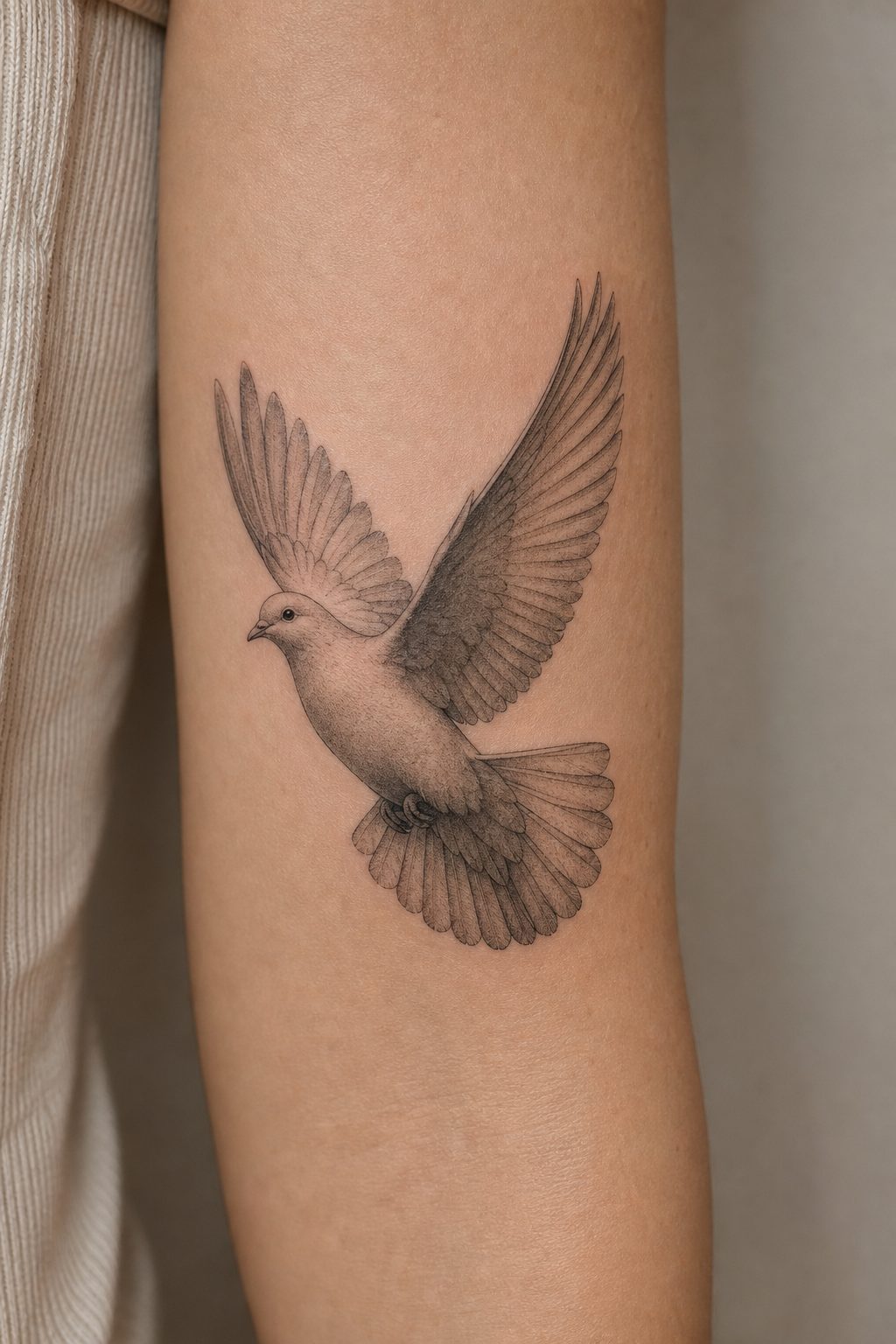
A dove tattoo most commonly signals peace, love, and spiritual devotion. The bird’s white plumage and gentle posture have made it shorthand for nonviolence across cultures, while paired doves represent romantic partnership or family bonds. Beyond these surface readings, the symbol carries weight in religious contexts, Christianity’s Holy Spirit, Noah’s olive branch, mourning traditions in Judaism, and functions as a memorial piece for lost loved ones in contemporary tattooing.
Similar & Related Symbols
Choosing a dove often means distinguishing it from close visual cousins that carry different baggage. Swallows, sparrows, and even certain finch species share the small-bird silhouette but diverge sharply in meaning.
Swallows vs. Doves
Traditional swallow tattoos (the bluebird with split tail) belong to sailors and travel, safe return, nautical miles logged. Doves lack that maritime DNA. Sparrows carry working-class connotations, sometimes prison associations depending on placement and style. A dove rendered too generically risks being misread as a swallow by viewers unfamiliar with tattoo vocabulary. The fix is simple: emphasize the rounded body, small head, and typically olive branch or clasped twig in the beak. These details anchor the reading.
The Olive Branch Alone
Some clients split the symbol, taking just the olive branch as a subtler statement. This works as a minimalist choice but loses the bird’s specific associations, Holy Spirit, soul’s ascent, romantic pairs. The branch without the dove reads more generally as “peace offering.” Pairing them, as in the classic biblical image, locks in both meanings.
Personal & Modern Meanings
Contemporary wearers rarely hew to single symbolic tracks. The dove accumulates private significance through context: a memorial date nearby, specific color choices, or companion imagery.
Memorial and Grief Work
Release imagery dominates here, a single bird ascending, sometimes fragmenting into particles or geometric shapes. Unlike rigid Christian iconography, these designs often strip religious specificity. The bird becomes pure motion, departure, continuation. Names and dates typically integrate into negative space or trail behind as if carried by wingbeats. Black-and-grey dominates memorial doves, though some clients introduce a single color accent: sky blue for a child, purple for a parent, red for a partner.
Recovery and Transition
Sober communities have adopted the dove alongside other symbols, though less universally than the semicolon or phoenix. The appeal is obvious: flight as escape, the bird’s association with hope in twelve-step literature. Placement matters here, visible locations (forearm, calf) signal openness about recovery; covered placements (ribs, upper thigh) keep the meaning private.
Design Tips & Pairings
The dove’s simple form tempts lazy execution. A blob with wings reads as amateur from ten feet. Specific choices prevent this.
- Line weight: Fine single-needle outlines age poorly on high-movement areas; the dove’s delicate structure demands either bold enough lines or strategic placement on stable skin (upper chest, outer forearm, calf).
- Shading approach: Smooth grey-wash gradients suit the bird’s soft plumage but require a skilled hand. Stipple or whip-shading alternatives add texture and age more forgivingly.
- Color reality: White ink on lighter skin tones vanishes within years; cream or pale grey substitutes better. On darker skin, white highlights only, never full fills. Consider purple-grey or blue-grey doves instead of attempting pure white.
- Pairing dynamics: Roses add romantic weight; clocks or hourglasses shift toward memento mori; geometric frames modernize the image; script banners risk kitsch unless the lettering is exceptionally clean.
Two doves facing each other with a heart or lock between them, this combination peaked in the 1990s and now reads dated. Single birds in flight or perched with turned heads carry more contemporary energy.
Mythology & Folklore
Tracing the dove’s symbolic lineage requires care. Multiple traditions claim overlapping territory.
Mediterranean and Near Eastern Roots
The bird is often linked to goddesses of love and fertility, Aphrodite in Greek practice, Ishtar in Mesopotamian contexts. These associations likely predate and inform later Christian adoption. Some trace the “lovebird” pairing to these cultic practices, though the evidence is fragmentary. The dove’s actual behavior (monogamous pairing, gentle demeanor) reinforced the symbolic reading regardless of theological framework.
Noah and the Flood
The Genesis account, dove returning with olive leaf, signaling receding waters, established the bird as divine messenger and hope symbol. This narrative crossed into secular peace imagery through political cartooning and anti-war movements, particularly post-World War I. The dove with olive branch became a visual cliché precisely because it worked so effectively across language barriers.
Christian Liturgical Use
Baptismal imagery, Pentecostal fire, the Spirit descending, these specific Christian readings require accompanying context (flames, water, halos) to register. A generic dove without these elements won’t automatically communicate religious devotion to viewers.
How It Ages on Skin
Small bird tattoos face predictable degradation. The dove’s thin beak, delicate feet, and wing feather details blur fastest. Here’s what actually happens.
On the inner bicep or ribs, where skin stretches and compresses, a fine-line dove becomes illegible in five to eight years. The chest plate and outer forearm hold sharper definition longer due to stable dermal layers. Hand and foot placements are essentially temporary, these areas shed ink rapidly through friction and regeneration.
Black-and-grey doves age more gracefully than color versions. Blue-grey maintains readable contrast on most skin tones; attempts at true white result in yellowed or disappeared highlights within a decade. If you want brightness, plan for touch-ups or accept the weathered look as part of the piece’s life.
Linework doves without fill last longer than shaded versions in terms of outline clarity, but can look unfinished or sketchy as surrounding tattoos darken with age. The sweet spot: bold enough line to survive, enough grey-wash to suggest dimension without relying on subtle gradients that won’t survive.
Who Chooses This Tattoo
Demographics have shifted. The dove was once overwhelmingly feminine-coded in Western tattooing, delicate, pretty, “girly.” That binary has eroded. Current wearers span gender presentations, though placement patterns still diverge.
Men often scale the image larger, pair it with darker imagery (skulls, clocks, script in gothic lettering), or integrate it into religious sleeve work. Women more frequently choose smaller scales, softer accompanying elements, and placement on ribs, ankles, or behind ears, though these are trends, not rules worth following if they don’t fit your body or style.
Age of first-timers varies widely. The dove appeals to older clients seeking meaningful commemoration rather than aesthetic experimentation. Younger wearers sometimes arrive with Pinterest references that homogenize the image; a good artist will push for personalization that prevents the “stock photo tattoo” problem.
Professional contexts matter. The dove remains one of the most socially acceptable tattoos for conservative workplaces, peaceful, non-threatening, potentially religious. This makes it a common choice for people in visible careers who want ink without friction.
Final Thoughts
The dove tattoo persists because it compresses multiple readable meanings into a visually simple form. That same simplicity risks blandness. The difference between a meaningful dove and a forgettable one lies in specificity, placement that suits your body’s movement, companion imagery that narrows the symbolic field, technical execution that respects how ink lives in skin over decades. Choose the symbol for what it actually communicates to you, then work with an artist who can make that communication visible to others without relying on generic shorthand.
Frequently Asked Questions
Does a dove tattoo always mean I’m religious?
Not at all. While doves carry strong Christian associations, secular wearers outnumber religious ones in most shops. The peace and love readings function independently. Only specific additions, halos, crosses, biblical script, lock in religious meaning.
How big should a dove tattoo be to age well?
Palm-sized minimum for any detail in the wings or beak. Smaller than that, and the fine lines blur into an unrecognizable blob within a few years. Simpler silhouettes can shrink slightly, but you’re still sacrificing nuance.
Can a dove tattoo cover up an old piece?
The bird’s rounded shape and wing spread work for certain coverups, but white feathers won’t hide dark existing ink. Strategic use of black-filled wings with negative-space highlights can work over faded grey pieces. Your artist needs to assess the specific old tattoo’s density and placement.
What’s the difference between a dove and a pigeon in tattoo symbolism?
Technically the same species, but culturally distinct. Pigeons carry urban, sometimes negative connotations, pests, grey drabness, city grime. Doves are selectively bred white variants, culturally purified through religious and political imagery. A tattoo artist rendering either will emphasize different body language: doves elegant and elongated, pigeons stockier and more grounded.