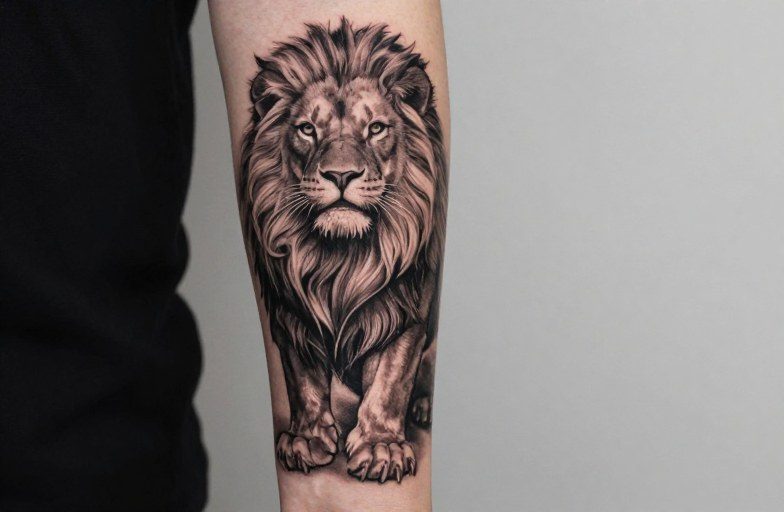
A Chinese lion tattoo most commonly represents protection and guardianship. The stone lions (Shi) flanking temple entrances and the mythical Fu Dogs evolved into tattoo imagery that speaks to warding off harm, demonstrating courage, and attracting good fortune. On skin, this design carries weight through its visual drama, broad manes, curled fur, often paired with spheres or cubs, making it as technically demanding as it is symbolically loaded.
Mythology & Folklore
The Guardian Pair
Traditional Chinese architecture places two stone lions at entrances: the male rests his paw on an embroidered sphere representing supremacy over the world, while the female shelters a cub beneath hers, symbolizing nurture and the cycle of life. Tattoo compositions frequently preserve this duality, with clients choosing paired designs on symmetrical placements, chest pieces, outer thighs, or forearms. The male-female distinction matters less in modern Western tattooing than the protective posture itself: open mouth, bared teeth, body coiled in readiness.
Fu Dog vs. Shi: Blurred Lines
Western tattoo culture often conflates “Fu Dog” (a Japanese-Chinese hybrid term) with the proper Chinese “Shi” or stone lion. The imagery overlaps substantially, both are leonine, both guard. What distinguishes them in tattoo design tends to be decorative detail: Fu Dog renditions borrow more heavily from Japanese foo dog conventions, with distinctively curled mane locks and sometimes horn-like protrusions; Shi designs hew closer to Han dynasty sculptural proportions, blockier and more architectural. Neither is more “authentic” on skin, but the distinction helps when researching reference material with your artist.
- Male with sphere: authority, cosmic order, yang energy
- Female with cub: protection of family, continuity, yin counterpart
- Open mouth: warding off evil spirits
- Closed mouth: keeping good spirits in (less common in tattooing)
Color vs Black and Grey
Traditional Color Symbolism
Red dominates in classical Chinese guardian lion depictions, vermillion lacquer on temple sculptures, gold leaf accents. On skin, saturated reds and golds carry immediate cultural legibility but demand technical precision. Red ink, particularly organic-based formulations, has a documented tendency to fade faster than carbon blacks, sometimes shifting toward pink or orange within five to seven years depending on sun exposure and skin chemistry. Gold and yellow pigments present similar challenges, often requiring touch-ups to maintain their initial warmth.
Black and Grey Adaptations
Black and grey Chinese lion tattoos have gained substantial ground, particularly in larger-scale Japanese-influenced work where the design integrates with sleeve or back-piece compositions. The advantage is structural: without color dependency, the mane’s texture, the facial planes, and the ornamental collar become exercises in contrast and saturation alone. A well-executed black and grey Shi holds its readability for decades, the way stone sculpture weathers rather than degrades. The trade-off is cultural specificity, red and gold immediately signal “Chinese guardian,” while monochrome requires stronger compositional cues (the sphere, the cub, architectural base elements) to read clearly.
Personal & Modern Meanings
Beyond traditional symbolism, contemporary wearers layer personal significance onto guardian lion imagery. Protection of family remains the most common thread, parents commissioning pieces after children are born, or memorializing lost relatives. The visual of something fierce standing watch resonates across circumstances. Some choose the design following recovery from violence or illness, not as magical prophylaxis but as embodied reminder of survived danger. Others connect to martial arts training, where lion dance performance and guardian imagery permeate school culture.
Modern variations include geometric fragmentation of the mane, integration with mandala patterns, or combining the lion with contemporary lettering. These hybrid approaches work best when the core protective posture remains recognizable; abstracted beyond that point, the tattoo risks becoming generic big-cat imagery without the cultural anchor that gives it weight.
How It Ages on Skin
Line Weight and Detail Retention
Chinese lion tattoos live or die by their line work. The mane’s curls, the facial fur texture, the ornamental collar, all require varied line weights that age differently. Fine lines in the mane’s interior detail tend to blur and spread within a decade, especially on high-movement areas like elbows, knees, or ribs. Bold outer contours hold their structure far longer. Experienced artists compensate by building contrast through stippled shading or whip-shaded gradients rather than relying solely on line hierarchy. The sphere, if included, benefits from solid black fill or heavy saturation to maintain its readability as a distinct object.
Placement Realities
Thighs and outer arms offer the most forgiving canvas for Chinese lion complexity, broad, relatively flat surfaces where the design’s front-facing symmetry reads clearly. Chest pieces work when centered, but pectoral movement distorts the face during certain poses. Ribs and stomach present challenges: the curved surface warps the guardian’s proportions, and the area’s tendency toward weight fluctuation accelerates detail loss. Hands and feet, while culturally significant in some traditions, rarely accommodate the design’s necessary scale; miniature guardian lions often devolve into indistinct dark masses within years.
- Best longevity: outer thigh, upper arm, calf
- Moderate compromise: chest (centered), outer forearm
- High risk for detail loss: ribs, stomach, inner bicep
- Generally inadvisable: hand, foot, behind ear
History & Cultural Roots
Stone guardian lions first appeared in Chinese contexts often linked to Han dynasty imperial tombs and palace architecture, though the precise transmission path from actual lion knowledge (lions are not native to China) remains debated. Some trace the imagery to Silk Road trade and diplomatic contact with Central Asian and Indian cultures, where lion symbolism already held religious and royal significance. Buddhist temple guardian pairs solidified the form by the Tang dynasty, spreading across East Asia and mutating into Japanese komainu, Korean guardian statues, and various Southeast Asian adaptations.
Tattooing of guardian imagery specifically is harder to document historically. Chinese tattoo traditions existed, punitive branding, minority ethnic practices, certain folk customs, but the large-scale decorative guardian lion tattoo is largely a twentieth-century development, accelerated by global tattoo culture’s cross-pollination and the rise of Japanese-style tattooing’s international influence. This doesn’t diminish its legitimacy; it simply means contemporary Chinese lion tattoos are modern artifacts drawing on ancient visual language, not unbroken traditional practice.
Who Chooses This Tattoo
The demographic has broadened considerably. Early Western adopters were often martial artists, Chinatown-raised individuals, or those with direct Chinese heritage. Now the wearer base includes anyone drawn to the visual power and receptive to its protective symbolism. What distinguishes thoughtful choices from superficial ones tends to be preparation: people who research the male-female pair conventions, who understand the sphere’s meaning, who select artists specifically for their experience with Asian-influenced large-scale work. The design’s popularity in flash sheets and Pinterest boards has produced plenty of generic execution; the best results come from collaborative design development rather than off-the-rack selection.
Cultural background matters less than respectful engagement. Non-Chinese wearers who understand the imagery’s roots and avoid treating it as mere exotic decoration generally carry the tattoo with the same legitimacy as heritage wearers. The line crosses when stereotypical add-ons (fortune cookie text, random “Asian” font selections, unrelated dragon or phoenix crowding) reveal design choices made from surface-level association rather than comprehension.
Final Thoughts
A Chinese lion tattoo succeeds when its visual weight matches its symbolic intention. The design demands scale, technical skill in line variation and shading, and placement that respects its front-facing, symmetrical nature. Whether rendered in saturated traditional color or enduring black and grey, the guardian’s core function remains: to stand watch, to embody ferocity in service of protection. Choose an artist who has handled similar complexity, budget for the time this level of detail requires, and heal it carefully. The result, done properly, ages like the stone originals, weathered but unmistakably present, still guarding its ground decades later.
Frequently Asked Questions
What’s the difference between a Chinese lion and a Japanese foo dog tattoo?
The imagery overlaps significantly, but Japanese foo dog tattoos typically feature more ornate, almost canine facial structures with prominent horns and distinctively curled mane locks. Chinese Shi renditions tend toward blockier, more sculptural proportions. In practice, many tattoo designs blend both traditions.
Can I get just the male lion, or does it need to be a pair?
Single guardian lion tattoos are common and perfectly valid. The paired tradition derives from architectural placement; on skin, a single well-executed guardian carries full protective symbolism. Some people do choose paired forearm or thigh pieces to reference the original duality.
How much does a full Chinese lion sleeve typically cost?
Sleeve-scale guardian lion work usually requires 15-30 hours depending on complexity, color versus black and grey, and the artist’s hourly rate. At standard professional rates, this translates to a substantial investment. The mane’s detail density and any background integration drive time upward significantly.
Is it culturally appropriative for non-Chinese people to get this tattoo?
Respectful engagement matters more than ethnicity. Research the symbolism, avoid stereotypical add-ons, choose an artist competent in the tradition, and wear the design with understanding of its protective meaning rather than exotic decoration. Many Chinese artists and cultural commentators welcome sincere cross-cultural appreciation.
Leave a Reply