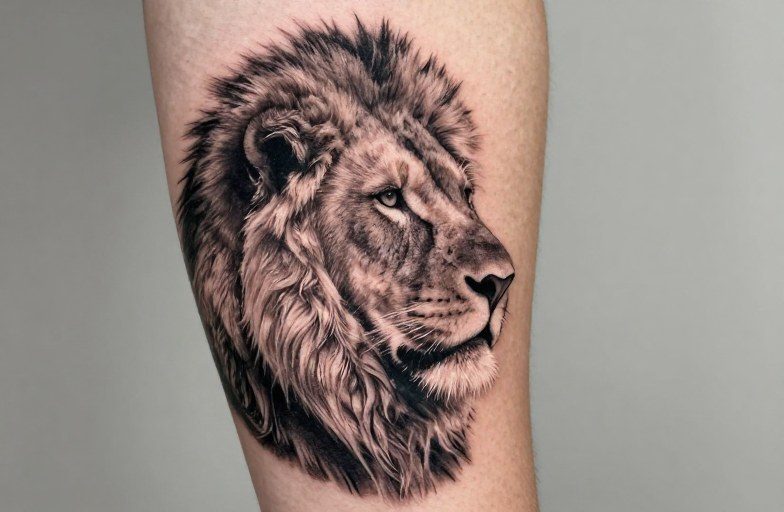
A lion profile tattoo shows the animal’s head from the side, mane flowing or cropped tight, face fixed in a steady gaze. The meaning centers on controlled strength, power held in reserve rather than displayed in full roar. This orientation also reads as watchfulness, a guardian stance that faces forward while the body remains unseen.
How It Ages on Skin
Line Work vs. Shading Longevity
Profile lion designs live or die by their outline. A clean, confident line tracing the forehead curve, nose bridge, and jaw holds up for years. Shading inside the mane and around the muzzle is where time does its work. Dense black fill in the mane tends to blur and soften after eight to twelve years, especially on high-movement areas. Whip-shaded or stippled manes age more gracefully than solid black saturation because the eye reads the texture even as individual dots spread slightly.
The eye is the detail most prone to disappearing. A tiny highlight dot placed too close to the pupil often falls out during healing or fades within two years. Smart design keeps the eye simple: a dark almond shape with minimal interior detail. The brow ridge and cheekbone shading, by contrast, usually stays readable because it sits in broader planes with less fine linework.
Placement Realities
- Outer forearm: Good visibility, moderate sun exposure. The flat plane suits the profile orientation naturally. Expect some fading on the sun-facing side if you skip sunscreen.
- Upper arm/shoulder cap: The curve can distort the jawline if the design isn’t adapted to the contour. A skilled artist will widen the cheek slightly so it doesn’t pinch inward when your arm hangs down.
- Ribcage: Soft tissue moves with breathing, which can blur fine details over time. Keep the mane looser here, less reliant on hair-by-hair precision.
- Calf: Stable skin, good for detailed work. The vertical profile reads well on the muscle’s natural shape. Sock friction on the lower edge is a real concern for healing.
- Side of neck: High visibility, high stakes. The profile orientation aligns with the neck’s length, but any blowout or uneven line lives front and center. Skin here is thin and heals unpredictably.
When the Profile Fails
Not every body area suits this orientation. The inner bicep, for instance, twists the profile into an awkward foreshortening when the arm rotates. Small areas below three inches wide lose the mane’s readable mass and become a dark blob. The profile also demands a minimum height to show the nose-to-mane depth; compress it too short and you get a generic cat, not a lion.
History and Cultural Roots
Ancient Near East and Egypt
Lions in profile appear on cylinder seals and palace reliefs from Mesopotamia, often linked to the third millennium BCE though exact dating of specific pieces remains debated among specialists. The orientation mattered: profile allowed simultaneous display of the mane’s volume, the open or closed mouth, and the forward-facing eye. Egyptian tomb paintings standardized the lion in strict side view, often linked to solar deities and the concept of divine kingship. These were not naturalistic wildlife studies but symbolic representations where every element carried specific weight.
European Heraldry
The medieval lion passant, three legs visible, one raised, head in profile, became one of the most common heraldic charges. The stance conveyed readiness without aggression, a defensive posture rather than attacking. This visual language filtered into decorative arts, woodcarvings, and eventually tattoo flash. The profile orientation persisted because it fit shields, banners, and later, rectangular tattoo designs more naturally than a frontal view.
Asian Traditions
Chinese guardian lions, or shishi, appear in pairs, one with a paw on a cub, one on a sphere. The profile orientation is standard, with the head turned slightly toward the viewer in a three-quarter view that is not quite the strict side view of Western heraldry. Japanese lion dogs, komainu, similarly use profile for the body with a frontal face, a hybrid approach that creates a different symbolic presence, more confrontational than the pure profile, more approachable than full frontal.
Symbolism and Core Meaning
Controlled Power
Frontal lion tattoos roar. Profile lions watch. The side view removes the open mouth from center stage and instead emphasizes the silhouette, the weight of the head, the mane’s mass, the set of the ears. This reads as potential energy rather than kinetic. People drawn to this orientation often identify with steadiness under pressure, the person who does not need to announce capability to possess it.
Guardianship and Territory
A profile lion faces a direction. In composition, this creates narrative tension: what is it watching? Paired profile lions facing each other frame a space between them, a common motif in architecture and now in chest pieces or symmetrical back designs. A single profile lion facing outward from the body suggests protection of what is behind it. The symbolism is spatial, dependent on how the design orients on your specific anatomy.
Pride and Identity
The mane itself carries weight. A full, rendered mane signals maturity and established status. A cropped or minimal mane reads younger, more streamlined, sometimes more aggressive. Female lions in profile are rarer in tattooing but carry their own register: hunting capability, social cohesion, absence of the performance that the male’s mane represents. Choosing which lion to depict is already a symbolic decision before any additional elements enter the design.
Common Variations and Styles
Neo-Traditional and American Traditional
Traditional lion profiles rely on bold black outlines, limited color palette, and stylized mane treatment that reads as flame or wave rather than realistic fur. The eye often gets a human-like expressiveness, heavy-lidded, almost brooding. Neo-traditional work keeps the graphic clarity but adds more dimensional shading, sometimes jewel tones in the mane or background florals that were not in the original vocabulary.
Black and Gray Realism
Photographic lion profiles demand technical precision in the transition from muzzle to mane. The challenge is maintaining the crisp edge where short facial hair meets longer mane hair without the whole thing turning to mud. Good realism here uses negative space strategically, highlights on the nose bridge, the cheek, the ear’s inner fur, to keep the form readable at smaller sizes. Bad realism overworks every strand and loses the animal in texture. On darker skin tones, the same principles apply but the value range shifts; what reads as subtle gray on light skin may need to stay lighter overall to prevent the mane from closing up into a dark mass.
Geometric and Dotwork
Breaking the profile into polygonal planes or constructing it from stippled gradients creates a different symbolic register. The lion becomes architectural, almost crystalline. This treatment works well for clients who want the symbolism without the literalism of a wildlife portrait. The mane especially lends itself to radiating geometric patterns that echo the natural growth direction while abstracting it.
Similar and Related Symbols
Tigers in profile share the same structural advantages but carry different cultural associations, more solitary, more ferocious, less regal. Wolves in profile suggest pack loyalty and wilderness rather than authority. Bears, especially in side view, read as grounded strength, more lumbering and less alert than the lion’s watchful pose.
Griffins and other composite creatures often borrow the lion’s hindquarters or mane in profile, combining the regal register with other symbolic functions. For a guardian function specifically, the lion profile pairs naturally with architectural elements, columns, keystones, shields, where the animal functions as a living bracket or support.
Mythology and Folklore
Nemean Lion and Labors
The Nemean lion of Greek myth was famously invulnerable to weapons, its hide eventually worn by Heracles as armor. Visual depictions from antiquity often show the lion in profile during the combat, the hero’s arm around its neck, the mouth open in the moment of struggle. The profile orientation allowed Greek vase painters to show both the lion’s size and the hero’s grip simultaneously. These images are artistic conventions, not documentary records. In tattooing, this narrative moment translates to struggle and triumph, though the profile alone without Heracles keeps the focus on the lion’s power rather than its defeat.
Judeo-Christian Symbolism
The lion of Judah, often linked to the tribe of Judah and later to Christ, appears in medieval art in profile within mandorlas or as a supporting figure in illuminated manuscripts. The stance is consistently passive, seated or standing, never attacking. This established a visual precedent for the profile lion as sacred guardian rather than wild threat, a precedent that still operates in contemporary religious tattooing.
What to Remember
A lion profile tattoo works because the orientation is inherently stable. It does not demand movement or drama to register as powerful. The meaning is in the restraint: the held breath, the fixed gaze, the weight of the mane suggesting capacity rather than action. This is a design that rewards patience in both creation and aging.
Choose your artist based on their line confidence and their willingness to adapt the design to your specific contour, not just their portfolio of impressive fresh pieces. Ask to see healed work, especially in the style you want. A profile lion that looks crisp at three months but loses its jawline definition by year five was poorly planned, not poorly executed.
Consider the direction your lion faces. Toward your heart or away from it, toward a partner piece or guarding a single space, the orientation carries meaning beyond the image itself. Do not default to facing outward because it is conventional. The profile gives you a vector, a line of attention. Use it deliberately.
Finally, respect the minimum size. A lion profile compressed below three inches wide sacrifices the mane’s volume and the facial structure’s readability. This is not a design that works as a tiny discreet mark. It needs room to breathe, to cast its shadow, to hold its watch. Give it that space, and it will hold its power for decades.
Frequently Asked Questions
How small can a lion profile tattoo be before it loses detail?
Three inches wide is the practical minimum for most placements. Below that, the mane becomes a dark blob and the facial structure loses definition. The eye, already the most vulnerable detail, simply disappears. If you need something smaller, consider a geometric or simplified version rather than attempting realism.
Does a lion profile tattoo work on dark skin?
Yes, but the value range needs adjustment. Black and gray realism on darker skin often requires lighter overall tones to prevent the mane from closing up into an unreadable mass. Talk with your artist about healed examples on skin tones similar to yours, not just fresh work.
Should the lion face toward or away from my body center?
This is personal and symbolic, not technical. Toward the center can read as introspection or self-protection. Away from center reads as guarding your external space. Paired pieces facing each other create a framed, architectural effect. Decide based on what relationship you want the lion to have to your body, not convention.
How do I keep the mane from blurring over time?
Avoid solid black saturation in large areas. Whip shading, stippling, or negative space techniques age more gracefully because the eye reads texture even as individual marks spread slightly. Sun protection on all exposed tattoo skin is not optional, it is maintenance.
Is a female lion in profile a different symbol entirely?
It carries a different register. Without the mane’s performance of status, the female lion emphasizes capability, social cohesion, and function over display. It is less common in tattooing, which makes it more distinctive if the symbolism fits your intent.

Leave a Reply