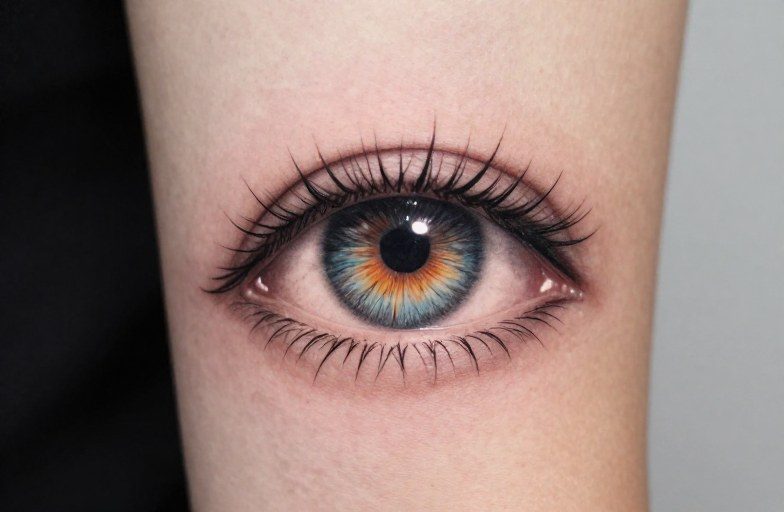
A dragon eye tattoo centers on one of mythology’s most loaded images: the unblinking gaze of a creature that sees through deception and guards what it claims. The meaning clusters around vigilance, fierce protection, and the kind of perception that cuts beneath surface appearances. Unlike a full dragon coiling across a back or thigh, the eye compresses all that symbolic weight into a single, staring focal point, intimate, confrontational, and impossible to ignore.
What the Symbol Actually Means
The dragon eye does not carry one fixed meaning. It gathers significance from centuries of stories, and those stories do not agree with one another. Your tattoo will mean what you and your artist build into it, but the raw material comes from a few recurring threads.
Protection and Boundary-Keeping
Across many cultures, the dragon eye watches thresholds. Temple carvings in East Asia and shrine paintings place dragon imagery at entry points, not as decoration but as functional warning. The tattoo borrows this architectural logic for skin: a permanent sentinel marking the wearer as someone who protects boundaries, whether family, creative work, or personal integrity. The spiritual angle here is not worship of dragons. It is the borrowing of their symbolic function as guardians of what lies inside.
Perception Beyond the Surface
Western esoteric traditions often link the dragon eye to hidden knowledge and the piercing of illusion. The reptilian slit pupil, vertical and alien, suggests inhuman perception, seeing frequencies or truths invisible to ordinary awareness. For those drawn to occult symbolism, this makes the dragon eye a natural companion to other second-sight imagery: the third eye, certain celestial motifs, or the moon in specific phases. The eye does not merely watch; it discerns.
Power Without Mercy
The dragon eye also carries aggression. This is not the benevolent gaze of a saint. It is predatory, territorial, ancient. Some wearers choose it to claim that hardness for themselves. Others choose it to acknowledge the hardness they have encountered. Either way, the symbol refuses to soften itself for comfortable viewing.
How It Relates to Other Symbols
The dragon eye does not exist in isolation. Understanding its neighbors helps clarify what you are actually asking for in a design consultation.
- The Evil Eye: Both stare outward defensively, but the evil eye absorbs and reflects malice back to its source. The dragon eye actively hunts threats. The evil eye is shield; the dragon eye is weapon.
- The All-Seeing Eye: Divine omniscience, usually benevolent or at least neutral. The dragon eye adds aggression, territoriality, something predatory in its watchfulness.
- Serpent and Basilisk Eyes: Close cousins, especially in Western tradition where dragons and serpents blur together. The basilisk eye kills; the dragon eye dominates and guards. Subtle but meaningful distinction for design choices.
- Cat Eyes: Shared vertical pupils, but cats carry stealth and nocturnal mystery where dragons bring overt power and ancient weight.
Mixing these symbols requires care. A dragon eye framed in geometric patterns reads differently than one emerging from scales or flame. Your artist needs to know which resonance you are chasing.
Where the Image Comes From
Pinning down a single origin proves impossible. Dragon imagery appears independently across cultures with no clear diffusion path. The eye as isolated symbol, however, has more traceable moments, though much of what follows is interpretation rather than documented fact.
East Asian Lineage
Chinese dragon art often emphasizes the eyes as the seat of the creature’s power and intention. A tradition, often linked to classical painting manuals, holds that artists completed the eyes last, as the moment the dragon awakens. Tattoo adaptations of this tradition sometimes isolate that awakening moment, the eye rendered as if just opening, still carrying sleep-murk or emerging light. Japanese traditions around ryū and tatsu imagery similarly treat the gaze as the dragon’s most spiritually charged feature, though this emphasis varies by region and period.
European Heraldic and Bestiary Sources
Medieval bestiaries described dragon eyes with obsessive specificity: burning, gem-like, hypnotic. Heraldic devices occasionally used stylized dragon eyes as protective badges or canting arms. The isolated eye in Western tattoo culture likely draws more from this descriptive tradition than from any actual historical practice of eye-only depiction, but the symbolic DNA is genuinely old. How much direct influence reaches modern tattooing is uncertain; the chain of transmission is mostly speculative.
Color Versus Black and Grey
This choice fundamentally changes what the tattoo communicates and how it holds up over decades.
Color dragon eyes, amber, green, gold, or bioluminescent blue, use the immediate shock of non-human color. The iris becomes the whole point, and good saturation makes the eye appear to glow against skin. Red around the sclera adds aggression; gold adds ancient, hoarding associations. Color demands more skin real estate to read properly. A tiny color eye turns muddy fast, and touch-ups are more complex when multiple hues are involved.
Black and grey shifts emphasis to texture and form. Scales, wrinkles, the wet gleam of a living orb, all rendered through value contrast rather than hue. This approach ages more gracefully, especially on smaller scales or areas with more sun exposure. The trade-off is some symbolic specificity: a black and grey eye reads as dragon generically where color might whisper green Chinese water dragon or gold European hoard-guardian.
One practical note: the sclera, the white of the eye, in black and grey work typically uses negative space or very light grey wash. This is the first area to blur or discolor as the tattoo ages, since pale grey has less pigment density to maintain its value against surrounding darker tones. Your artist should plan for this, not pretend otherwise.
How It Ages on Skin
Dragon eye tattoos face specific aging challenges that general tattoo-fade advice does not address.
The vertical slit pupil is your anchor. Thin as it starts, that dark line needs to remain crisp or the whole eye loses its alien specificity, becoming generic reptile or, worse, unrecognizable blob. Experienced artists compensate by making the pupil slightly darker and wider than anatomically correct, anticipating the inevitable spread.
Iris detail, radiating lines, color segments, subtle gradients, degrades fastest. What reads as intricate patterning at six months becomes soft texture at five years. The best long-term results either simplify iris structure to bold, readable shapes or accept that fine detail will mellow into atmosphere.
Placement matters enormously. The eye’s round form works beautifully on convex surfaces: shoulder cap, outer thigh, calf, where the curve of the body echoes the orb shape. Flat planes like the inner forearm or sternum flatten the dimensional illusion. Areas with frequent stretching or clothing friction, wrists, ribs immediately below the bra line, accelerate the softening of those crucial fine lines.
Scale work surrounding the eye often ages better than the eye itself, which is worth considering for touch-up strategy. The eye may need refreshing while peripheral scales hold steady. Plan for this maintenance, not just the initial session.
Finding the Right Artist
This subject separates competent tattooers from those who truly understand it. The dragon eye is not a generic image you can hand to any professional with a portfolio of animals.
Look for artists who have done multiple dragon or reptile eyes, not one or two. Ask to see healed photos, not just fresh work. The fresh tattoo is a lie; the healed tattoo is the truth. Pay attention to how the pupil held, whether the iris still reads as layered or has flattened to a single tone, whether the sclera stayed clean or greyed out.
Ask specifically about their approach to the slit pupil. If they have not thought about compensating for spread, they have not thought enough about this image. Ask about their plan for the sclera in black and grey work. If they say “skin tone” without discussing your actual undertone and how it will shift with sun, they are winging it.
Budget for the time this takes. A small, simple dragon eye might run two to three hours. A large, detailed piece with surrounding scales and environmental elements could require multiple sessions. Rushing this image destroys it. The eye’s power comes from precision, and precision takes time.
What to Remember
A dragon eye tattoo works when the technical execution matches the symbolic ambition. The eye’s power comes from precision: the slit pupil that reads instantly as non-human, the scale texture that proves this is not any ordinary creature, the color or value choices that direct emotional temperature from protective to predatory to transcendent.
Go small and you sacrifice the detail that makes it specifically dragon, not generic reptile. Go large and you need the skin real estate, the budget, and the patience for multiple sessions. Go cheap and you get an eye that blurs into something unreadable, the pupil spreading, the iris flattening, the whole symbol collapsing into expensive regret.
The symbol carries genuine weight, but that weight is yours to direct. Guardian or predator, cosmic observer or territorial watcher, the dragon eye will hold whatever meaning you build into it, provided you build it with care, with the right artist, and with honest attention to how it will live on your skin for the decades to come.
Frequently Asked Questions
How painful is a dragon eye tattoo compared to other designs?
Pain depends entirely on placement, not the image itself. A dragon eye on the shoulder cap or outer thigh is moderate. The same design on ribs, sternum, or inner wrist intensifies significantly. The eye itself does not require more needle passes than other detailed work, but surrounding scales or environmental elements add time, which adds cumulative discomfort.
Can a dragon eye tattoo be covered up later if I change my mind?
Cover-ups are possible but challenging. Dark, saturated dragon eyes with heavy black pupils limit your options. The eye’s round shape and strong focal point also resist easy integration into other designs. If you have any doubt about long-term commitment, consider placement on an area that allows for future expansion or modification, and avoid the most aggressive black saturation.
What is the best size for a dragon eye tattoo?
Minimum four to five centimeters in diameter for the eye itself, smaller and the pupil becomes a dot that spreads into nothing, the iris loses any readable structure. Larger is generally better for longevity, provided you have the placement and budget. Many strong examples range from fist-sized to full upper arm pieces where the eye anchors a larger composition.
How do I describe what I want to an artist who has never done a dragon eye?
Bring reference images of the specific emotional tone you want, not just dragon eyes. A protective guardian eye looks different from a predatory hunter eye. Note the pupil shape, iris complexity, surrounding elements. Ask if they have done detailed reptile or creature eyes of any kind. Their experience with snake tattoos, dinosaur eyes, or similar subjects transfers more than you might expect.
Does the direction the eye faces matter symbolically?
Forward-facing eyes confront the viewer directly, claiming territory, challenging observation. Eyes in profile suggest watchfulness in a specific direction, guarding what lies ahead. Some wearers choose eyes that appear to look slightly upward, suggesting transcendence or cosmic awareness. The choice is personal, but it is worth making deliberately rather than defaulting to whatever the reference image showed.


Leave a Reply