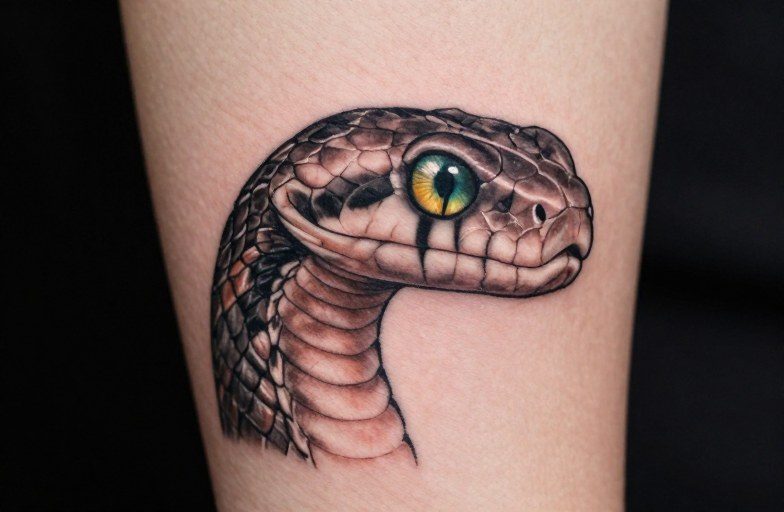
Snake eyes tattoo meaning starts with a simple image: two dice showing single dots, the lowest throw in craps, the roll gamblers dread. But that same symbol of bad luck has become something people choose to wear permanently, often for reasons that have nothing to do with casino floors. The design usually pairs those two dotted cubes with a serpent coiled nearby, wrapping gambling folklore together with older snake mythology. What you get is a tattoo about chance, failure, and the change that comes after both.
What the Symbol Actually Means
The Gambling Root
The phrase itself comes from craps tables. When both dice land with one pip up, the result looks like a pair of cold, staring eyes, reptilian, unblinking. Gamblers call it a loss. For tattoo collectors, that losing roll becomes personal in several ways. Some wear it as honest record of a life spent taking risks, financial, emotional, physical. Others use it as self-warning, a visible reminder of how gambling or impulsive behavior cost them. And some invert the meaning entirely: the worst roll is the moment right before the comeback, the bottom that makes the rebound possible.
The gambling connection does not mean every wearer gambles. The symbol has traveled far from its origin. What remains is the emotional shape of the thing: sudden downturn, unexpected loss, the moment fortune turns without asking permission.
Snake as Transformer
Snakes shed their skin. Dice determine outcomes no one controls. Combined, they suggest change forced by chance, the person you become after luck knocks you down. The snake element, often linked to rebirth across cultures, adds weight. Someone might choose this design after recovery, after leaving a career or relationship, after any life pivot where they did not choose the disruption but had to become someone new because of it. The dice say: I did not control what happened. The snake says: I changed anyway.
Why People Choose This Design Today
Modern meanings have multiplied. The tattoo works as shorthand for survival, for comfort with uncertainty, even for dark humor against forced positivity. Here are the most common current readings:
- Resilience badge: Wearing your worst roll openly, refusing to hide past failure
- Calculated risk: Entrepreneurs, traders, competitors sometimes use it to signal they accept uncertainty as part of their work
- Rebellion against optimism: A counter to relentless positivity culture, acknowledging that luck sometimes fails
- Partnership symbol: Two matching dice can represent two people who found each other against improbable odds
Social media has pushed the design toward stylized, almost abstract versions. Dice become geometric shapes. Snakes reduce to single continuous lines. These stripped-down forms carry less literal gambling weight and more personal ambiguity, which suits people who want the symbol without the casino association.
Spiritual and Religious Readings
Christian and Western Tension
Snakes carry heavy biblical load: temptation, the fall, deception. Dice, as tools of chance, have sometimes been viewed as challenging divine providence. Pairing the two creates tension that some Christian collectors deliberately avoid. Others lean in, using the design to acknowledge human fallibility: the snake as flawed nature, the dice as the randomness of grace or consequence. Augustine wrote against gambling as sinful distraction in his Confessions, and that echo still resonates in some devout communities, making this tattoo potentially provocative depending on your circle.
Eastern and Indigenous Threads
In Hindu tradition, snakes connect to kundalini energy coiled at the spine’s base. Dice appear in the Mahabharata as instruments with cosmic stakes, games that shaped kingdoms and fates. Some trace symbolic resonance to these roots, though direct historical evidence for “snake eyes” as a unified symbol in Eastern practice is thin. In Mesoamerican cultures, serpents and ritual games both carried cosmic significance; modern Chicano tattooing sometimes blends these elements with dice and cards in larger narrative pieces. The spiritual reading here tends toward balance, order and chaos held together.
Choosing Color or Black and Grey
What Ages Better
Black and grey snake eyes tattoos typically age more gracefully than color versions. Dice dots are tiny; in bright reds or whites, they tend to blur or fall out over time. Solid black pips on neutral dice remain readable from across a room even a decade later. If you want color, the safest approach is limited: a green snake body, perhaps, with the dice themselves staying neutral. Yellows and light oranges fade fastest, especially on sun-exposed placements like forearms or hands.
Mood and Social Signal
Color versions read more playful, more neon, more weekend energy. Black and grey read harder, closer to street or prison tattoo origins. That aesthetic association matters for placement decisions. A colorful snake eyes on the forearm suggests casual risk, party context. The same design in black and grey on the neck or hand carries different social weight: more committed, more edge, less easy to explain away. These are different dialects of the same visual language. Neither is superior; they speak to different audiences.
Where to Place It
Flat Surfaces Work Best
Snake eyes designs need enough flat surface to show the dice clearly. The face of each die should be readable at a glance, which rules out spots that curve too aggressively or move too much.
- Forearm: Ideal. Flat plane, visible to you, easy to show or cover. Outer forearm gets more sun and fades faster; inner forearm stays protected but may warp slightly with wrist movement
- Chest or upper pectoral: Classic for gambling-themed work. Proximity to the heart adds metaphorical weight, risk worn close to what matters
- Thigh: Large canvas allows detailed scales and realistic dice shading. Less visible for professional settings, which some prefer
High-Commitment Spots
Hand, finger, and neck placements demand more consideration. Dice on knuckles or the back of the hand read immediately but limit future employment options. The small surface forces simplification, often just the two pips without the snake. Neck placement is bold, impossible to hide. The design works best when the snake body wraps toward the collarbone or jaw, using the neck’s natural cylinder shape rather than fighting it.
Behind the ear or on the ribs can work for minimalist versions, but detailed dice with serpent coils usually need more room than these spots comfortably provide.
Style Options and Longevity
Traditional American
Bold black outlines, limited palette of red, green, yellow, and black, stylized snake with diamond patterns. Dice often appear slightly exploded or in motion, capturing the moment of the unlucky roll. Heavy line weight and saturated pigment help this style age well. Sailor Jerry-influenced versions sometimes add banners with text, names, or short phrases.
Realism and Neo-Traditional
Photographic dice with correct translucency, scale-by-scale snake detail, dramatic lighting. These pieces demand larger size and skilled execution. The risk is overworking the design; too much detail in too small a space turns muddy within five years. Neo-traditional offers a middle path, realistic forms with traditional boldness, jewel-toned color, decorative elements like flowers or daggers framing the central image.
Minimalist and Single-Needle
Thin lines, no shading, extreme simplicity. Two circles with dots, a single curved line suggesting snake body. These suit small placements: wrist, ankle, behind the ear. The tradeoff is longevity. Fine lines spread and soften faster than bold traditional work. Touch-ups every few years become part of the commitment, not an exception.
What to Remember
Snake eyes tattoo meaning ultimately bends to whoever wears it, but the core symbols stay stable: chance, risk, transformation, and the moment when luck turns without warning. The design works across styles from bold traditional to whisper-thin minimalist, though black and grey execution offers the clearest long-term readability. Placement should respect the need for flat surface and legible dice faces; forearm, chest, and thigh lead the practical choices. Religious or spiritual readings add depth for some collectors, while others keep the meaning purely personal and secular.
If you are considering this design, the useful question is which snake you are invoking. The gambler’s bad break? The shedding of old skin? The cosmic roll of whatever comes next? The tattoo will answer differently over the years you wear it. That mutability is part of its point.
Frequently Asked Questions
Does a snake eyes tattoo always mean someone gambles?
Not at all. While the phrase originates in craps, many people choose it for broader symbolism: risk, bad luck overcome, or transformation. The gambling connection is just one layer among several.
How small can a snake eyes tattoo be before it becomes unreadable?
Dice faces need enough space for the pips to stay distinct as ink spreads slightly over time. Each die should generally be no smaller than a quarter for long-term clarity. Minimalist single-needle versions can go smaller but will require touch-ups to maintain readability.
What is the best style for longevity?
Bold traditional American with heavy black outlines and limited color typically ages best. Black and grey realism also holds up well. Fine-line minimalist work requires more frequent maintenance.
Does the snake have to wrap around the dice?
No. Some designs show the snake nearby, coiled above or below, or use only the dice with a small serpent element. The composition depends on your artist’s design and the placement you choose.
Is this tattoo associated with any particular group or subculture?
The design has roots in gambling and street tattooing, but it has broadened significantly. Today you will see it across demographics, from finance professionals to musicians to people with no particular subculture affiliation.
Leave a Reply