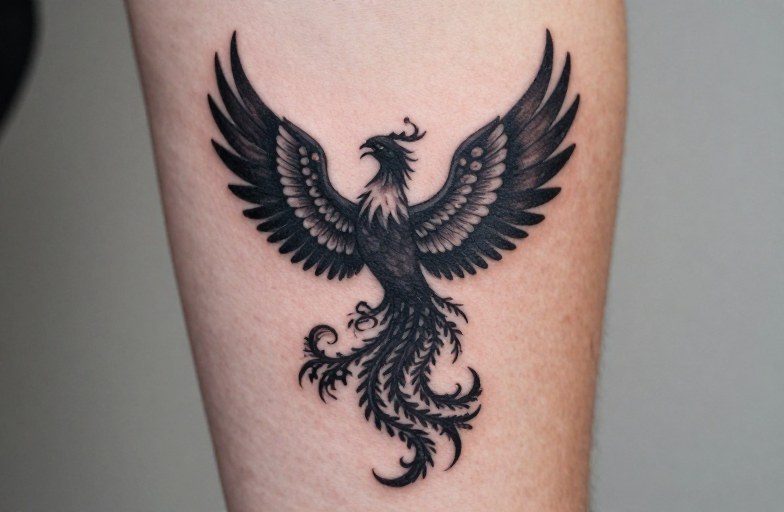
A phoenix silhouette tattoo strips the mythical bird to its essential outline, trading feathered detail for pure form. The meaning centers on rebirth, resilience, and transformation, but the silhouette treatment adds something distinct: the bird becomes shadow, memory, or emerging presence rather than fully realized creature. You’re choosing to show the phoenix as impression or aftermath, which shifts how the symbolism lands.
Mythology & Folklore
The phoenix spans Greek, Egyptian, Persian, and Chinese traditions with surprising consistency. Most versions describe a bird that dies in flame and returns renewed. The silhouette form, however, rarely appeared in ancient art; classical depictions favored full plumage and color. The modern silhouette treatment borrows from 19th-century mourning imagery and early photography, where shadow and outline carried weight absent detail.
From Full Color to Stark Outline
Traditional phoenix illustrations emphasized the cycle’s drama, flames, ashes, the full bird in glorious color. The silhouette compresses this narrative into a single frozen moment. You’re not watching the rebirth unfold; you’re seeing its result, or its ghost. This compression suits the tattoo format, where a single static image must carry temporal meaning.
Regional Variations in the Myth
The Chinese fenghuang often paired with dragon and symbolized virtue and prosperity, not strictly rebirth. The Egyptian bennu, commonly linked to the phoenix concept, connected to solar cycles and creation. The Greek phoenix emphasized individual renewal. A silhouette can gesture toward any of these threads without committing to one, letting the form’s ambiguity do interpretive work.
Religious & Spiritual Angles
Christian tradition adopted the phoenix as resurrection symbol as early as the first century CE, with Clement of Rome and Tertullian both referencing it. The silhouette form strips away the ornamental associations that accumulated over centuries, returning to something closer to early Christian usage: simple, stark, focused on death-to-life transition rather than decorative beauty.
Secular Spirituality
Outside organized religion, the silhouette resonates with concepts of ego death, shadow integration, and personal metamorphosis. The Jungian shadow, unacknowledged aspects of self, finds literal form here. You’re not illuminating every feather; you’re acknowledging the whole shape without demanding full visibility. This makes the design particularly suited to marking periods of significant internal change rather than external achievement.
How It Ages on Skin
Silhouette tattoos age differently than their detailed counterparts, and phoenix silhouettes present specific challenges. Solid black fill stays readable longer than fine linework, but large black areas can blur at edges over a decade. The phoenix’s spreading wings and tail feathers create thin projections that soften over time.
Placement Considerations
- Upper back/shoulder blade: flat surface preserves wing symmetry; less sun exposure than forearm
- Outer upper arm: good visibility, moderate sun exposure, muscle movement adds subtle dynamism
- Ribcage: high pain area, but the curved canvas can emphasize the bird’s arc; prone to stretching with weight fluctuation
- Thigh: large canvas allows bigger silhouette, but friction from clothing affects healing
- Behind ear or wrist: trendy placements that force extreme simplification; lose recognizable phoenix form at small scale
Line Weight and Negative Space
Crisp silhouette edges require confident, consistent line weight. Too thin, and the outline disappears into skin texture within years. Too thick, and the form becomes blob-like. The best approach uses slightly heavier outline than you’d expect, with interior negative space, cutouts for eye, flame accents, or feather texture, to prevent the solid black from reading as arbitrary shape rather than intentional form.
White ink highlights, once popular, rarely age well; they yellow or disappear entirely. If you want flame or ash detail, consider skin-tone negative space rather than white ink.
Design Tips & Pairings
The silhouette’s simplicity makes it a versatile anchor, but that same simplicity demands thoughtful companions. Random additional elements dilute the form’s power; each pairing should sharpen rather than decorate.
Effective Combinations
- Single flame or ember below the bird: reinforces the rebirth narrative without cluttering
- Circular or oval frame: contains the spreading wings, creates medallion or cameo effect
- Script or lettering integrated into negative space: requires skilled design to maintain legibility
- Geometric elements (triangles, broken lines) intersecting the form: modern contrast to organic shape
- Moon phases above or below: temporal cycle echoing the phoenix’s own
Styles That Work
Traditional American framing with bold black silhouette center creates striking hybrid. Dotwork or stipple shading at edges softens the silhouette into atmosphere. Minimalist single-line versions sacrifice recognizability for elegance. The double-exposure approach, forest, cityscape, or flame visible within the bird’s outline, trended heavily in the 2010s and now reads dated; proceed with caution if longevity matters.
Personal & Modern Meanings
Contemporary wearers gravitate toward the phoenix silhouette for specific life transitions: recovery from addiction, surviving illness, ending marriages, emerging from depression, career reinvention. The silhouette’s darkness suits these contexts better than a brightly colored, triumphal bird would. You’re not claiming victory; you’re acknowledging passage through something.
Gendered Readings and Rejections
The phoenix carries no inherent gender, though tattoo culture has historically gendered it female through association with fire and rebirth metaphors. The silhouette’s starkness resists this coding more effectively than ornate, colorful versions. Its appeal spans presentation styles, and the form reads equally as masculine, feminine, or deliberately neutral depending on accompanying elements and placement.
Similar & Related Symbols
Understanding adjacent symbols helps clarify what the phoenix silhouette specifically offers.
- Ouroboros (snake consuming its tail): cyclical return, but without the death-to-life progression; more static
- Lotus: emergence from murk into beauty, but without fire or destruction component
- Butterfly: transformation, but culturally coded as gentler, less violent change
- Rising sun: new beginnings, but lacks the self-originating, self-destroying agency
- Fire itself: destruction and purification, but no embodied form, no return
The phoenix silhouette occupies unique territory: it implies violence survived, not merely change undergone. The shadow form specifically suggests something that persists despite being stripped to essence.
Key Takeaways
The phoenix silhouette tattoo compresses extensive mythology into a single stark form. Its power lies in what it withholds, color, detail, explicit narrative, forcing the symbol to operate through shape and negative space alone. For longevity, prioritize bold consistent outlines, strategic negative space, and placements that minimize sun exposure and stretching. For meaning, recognize that the silhouette treatment shifts the emphasis from glorious rebirth to survived transformation, from display to testament. The design works best when the darkness in the form genuinely corresponds to darkness in the experience it commemorates, rather than serving as aesthetic preference alone.
Frequently Asked Questions
Does a phoenix silhouette tattoo work in color, or must it stay black?
Pure silhouette by definition uses single tone, but you can create ‘silhouette effect’ with deep purple, navy, or dark red rather than black. The key is uniform darkness without internal shading variation. Once you add gradient or multiple hues, you’ve left silhouette territory for illustrated style.
How big should a phoenix silhouette be to stay recognizable?
At minimum, palm-sized for basic wing and tail distinction. Smaller than three inches across, the projecting elements, head crest, tail feathers, wing tips, blur together into unidentifiable shape. Simpler geometric phoenix variants can go smaller, but sacrifice the recognizable mythological form.
What’s the difference between a phoenix and an eagle silhouette?
The phoenix typically shows longer, more flowing tail feathers and often a crest or head flourish. Eagles hold more compact, horizontal posture with broader chest. In pure silhouette, these distinctions become subtle; the phoenix usually arcs more dramatically, with upward-sweeping wings suggesting ascent rather than eagle’s perched or hunting stance.
Can a phoenix silhouette face downward or must it rise?
Downward-facing phoenix silhouettes exist but read as falling or defeated rather than ascending. The rising orientation is so culturally embedded that deviation requires explicit contextual support, flames below, broken chains, upward-pointing arrows, to avoid misreading. Most artists recommend maintaining the upward arc unless you specifically want the fallen-then-rising narrative sequence.
Related Tattoo Meanings
One response to “Phoenix Silhouette Tattoo Meaning: Rising from Shadow”
[…] Phoenix Silhouette Tattoo Meaning: Rising from Shadow […]


Leave a Reply