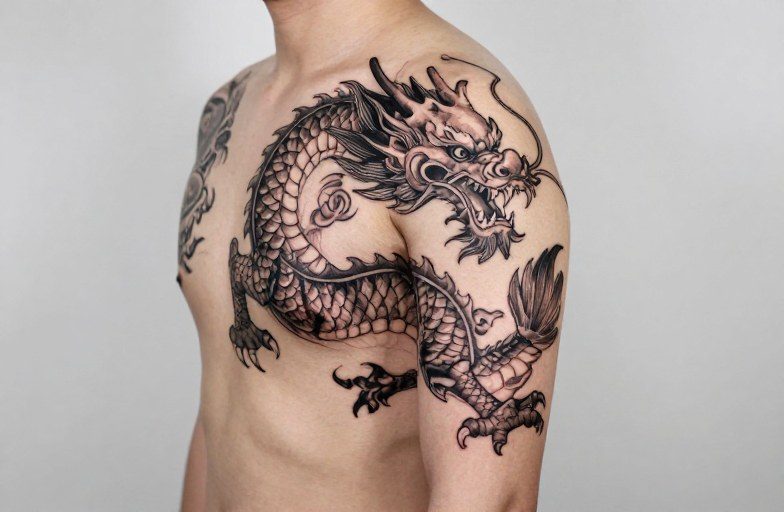
A Chinese dragon tattoo primarily signals power tempered by benevolence, unlike Western dragons, the Chinese lung is a guardian figure associated with rainfall, rivers, and imperial authority. The meaning shifts with specific design choices: a dragon clutching a pearl suggests the pursuit of wisdom or immortality; one emerging from clouds emphasizes transformation and transcendence. Most people drawn to this imagery want externalized strength without aggression, or a connection to cultural heritage.
History & Cultural Roots
The dragon’s status in China evolved over millennia from regional totem to exclusive imperial symbol. During the Han dynasty, dragon imagery appeared on bronze vessels and jade burial objects. By the Tang and Song periods, five-clawed dragons became restricted to emperor use, four claws for nobility, three for common officials. This hierarchy still matters in tattoo design today.
Imperial vs Folk Depictions
Imperial dragons face forward, claws extended, often surrounded by flames or clouds. Folk dragons coil dynamically, sometimes playful, integrated with waves or lotus. Tattoo collectors choosing between these modes signal different relationships to authority: reverence, subversion, or personal identification with the dragon’s protective role rather than its domination.
Regional Variation
Northern Chinese dragon depictions tend toward heavier bodies, more angular horns, and thundercloud associations. Southern traditions, particularly Fujian and Guangdong, produce slimmer, more serpentine forms with pronounced whiskers and pearl motifs. These regional styles migrated with diaspora communities and now appear in tattoo shops from Vancouver to Sydney.
Color vs Black and Grey
Color choice fundamentally alters how a Chinese dragon tattoo reads on skin and how it ages. This isn’t merely aesthetic preference, it affects the symbolic weight and the practical lifespan of the piece.
Traditional Color Symbolism
- Gold/Yellow: Imperial authority, the sun, supreme power. Use sparingly; large yellow fields look muddy as they fade.
- Red: Luck, celebration, active yang energy. Holds saturation well but requires periodic refresh.
- Blue/Green: Eastern direction, spring, vegetation. Often appears on dragon scales or water elements.
- Black: Water element, depth, mystery. The most common choice for full dragon pieces.
Black and Grey Longevity
Black and grey Chinese dragon tattoos age more gracefully than color equivalents. The intricate linework of scales, whiskers, and cloud patterns stays readable longer without color bleeding between adjacent areas. For large back pieces or sleeves where the dragon weaves through negative space, black and grey allows the skin itself to function as “sky” or “water.”
That said, a properly executed color dragon with saturated reds and limited gold accents can remain striking for decades if protected from sun exposure. The trade-off: color demands more committed aftercare and touch-up scheduling.
Mythology & Folklore
Chinese dragon mythology offers specific narrative anchors for tattoo design. The dragon gate legend, where carp transform into dragons by swimming upstream, provides a framework for pieces incorporating fish or water ladders. The four dragon kings who govern seas and rainfall appear in compositions with explicit water imagery, often suitable for placements that follow the body’s natural flow (down the arm, across the ribs).
The Pearl and Its Meanings
The flaming pearl, or zhu, nearly always appears near the dragon’s head or claws. Often linked to the moon, to wisdom, or to the elixir of immortality, this element transforms a decorative dragon into a narrative piece. Placement matters: a dragon pursuing the pearl suggests striving; one holding it suggests attainment. Some designs place the pearl at the center of a spiral body, creating visual focus and symbolic enclosure.
Dragon and Phoenix Pairing
The dragon-phoenix (longfeng) combination traditionally represents marital harmony and cosmic balance, dragon as yang, phoenix as yin. Solo collectors sometimes choose this pairing to symbolize internal balance rather than partnership. The phoenix’s flames and the dragon’s water create natural color and compositional tension that skilled artists exploit for movement.
Similar & Related Symbols
Chinese dragon tattoos rarely appear in isolation. Understanding adjacent symbols helps avoid unintentional combinations or missed opportunities for coherent design.
- Tiger: The dragon-tiger pairing represents the tension between spiritual aspiration (dragon, heaven) and earthly power (tiger, matter). Popular for chest pieces or split compositions.
- Koi: Directly references the dragon gate transformation narrative. Effective in transitional areas like elbow ditch or knee.
- Clouds and wind: Not mere background, these elements indicate the dragon’s movement between realms. Sparse clouds suggest emergence; dense coverage suggests concealment or protection.
- Mountains: Ground the dragon geographically, often referencing specific sacred peaks like Tai Shan or Kunlun.
Japanese dragon imagery (ryū) overlaps significantly but differs in claw structure, horn curvature, and typical association with Buddhist rather than Daoist cosmology. Mixing traditions without intention reads as sloppy rather than eclectic.
Symbolism & Core Meaning
Beyond cultural specificity, Chinese dragon tattoos carry several universal symbolic threads that explain their persistent popularity across ethnic backgrounds.
Transformation and Ascent
The dragon’s association with spring thunderstorms and rising water makes it inherently about change and upward movement. This resonates with people marking career transitions, recovery periods, or geographic relocation. The coiled body, never fully extended in traditional depiction, suggests potential energy, readiness, rather than completed action.
Protection Without Domination
Unlike Western dragons guarding hoards through violence, the Chinese lung protects through presence and beneficence. This distinction matters for people who want to project strength without intimidation. A dragon wrapped around a shoulder or extending down a forearm functions as guardian imagery without the aggression of, say, a snarling predator.
Who Chooses This Tattoo
The demographic for Chinese dragon tattoos is broader than stereotype suggests, though certain patterns hold.
Heritage and Reclamation
Second- and third-generation Chinese diaspora members sometimes choose this imagery to reconnect with ancestral culture, particularly if family dragon references were suppressed during assimilation periods. The tattoo becomes a visible, permanent claim rather than a costume.
Non-Asian Collectors and Considerations
Non-Asian people drawn to Chinese dragon imagery should engage seriously with the symbol’s cultural weight. The dragon is not generic “exotic” decoration, it’s a living cultural signifier. Working with artists who understand the iconography, avoiding sacred combinations (like imperial five-clawed dragons without context), and being prepared to explain the choice beyond “it looks cool” separates respectful adoption from appropriation.
Placement patterns differ by intent: heritage pieces often favor the back or upper arm where they can be revealed or concealed; purely aesthetic choices trend toward more visible forearm or calf placements.
The Takeaway
A Chinese dragon tattoo succeeds when the collector understands what specific dragon they’re wearing, imperial or folk, pursuing or holding, water-associated or sky-bound. The meaning isn’t inherent in the generic form but in the particular combination of claws, pearl, color, and companion symbols. Work with artists who can render scale patterns correctly, who know the difference between horn types, and who won’t default to a Japanese dragon template with Chinese label attached. The dragon’s power in tattoo form comes from precision, not vague exoticism.
Frequently Asked Questions
How many claws should a Chinese dragon tattoo have?
Three, four, or five claws are all historically valid, but five-clawed dragons were restricted to imperial use in Qing dynasty China. Many heritage collectors prefer four claws to avoid claiming imperial status. Discuss the specific cultural period you’re referencing with your artist.
Can a Chinese dragon face downward in a tattoo?
Downward-facing dragons appear in some folk traditions, particularly water-associated depictions, but the most common tattoo composition shows ascent or horizontal movement. Downward-facing dragons can read as decline or defeat unless carefully contextualized with water or cloud elements.
What’s the best placement for a Chinese dragon sleeve?
The dragon’s body follows the arm’s musculature naturally, with the head typically at the shoulder or upper arm and the tail wrapping toward the wrist. This allows the coiled body to utilize the bicep and forearm curves. Reversing this flow can work but requires more design adjustment.
How do I keep the fine details from blurring over time?
Scale linework and whisker details need adequate spacing, crowded lines blur together as skin ages. Choose slightly larger scale than minimum viable size, prioritize black ink for structural elements, and commit to sun protection. Touch-ups every 5-8 years maintain readability.
Leave a Reply