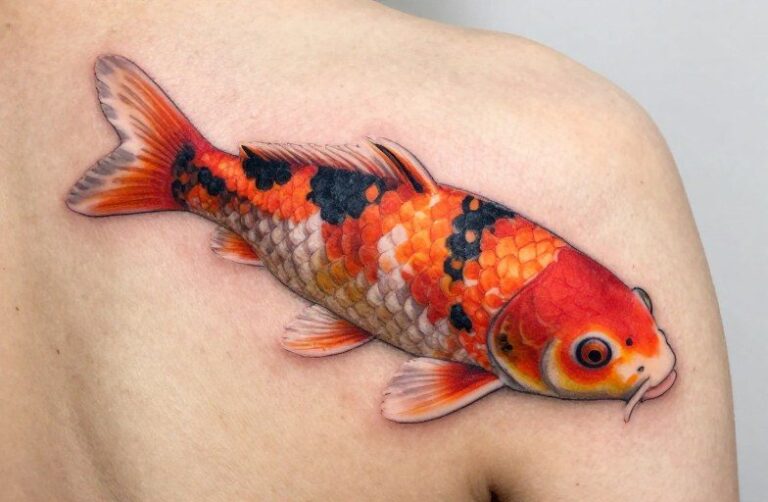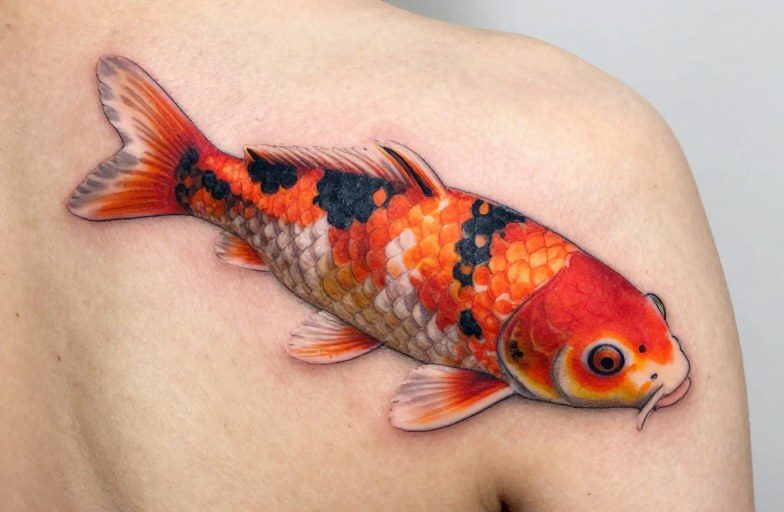
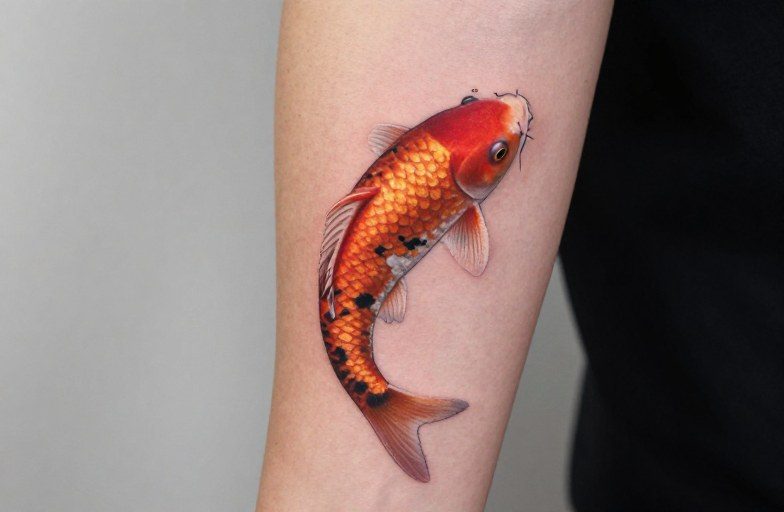
A koi carp tattoo primarily means perseverance through hardship and the determination to overcome obstacles. The image draws from a legend, found in both Chinese and Japanese sources, of carp swimming upstream and transforming into dragons. This serves as an allegory for personal struggle and eventual triumph. Today, people choose this motif to mark survived difficulties, ambitious goals, or simply an attraction to its visual power and cultural resonance.
Religious and Spiritual Angles
Buddhist and Shinto Connections
In Buddhist tradition, the koi’s upstream journey mirrors the spiritual path toward enlightenment: effort against the current of worldly desire and suffering. Temples in Japan and China have long kept koi ponds as living symbols of this progression. The fish’s ability to remain calm near the water’s surface while powerful currents move beneath also resonates with meditation practices. Stillness amid motion.
Shinto, Japan’s indigenous spirituality, associates water and its creatures with purification. Koi specifically connect to the deity Ebisu, one of the Seven Gods of Fortune, who brings prosperity to fishermen and merchants. A koi tattoo can carry this blessing-seeking intention, particularly when rendered with traditional color symbolism. Gold often stands for wealth, red for familial love and strength.
Yin-Yang and Balance
Chinese philosophy often pairs koi with the yin-yang symbol, one fish black and one white, circling each other. This represents harmony between opposing forces: light and dark, masculine and feminine, motion and rest. The circular composition works exceptionally well on rounded body parts like shoulders, chest plates, or the outer thigh, where the curve of muscle follows the form naturally.
Personal and Modern Meanings
Recovery and Resilience
The most common contemporary reason for choosing koi imagery is marking a period of sustained effort against difficult odds. Cancer survivors, people who have rebuilt lives after addiction, veterans, anyone who has clawed through a prolonged struggle. The koi offers a dignified, culturally established symbol that says you kept moving without requiring explanation. The upstream direction matters here. A koi facing downward or passive reads as decorative rather than narrative.
Ambition and Career Markers
Business owners and professionals sometimes select koi to represent their climb through competitive environments. The dragon-gate transformation specifically, the moment of becoming, appeals to those who have crossed a threshold: first major revenue milestone, partnership, published book. These pieces often incorporate the dragon partially formed, scales emerging from the koi’s body, placed on the back or upper arm where the metamorphosis unfolds across significant canvas.
- Single koi facing upward: personal struggle, solitary determination
- Pair of koi: romantic partnership, parental bond, or duality within oneself
- Koi with lotus: purity emerging from muddy difficulty
- Koi with cherry blossoms: beauty’s fleeting nature, living fully despite impermanence
- Koi becoming dragon: transformation achieved, or in progress
Common Variations and Styles
Traditional Japanese (Irezumi)
Classic irezumi koi feature bold black outlines, flat color fields, and specific directional flow following the body’s musculature. The scales get individually rendered, each a small technical challenge. Traditional color rules apply. Kohaku, white with red patches, often carries associations with love and career success. Showa, black with red and white, connects to overcoming adversity. Ogon, metallic gold, relates to wealth attraction. These pieces demand large scale. Half sleeve minimum, full back or body suit for proper narrative development with water, flowers, and wind bars.
Contemporary Adaptations
Modern interpretations loosen the rules considerably. Watercolor-style koi abandon black outlines for color bleeding and splatter effects, though this sacrifices longevity. Those soft edges blur faster than crisp lines. Single-needle blackwork koi reduce the image to essential form, often swimming in negative space rather than rendered water. Neo-traditional approaches keep the recognizable koi shape but introduce non-canonical color palettes: purples, teals, sunset gradients that no living fish ever displayed.
Placement considerations vary dramatically by style. Traditional Japanese koi need space to breathe. Compressing one into a 4-inch ankle spot wastes the compositional potential. Watercolor and minimalist versions adapt better to smaller areas: wrists, behind ears, ribcage edges, though visibility of fine detail remains limited long-term.
How It Ages on Skin
Scale Pattern Challenges
Koi tattoos present specific aging challenges worth understanding before committing. The scale pattern, rendered in fine lines and color dots, tends to blur and merge over 5-10 years as skin naturally thickens and ink particles migrate. What reads as distinct individual scales in fresh work becomes a textured orange or gold field. Black outlines hold definition far longer. This is why traditional Japanese work ages more gracefully than watercolor or photorealistic approaches.
Color Stability and Placement
Red pigments, heavily used in koi work, historically faded fastest, though modern organic reds have improved stability. Yellows and golds remain prone to quicker degradation, often requiring touch-up to maintain their presence. The water surrounding koi, typically rendered in blue or black gradients, ages most consistently and can carry visual weight even as the fish itself softens.
Sun exposure accelerates all fading. Koi on frequently exposed skin, forearms, calves, hands, need more diligent protection than back or thigh placements. White highlight dots, often added for water sparkle or scale gleam, frequently disappear entirely within a few years as the immune system processes lighter pigment loads.
History and Cultural Roots
Chinese Origins, Japanese Refinement
The koi legend traces to Chinese accounts of carp swimming upstream in the Yellow River, attempting to leap the Dragon Gate waterfall. Those succeeding transformed into dragons. This narrative migrated to Japan alongside other continental cultural imports, often linked to the Asuka and Nara periods. Japanese artists and storytellers refined the imagery, connecting it to Boys’ Day celebrations and samurai ideals of perseverance.
Tattooing specifically adopted koi imagery during the Edo period’s flourishing of decorative body art, when firemen, laborers, and eventually organized crime groups embraced irezumi as identity markers. The koi’s association with masculine virtue made it a frequent choice. Early koi tattoos were predominantly male in documented practice; gender associations have dissolved almost completely in contemporary work.
Global Spread and Appropriation Concerns
Koi tattoos proliferated internationally through the late twentieth and early twenty-first centuries alongside Japanese tattooing’s global recognition. Some practitioners from Japanese backgrounds express concern about decontextualized use, koi rendered as mere decorative fish without understanding upstream symbolism. Others welcome the spread, noting cultural exchange has always shaped tattoo evolution. The meaningfulness of any piece ultimately depends on the wearer’s genuine connection to its symbolism, not ethnic origin.
Who Chooses This Tattoo
Common Patterns
People who select koi tattoos share certain psychological profiles more than demographic categories. The common thread: those who have experienced a defining struggle and want permanent acknowledgment without explicit text or dates. Koi offer symbolic density that rewards personal interpretation. Someone who fought through depression, bankruptcy, physical rehabilitation, or identity transition can all find relevant meaning in the same image without the design requiring customization.
Geographic concentration remains higher in regions where Japanese cultural influence runs deeper and quality traditional practitioners cluster: the American West Coast, Hawaii, major European cities, Australia. However, skilled koi work exists wherever Japanese-trained tattooers have settled, including increasingly in South America and Southeast Asia.
Gender and Scale Shifts
Where koi tattoos were once predominantly requested by men, contemporary practice shows no significant gender skew. Women often request softer compositional approaches: more lotus integration, gentler water rendering, smaller scale overall. Men continue to favor large back pieces and full sleeves. These are tendencies, not rules, and the best work ignores them when the client’s vision demands it.
What to Remember
A koi carp tattoo carries genuine weight because its symbolism has been tested across centuries and cultures. The upstream journey, the transformation potential, the specific color language, all offer structured meaning without rigidity. If you are considering one, prioritize finding an artist who understands the directional flow and compositional traditions, not merely someone who can render a fish.
Consider your own narrative honestly. Are you still swimming, or have you cleared the gate? The answer determines whether your koi should face upward, struggle visible, or emerge with dragon features beginning to show. Either is valid. Neither should be chosen for aesthetics alone, though the image is beautiful enough to tempt that shortcut.
Plan for aging. The finest scale work will soften. Black outlines and water backgrounds will carry the piece decades forward. Budget for touch-ups, especially if you choose yellow or gold heavily. Protect the work from sun, and it will protect its meaning longer.
Finally, respect the source without being paralyzed by it. You need not be Japanese, Buddhist, or a scholar of Edo-period art to wear koi meaningfully. You do need to know what the image says, and to mean it when you wear it. The fish does not swim for decoration. It swims because the current demands effort, and effort is the whole point.
Frequently Asked Questions
Does the direction my koi faces actually matter?
Yes, direction carries meaning. Upward-facing koi traditionally represents active struggle and determination. Downward-facing koi can suggest the struggle has been overcome, or can read as purely decorative depending on context. A koi swimming across the body horizontally often emphasizes balance or partnership rather than individual effort. Discuss the specific narrative you want with your artist before settling on orientation.
How large does a koi tattoo need to be to work properly?
Traditional Japanese koi require substantial space, half sleeve or larger, to allow proper scale rendering and compositional flow with water and secondary elements. Minimalist or single-needle blackwork versions can work at smaller sizes, but lose the detailed color symbolism that gives traditional koi their depth. As a rough guide: if your artist cannot fit at least twenty individually distinguishable scales, the piece will age into a colored blob rather than a readable fish.
Can I get a koi tattoo if I am not Japanese?
The question of cultural appropriation around koi tattoos is debated even among practitioners. Most Japanese tattooers welcome sincere adoption of the imagery, particularly when the wearer understands and respects the upstream symbolism. The concern arises when koi are treated as mere exotic decoration, stripped of meaning. If you choose this motif, learn its history, select an artist with genuine technical knowledge of the tradition, and wear it with intentional connection to its themes of perseverance.