What the Flying Fish Actually Means
A flying fish tattoo carries a specific, layered symbolism: the ability to escape danger through extraordinary effort, the courage to exist between two worlds, and the ambition to reach beyond apparent limitations. Unlike purely aquatic creatures, the flying fish breaches the surface, making it a symbol of breaking through, not merely surviving. The meaning sharpens when you consider the biological reality: these fish don’t truly fly, they glide, propelled by desperation and built-up speed. That distinction matters for anyone choosing this image.
Personal & Modern Meanings
What It Signals Now
Contemporary wearers gravitate toward the flying fish for several grounded reasons. The image speaks to people who’ve left restrictive environments, toxic jobs, small towns, limiting relationships, through sheer momentum rather than magical transformation. It’s become a marker for the self-taught, the career-changers, the ones who built escape velocity without a runway. The fish doesn’t soar gracefully; it thrashes into air, stays briefly, drops back. That honesty appeals to people who distrust symbols of effortless transcendence.
Some choose it to mark a period of living between states: immigrant status, gender transition, recovery from addiction, any liminal existence where you’re not fully in one world or another. The fish dies if it stays airborne too long; it drowns if it never leaves water. That tension resonates.
Placement & Personal Reading
Where you put it shifts the meaning subtly. On the ribs, expanding and contracting with breath, emphasizes the struggle of propulsion. On the forearm, visible to the wearer, it functions as a private reminder of past escape. Behind the ear or on the ankle, smaller and more intimate, it becomes a quiet signal to those who recognize it rather than a declaration. A strong piece wrapping the wrist, the fish appearing to leap from the pulse point, shows how placement can do more work than elaborate design.
How It Ages on Skin
The Fine Line Problem
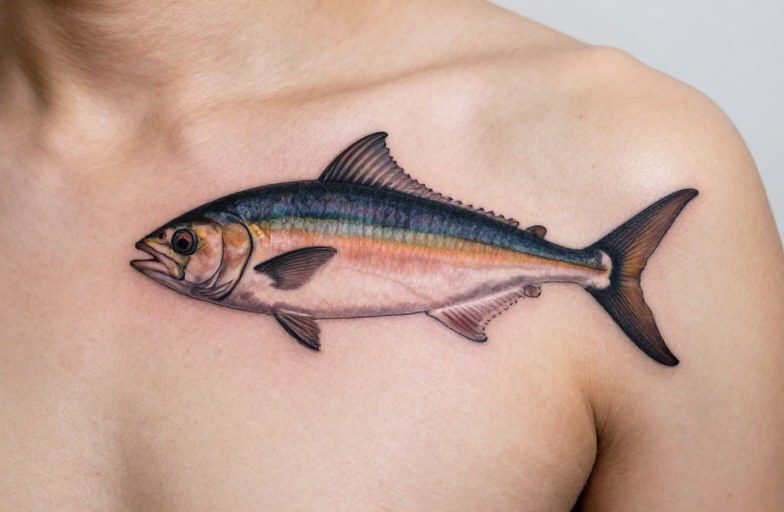
Flying fish tattoos tempt artists toward delicate linework: thin rays, detailed fins, the spray of water rendered in negative space. This ages poorly. Those fine rays blur within five to seven years on high-movement areas like wrists or ankles. The fin membranes, if done as single-needle lines, become indistinct gray smudges. For longevity, the body needs weight, thicker outlines on the main form, strategic black fill in the dorsal area, simplified ray count.
Shading Strategy
Smooth gradients that suggest the fish’s iridescent skin (blues shifting to silver) look stunning fresh but settle unevenly. The blue-green pigments common to this subject are particularly prone to fading toward a muddy teal. Better approach: stipple or whip-shade the transition areas, letting the texture carry the color shift rather than relying on perfectly blended saturation. Black and gray versions actually age more gracefully and read more clearly from distance; the color version demands more frequent touch-ups.
Water splashes around the fish suffer most. That energetic spray of droplets, so appealing in the first year, becomes blobby and disconnected by year eight. If you want the leap effect, consider solid black water shapes or omit the splash entirely, letting the fish’s angle imply motion.
Similar & Related Symbols
The flying fish sits in a crowded symbolic neighborhood, and understanding the distinctions helps clarify your choice.
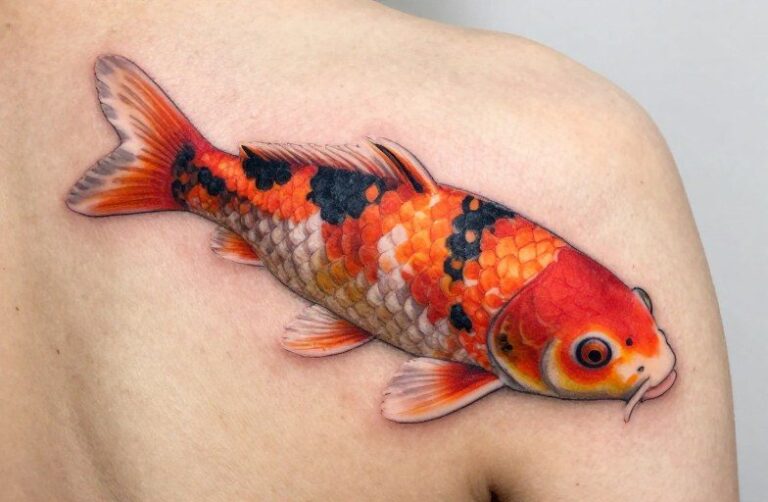
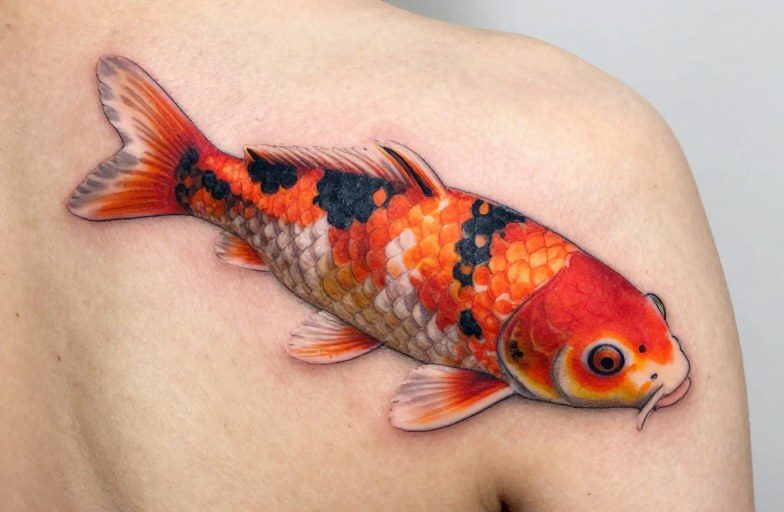
- Koi (upstream): Perseverance through known obstacles, traditionally masculine, associated with specific Japanese narratives. The flying fish is more about unexpected escape than steady struggle.
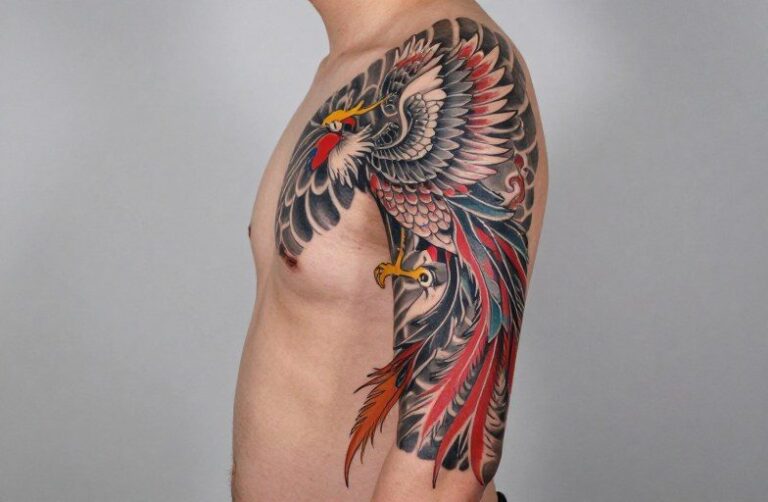
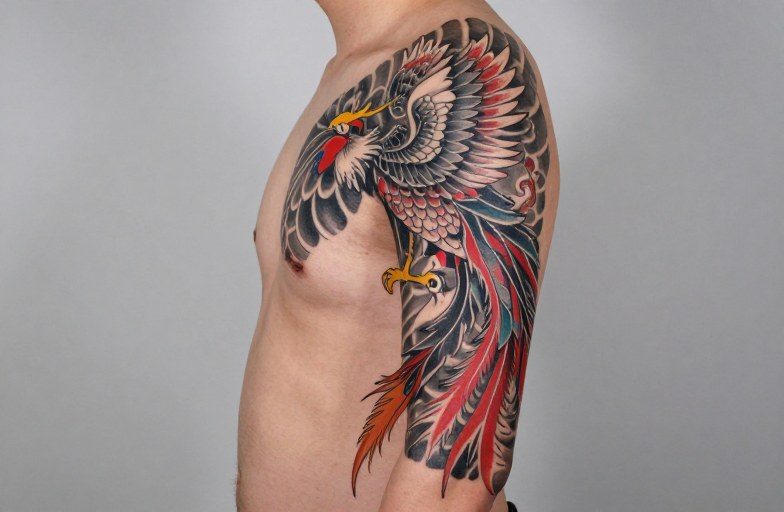
- Phoenix: Cyclical rebirth from destruction, grand and fiery. The fish offers no promise of return; it’s a one-way leap, more desperate than triumphant.
- Bird in flight: Freedom as natural state. The flying fish emphasizes that its flight is temporary, earned, and risky, freedom as exception, not default.
- Salmon: Return to origin, completion of cycle. The flying fish has no destination; it’s pure exit velocity.
- Marlin/sailfish: Speed and sport, human dominance over nature. The flying fish is prey, not predator, its leap is defensive, not aggressive.
Closest relative, symbolically: the flying squirrel, another glider mistaken for a flyer, another creature that belongs fully to neither air nor ground. But the fish carries the additional weight of suffocation in the wrong element, air is as deadly to it as water would be to us.
Design Tips & Pairings
What Works With It
Compass roses pair naturally, though the combination risks nautical cliché unless stylized unusually, perhaps a compass with no needle, or one where the fish replaces the needle. Wave patterns beneath, rendered as solid black Japanese-style water (sui or mizu), ground the image without competing. Clouds above, especially wind-bar clouds (kumobori), create the visual tension of two elements the fish moves between.
Text pairings work best when brief and specific. “Out of depth” plays on the double meaning. “Not drowned yet” carries a grim humor that suits the subject. Avoid anything about “soaring” or “the sky’s the limit”, the fish doesn’t soar, and the sky kills it.
Composition Considerations
The flying fish body offers a strong diagonal line, which tattoo artists love for flow along limbs. The natural pose, head up, tail down, pectoral fins extended, reads as upward movement. Reversing it, tail-up in a dive back toward water, changes the emotional register entirely: return, surrender, perhaps failed escape. Side-view shows the full wing-like fin spread; three-quarter view emphasizes the muscular body and the effort of launch.
Scale matters. At under three inches, the fin rays become unworkable; the fish reads as generic. At six-plus inches, the artist can render the corrugated scale texture, the distinct lower lobe of the caudal fin, the actual anatomy that separates Exocoetidae from other fish. Most people choose too small.
Mythology & Folklore
Pacific Island Traditions
In parts of Polynesia and Micronesia, flying fish appear in navigation lore, often linked to wayfinding and the reading of ocean signs. Some traditions trace specific island arrival stories to schools of flying fish spotted at dawn, their silver flashes marking reef proximity before land was visible. The fish thus carries associations with guidance through uncertain passages, not magical protection, but practical attention to natural signals.
East Asian Associations
Japanese fishermen’s lore treated flying fish as weather indicators, their mass appearance sometimes read as storm precursors. This gives the image a prophetic or warning quality in some regional contexts. Chinese coastal traditions occasionally linked them to the yulong or fish-dragon transformation motif, though this connection is less documented than with carp. Korean island communities had seasonal rituals around flying fish runs, marking temporal boundaries rather than spiritual ones.
Western literary use, Hemingway’s The Old Man and the Sea, for instance, emphasizes the fish as sustenance and as fellow prey, bound to the marlin in the food chain. That reading strips away romanticism and returns the symbol to biological reality: this creature escapes one death to risk another.
Common Variations & Styles
- Traditional/Americana: Bold outlines, limited color palette (blue, red, yellow), simplified fins. Reads immediately, ages well. The fish becomes more emblem than specimen.
- Japanese (Irezumi): Often integrated into larger water scenes, rendered with more naturalistic proportions but stylized waves. Color saturation demands experienced specialist; cheap versions look muddy fast.
- Blackwork/dotwork: Stippled shading creates the iridescent effect through density variation rather than color. Excellent for the fin membranes, challenging for the body contours.
- Scientific illustration style: Accurate anatomy, Latin name included, sometimes with measurement lines. Appeals to biologists, fishermen, people who value the real creature over symbolic abstraction. Requires artist with actual reference discipline, many tattooists wing the anatomy and it shows.
- Abstract/geometric: The fish form broken into triangles or line segments. Trendy, but the specific identity of the creature gets lost; might as well be any fish. Effective only when the extended fins are preserved as recognizable silhouette.
What to Remember
The flying fish tattoo works best when you respect its contradictions. It is not a bird, not a symbol of effortless freedom, not a promise of permanent escape. It is a creature that leaves its element through violent effort, survives briefly in the place that will kill it, and returns or falls. The honesty of that biology is what gives the image its weight.
Choose an artist who understands that the design must be built to last, not just to photograph well. Prioritize thick lines, simplified detail, strategic black. Accept that color will shift and fade. Place it where the meaning aligns with the body: ribs for the labor of breath, forearm for private witness, larger scale for anatomical accuracy.
Most importantly, do not romanticize what the fish does. It flees. It survives. It does not conquer air or transcend water. The tattoo should carry that same grounded urgency: you escaped, you are between, you continue. That is enough. That is the whole point.
Frequently Asked Questions
Does a flying fish tattoo mean good luck?
Not traditionally. Unlike koi or dragon symbols, the flying fish carries no established luck association in most cultures. Its meaning centers on escape, liminal existence, and earned effort rather than fortune or protection.
How big should a flying fish tattoo be?
Minimum three inches to render the extended fins recognizably; six or more inches allows accurate anatomy including scale texture and caudal fin structure. Smaller than three inches, it becomes generic fish.
What colors work best for aging?
Black and gray age most gracefully. Blue-green pigments common to this subject fade toward muddy teal. If you want color, plan for touch-ups every few years, or use stippled shading to create tonal variation without relying on smooth color gradients.
Can I add a quote about soaring or flying?
Avoid text about “soaring,” “the sky,” or “limits.” The fish glides through desperate escape, not flight. Better options: “Out of depth” or “Not drowned yet,” which respect the biological reality.
Is the flying fish tattoo masculine or feminine?
Neither association dominates. The symbolism of escape and liminal existence crosses gender lines. Placement and style choices matter more than the subject itself for gendered reading.