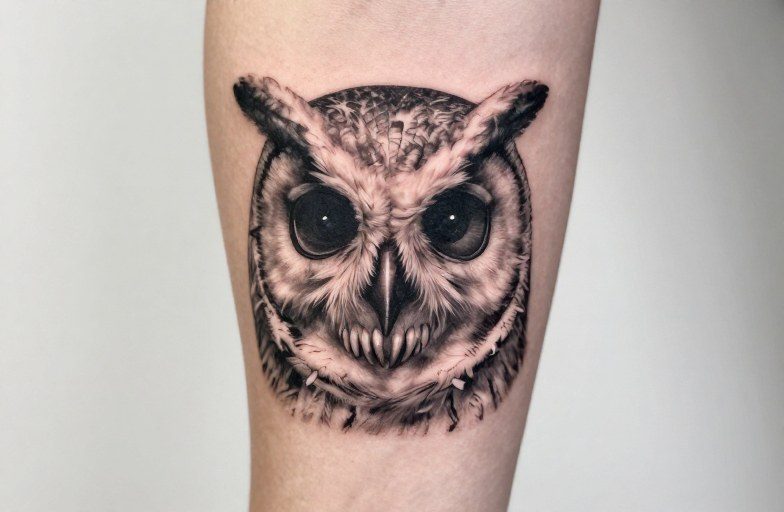
An owl skull tattoo fuses two loaded images into one stark design. The owl carries weight as a symbol of knowledge, night vision, and silent observation. The skull speaks plainly of death, impermanence, and what remains after life ends. Together, they create a meditation on mortality seen through a lens of awareness: death witnessed with open eyes, not feared in blindness. Most people drawn to this image are not looking for shock value. They are marking a personal reckoning with endings, transitions, or the pursuit of understanding in the face of the inevitable.
Symbolism and Core Meaning
The power of this design lives in collision, not combination. An owl and a skull do not blend into a gentle metaphor. They sit in tension, and that friction is the point.
The Owl’s Traditional Weight
Across cultures, the owl occupies an uneasy space. Greek tradition tied it to Athena, goddess of wisdom and strategic warfare, intelligence that could kill. In several Indigenous North American traditions, owls serve as messengers from the dead, their calls carrying warnings or guidance. Medieval Europe cast them as familiars of witches, creatures of liminal hours and liminal spaces. The common thread: the owl sees what others miss, operates in darkness, and moves between worlds. A skull strips away the living owl’s softness, feathers, and flight, the illusion of ongoing life, leaving only bone and the hollow sockets that once held those famous eyes.
What the Skull Changes
Without the skull, an owl tattoo might read as scholarly, spiritual, or nature-focused. The skull drags it toward memento mori territory. This is not a celebration of death; it is a refusal to look away. The design resonates with people who have faced loss directly, who work in death-adjacent professions, or who simply reject the cultural pressure to pretend mortality does not exist. Some wear it after surviving something that reshaped their understanding of time: illness, bereavement, a close call. The owl skull becomes a private marker of knowing, seeing, and continuing anyway.
How It Ages on Skin
Any skull tattoo lives or dies by its eye sockets. In an owl skull design, those hollows are the focal point, and they demand technical respect.
Line Work and Negative Space
Clean outlines around the eye sockets and nasal cavity hold the design together as it settles. Over years, fine lines soften and spread slightly; this is normal ink behavior, not poor craftsmanship. A well-executed owl skull with confident line weight and deliberate negative space ages into a readable silhouette even as detail blurs. The danger lies in overworking: too many tiny lines inside the cranial structure, too much attempted texture in the bone surface. That complexity turns to mush. The best versions let the bone read as smooth, with shadow concentrated at the eye sockets and the joint where skull meets spine.
Placement Realities
- Forearm or calf: Flat planes let the skull’s geometry sit correctly; easy to show or cover.
- Thigh or upper arm: More room for scale, which helps the eye sockets read as hollow rather than solid dark spots.
- Ribcage or sternum: The curve of bone-on-bone feels thematically apt, but the shape must be adapted to the body’s movement or the skull can distort oddly when you twist.
- Hands, fingers, neck: High visibility, fast fading due to sun exposure and skin turnover. The detail required for a recognizable owl skull rarely survives long here.
Black and grey ages more predictably than color in this specific design. The skull’s bone tone is already monochrome in nature; adding color often fights against the subject rather than serving it.
Similar and Related Symbols
The owl skull sits in a family of mortality-and-knowledge imagery that tattoo collectors often consider alongside it.
The raven skull operates in similar territory: corvid intelligence, death’s messengers, Gothic atmosphere. But it lacks the owl’s specific association with wisdom and nocturnal sight. A human skull with owl eyes inserted into the sockets creates a more surreal, less naturalistic statement. Hourglasses, extinguished candles, and wilted flowers accompany both owl and human skulls in traditional memento mori compositions; some collectors build full scenes around the central skull rather than letting it stand alone.
The sugar skull, with its Mexican Day of the Dead origins, brings color and celebration where the owl skull brings austerity. They are emotional opposites: one says death is a party the dead attend, the other says death is a silence you watch alone. People sometimes combine elements, such as an owl skull with geometric mandala patterns, but the core image is strong enough that additions often dilute rather than deepen.
Color Versus Black and Grey
This design makes its case most clearly without color. The subject matter, bone, hollow space, night-hunting bird, reads as inherently tonal. That said, two approaches to color deserve mention.
Accents only: A single gold eye, a thin red line, a background moon in muted blue. This keeps the skull’s severity while adding symbolic punctuation. Gold references the owl’s traditional wisdom; red suggests blood, life force, or danger.
Full color realism: Attempting to render feather remnants, fresh blood, or environmental storytelling in full color. This demands exceptional technical skill and a collector committed to maintenance. Color realism in skull tattoos often dates faster than black and grey because skin tone shifts, ink pigments break down unevenly, and the subject’s natural palette is already so limited. The owl skull’s strength is its restraint. Color risks making it illustrative in a way that undercuts its gravity.
Who Chooses This Tattoo
No single demographic owns this image, but patterns emerge in placement and context.
Professions and Life Stages
People in analytical fields, programmers, researchers, investigators, sometimes gravitate toward the owl’s knowledge symbolism stripped of its softer academic associations. The skull adds edge, acknowledges that their work consumes time they will never recover. Others come to it after the death of someone who taught them, the owl becoming a stand-in for lost wisdom, the skull for the finality of that loss.
Gender and Scale
Men and women both wear this design, though scale and surrounding imagery often differ. Larger, more aggressive versions with cracks, barbed wire, or weaponry tend toward masculine presentation in Western tattoo culture. Smaller, more anatomically precise owl skulls, sometimes with botanical elements or moon phases, read as more common in feminine-presenting collections. These are not rules, only observations from shop floors. The image itself is symbolically neutral; the collector’s choices in execution determine its voice.
Mythology and Folklore
Specific traditions give the owl skull its deepest resonances, though origins should be approached carefully rather than claimed with certainty.
The Greek glaux, Athena’s owl, was a live bird associated with protection and strategic thought. Some trace later European associations between owls and death to Roman reinterpretations and medieval Christian demonology, where nocturnal animals broadly fell under suspicion. In Mesoamerican cultures, the owl is often linked to Mictlantecuhtli, lord of the underworld, carrying explicit death correspondence that predates European contact. A tattoo drawing on this lineage carries different weight than one referencing Gothic Victorian imagery.
Norse tradition offers the owl less directly, but the broader concept of wisdom purchased through sacrifice, Odin’s eye, hung from Yggdrasil, resonates with the skull’s memento mori function. Celtic sources sometimes associate owls with the Crone aspect of the triple goddess, she who knows death because she stands nearest to it. These threads do not need to be consciously referenced for the tattoo to draw on their accumulated weight. The image has been circulating too long to be clean of history.
What to Remember
- An owl skull tattoo means mortality witnessed with awareness, not death celebrated or feared in ignorance.
- Technical execution matters enormously: eye socket definition, line weight, and restraint in detail determine whether the design holds for decades or blurs into unrecognition.
- Black and grey serves this image better than color; the subject’s natural palette is already complete.
- Placement on flatter, less sun-exposed skin, forearm, calf, or thigh, preserves readability and slows fading.
- Cultural associations vary significantly. Greek wisdom, Mesoamerican underworld connection, and European Gothic tradition all inform the image, but no single origin story owns it.
- The design’s power is in its tension, not its comfort. It is not meant to soothe. It is meant to mark that you have looked at something difficult and kept your eyes open.
Frequently Asked Questions
Does an owl skull tattoo always mean death?
Not exactly. It means mortality acknowledged, not necessarily death wished for or feared. The skull is memento mori, a reminder that life ends. The owl adds the quality of seeing clearly in darkness. Together, they suggest facing the fact of death with awareness rather than denial.
Will an owl skull tattoo fade quickly?
It depends on placement and execution. Areas with frequent sun exposure, like hands or neck, fade faster. The design’s heavy reliance on eye socket definition means that blur from age or sun damage can hurt readability more than with some other subjects. Black and grey generally ages more predictably than color for this specific image.
Can I add color to an owl skull tattoo?
You can, but most experienced collectors and artists recommend restraint. Small accents, a single gold eye, a muted background moon, work better than full color realism. The subject’s natural palette is bone and shadow; color often fights that rather than serving it.
Is the owl skull tattoo connected to a specific culture?
No single culture owns it. The owl carries different weight in Greek, Mesoamerican, Indigenous North American, and European traditions. The skull as memento mori has its own history, particularly in European art. The tattoo draws on accumulated associations rather than one authentic source. Be wary of anyone claiming it belongs exclusively to one tradition.

Leave a Reply