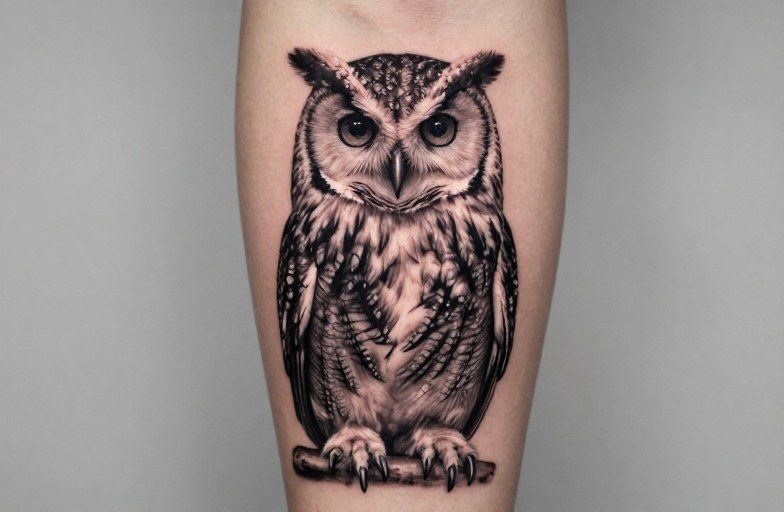
An owl tattoo most commonly signals wisdom, intuition, and the ability to see what others miss. Beyond that surface reading, it often marks personal transformation, a connection to night and shadow, or a protective vigilance over loved ones. The meaning tightens or expands depending on how the bird is rendered, perched and alert, mid-flight, skull-faced, or paired with specific objects like keys, clocks, or moon phases.
Who Chooses This Tattoo
The appeal crosses surprisingly broad territory. You’ll find owl tats on literature students, night-shift workers, people who’ve come through hard transitions, and those drawn simply to the visual power of the image. The bird carries enough symbolic weight that it doesn’t require explanation, yet remains flexible enough to absorb personal meaning.
Common Placements and Why They Matter
Forearms and upper arms dominate for visibility and the natural horizontal line of a perched owl. Chest pieces allow for spread wings and detailed feather work. Thighs and ribs suit larger, more illustrative pieces where the body curves complement the bird’s rounded form. Smaller behind-the-ear or wrist placements work for minimalist line drawings, though fine detail there blurs faster than most people expect.
- Forearm: Easy to show or cover; good for medium detail
- Back/shoulder blade: Room for full wingspan and background elements
- Ribcage: Painful but allows vertical composition with moon or branch
- Hand/finger: Trendy but fades quickly; requires committed maintenance
Style Preferences by Placement
Traditional American owl tats with bold outlines and limited color hold up best on high-movement areas like elbows and knees. Fine-line single-needle work demands flat, low-friction skin, think inner bicep, calf, or upper back. Realistic black and grey pieces need space to breathe; cramming photorealistic feather texture into a 3-inch spot wastes the effort and ages poorly.
Symbolism & Core Meaning
The owl’s symbolic range runs wider than most animals. Ancient Greek association with Athena gave it the wisdom hook, but other threads run through darkness, death, femininity, and secret knowledge. A tattoo can emphasize any of these through specific choices in pose, accompanying imagery, and expression.
Key Visual Variations
A staring, forward-facing owl reads as confrontational and watchful, almost guardian-like. Profile views feel more naturalistic and contemplative. Owls with exposed skull features (often called “skull owls”) lean into memento mori territory, though this trend peaked around 2010-2015 and now reads as dated in some circles. Barn owls with heart-shaped faces carry softer, more spiritual connotations than the heavy-browed great horned owl.
- Perched on a branch: Patience, observation, readiness
- In flight: Transition, pursuit, freedom
- With clock or hourglass: Mortality, fleeting time
- With key or lock: Hidden knowledge, secrets kept or revealed
The Eye Question
Owl eyes dominate composition and meaning. Large, detailed eyes with catchlights feel alive and aware. Solid black or hollow eyes shift toward the ominous and otherworldly. Yellow or orange irises (common in color work) add intensity; pale grey-blue reads colder and more distant. The eye direction matters too, looking outward engages the viewer, looking past them suggests inward focus.
History & Cultural Roots
Association with wisdom is often linked to Athena, though the connection predates her and appears independently in several cultures. Some trace owl reverence to prehistoric goddess figurines where bird and woman features merged. In Mesoamerican traditions, the owl accompanied death deities and served as messenger between worlds. Among several Indigenous nations of the Americas, the owl occupies complex territory, sometimes respected as truth-teller, sometimes feared as death omen.
Japanese tattooing (irezumi) incorporated the owl less frequently than tigers or dragons, but when it appeared, it commonly carried protection against suffering and hardship. European folk traditions were more ambivalent: owls attracted witchcraft associations, particularly in English and German folklore. A tattoo drawing on these threads might pair the owl with specific protective or occult symbols rather than presenting the bird alone.
Modern Cultural Absorption
Contemporary tattooing has largely flattened these distinctions into a generalized “mystery and wisdom” package. That’s neither good nor bad, just something to recognize if you want your piece to carry specific cultural weight rather than generic nocturnal vibes. Researching which tradition speaks to your particular intention helps avoid unintentionally mixing contradictory symbols.
Color vs Black and Grey
This choice fundamentally changes how the tattoo reads and how it lasts. Black and grey realism excels at capturing the actual texture of owl feathers, the soft gradients, the way light catches differently on facial discs versus flight feathers. Color introduces symbolic temperature: warm browns and golds feel earthy and accessible; cool blues and purples push toward fantasy and dream imagery; stark black-and-red combinations read aggressive or occult.
Technical Longevity Considerations
Yellows and light oranges in owl eyes and beaks fade fastest, often shifting to a pale greenish cast within five to seven years. Deep blues and purples hold better but can muddy if over-saturated. Black and grey offers the safest longevity bet, particularly for larger pieces where reworking color is expensive and logistically complicated. White highlight accents, popular for feather texture and eye shine, disappear almost entirely on most skin tones within two to four years.
- Black and grey: Best aging, widest skin-tone compatibility, lower maintenance
- Earth tones (brown, rust, olive): Naturalistic, moderate fade, good for traditional styles
- Bold primaries: High initial impact, requires touch-up commitment
- Pastels: Generally avoid; fade to indistinct wash quickly
How It Ages on Skin
Feather detail is where owl tattoos live or die over time. Fresh, an owl piece might show individual barb textures, delicate facial ruff edges, and crisp talon definition. A decade later, the same piece either reads as a coherent shape with soft tonal variation, or as a blurry dark mass with indistinct edges. The difference comes down to initial design choices and placement.
What Holds and What Blurs
Strong outer contours preserve legibility. Interior detail should be supported by value contrast, areas of definite dark against definite light, rather than relying on fine lines alone. The facial disc (the flat, disc-shaped arrangement of feathers around owl eyes) blurs particularly badly if rendered with too many concentric thin lines. Simplifying this to bold shapes with selective texture ages far better.
Placement on high-sun areas (forearms, hands, calves if you wear shorts) accelerates fading regardless of ink quality. Moisturizer and sunscreen help, but won’t override physics. Expect significant softening by year seven to ten on any exposed skin; covered areas maintain punch longer.
Touch-Up Realities
Owl tats are moderately forgiving for refresh work. Solid black areas can be rebuilt, and lost detail can be simplified rather than exactly replicated. However, adding color back into a faded piece rarely achieves the saturation of original work. Plan the initial design with future degradation in mind, imagine how it reads at 70% fidelity, because that’s where it’s heading.
Personal & Modern Meanings
Current tattoo culture uses the owl to mark specific life passages: surviving depression or addiction, completing demanding education, honoring nocturnal nature, or claiming space as an observer rather than performer. These personal applications often layer over traditional symbolism without replacing it.
Contemporary Combinations
Geometric framing around realistic owl portraits peaked in popularity around 2015-2018 and now signals that era. Current trends favor either fully traditional styling (bold lines, limited palette) or fully rendered realism without decorative borders. Minimalist line owls, single continuous line or spare silhouette, appeal for their adaptability but sacrifice the symbolic weight of detailed rendering.
Moon phases paired with owls remain common, sometimes reading as feminine energy or cyclical change, sometimes as generic “night theme.” Clocks and compasses suggest direction and mortality. Floral elements (roses, night-blooming flowers) soften the image and connect to specific relationships or growth periods. The combination should clarify rather than dilute your intention.
What to Remember
An owl tattoo succeeds when the visual approach matches the symbolic intention. A photorealistic piece demands proper scale and skin real estate; a small symbolic mark needs graphic simplicity to survive. The bird’s cultural history offers depth if you engage it, but the image works fine as personal emblem without historical justification.
Prioritize strong design over intricate detail. Feather texture that looks stunning at three months will settle; the underlying shape and contrast carries the piece at ten years. Discuss aging explicitly with your artist, how they plan for blur, what they’ll simplify, where they’ll reinforce. The best owl tattoos look intentional at every stage of their life on your skin, not just the day they’re finished.
Frequently Asked Questions
Does an owl tattoo always mean wisdom, or can it have negative connotations?
Wisdom is the most common reading, but owls carry death, secrecy, and occult associations in several traditions. Context and accompanying symbols determine which thread dominates. A skull owl reads very differently than a barn owl with moon phases.
How big should an owl tattoo be for the detail to last?
For realistic feather texture, palm-sized minimum; for traditional bold-line work, you can go smaller. Fine-line single-needle owls need significant space, think softball-sized or larger, to avoid becoming indistinct blobs within a few years.
Is the chest or back better for a large owl with spread wings?
Backs offer the flattest, most stable canvas for symmetrical wing spreads. Chest pieces work but must accommodate pectoral movement; wings often get slightly distorted when arms are raised. Discuss dynamic posing with your artist.
Do owl tattoos work on darker skin tones?
Absolutely, but approach matters. High-contrast black and grey with deliberate negative space reads clearer than subtle grey washes. Color saturation requires experienced application; consult an artist with demonstrated portfolio work on similar skin tones.

Leave a Reply