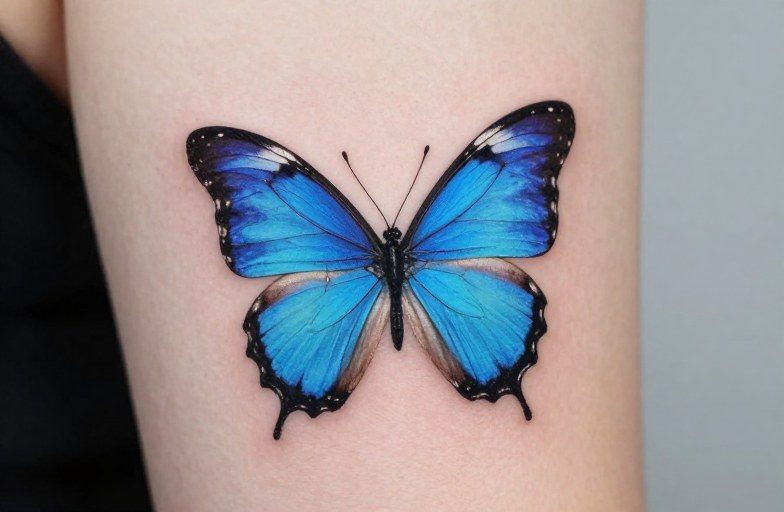
A blue butterfly tattoo most commonly signals transformation, freedom, and the beauty of change. The blue color specifically adds layers of rarity, calm, and sometimes melancholy or memory, depending on the shade and species referenced. Unlike generic butterfly designs, the blue variant carries distinct visual weight because true blue pigment is rare in nature, making these insects feel almost otherworldly when you see one land nearby.
Personal & Modern Meanings
People gravitate toward blue butterflies for reasons that sit outside traditional symbolism. The color blue in tattoo culture has developed its own shorthand: navy and cobalt shades often read as masculine or neutral, while powder and sky blues tend to code feminine in Western shops. That said, the meaning someone attaches is usually more specific than gender expression.
Mental Health and Survival
The blue butterfly has become a quiet emblem for depression survival and anxiety management, partly because of the “blue” mood association, partly because transformation narratives resonate with people rebuilding after breakdowns. A single blue butterfly on a wrist or behind an ear can function as a private marker of having survived a period the wearer doesn’t necessarily discuss. Placement matters here, visible enough for the wearer to see, small enough to not invite conversation.
Memorial and Loss
Some choose this design to mark a specific loss, particularly the death of a child or sibling. The butterfly’s brief lifespan mirrors the fragility being grieved, while the blue can reference a nursery color, an eye color, or simply the emotional temperature of the mourning. Rib placements and collarbone areas are common for these, since they’re easily covered during professional hours but accessible during private moments.
How It Ages on Skin
Blue ink ages differently than black, and butterfly designs have specific structural vulnerabilities you should understand before committing.
Color Fading and Migration
Bright blues, especially electric and turquoise shades, tend to fade toward green or grey within five to eight years. This happens because phthalocyanine blue pigments break down under UV exposure, and the yellow undertones in skin push the cooling color warmer. Royal and navy blues hold longer, sometimes a decade or more, because they’re denser pigment loads. Watercolor-style blue butterflies with no black outline face the fastest degradation; the color literally bleeds outward without a barrier.
Line Work vs. Shading Strategy
Traditional American-style blue butterflies with bold black outlines and limited blue fill age most gracefully. The black traps the color and provides structure even as the blue mutes. Fine-line blue butterflies without black outlines look delicate fresh but often become unrecognizable blobs as the ink spreads. If you want detail in the wing patterns, that requires either very tight line work that will thicken slightly over time, or strategic use of negative space where skin tone creates the pattern against blue fields.
- Upper arm and thigh: best longevity due to less sun exposure and stable skin
- Hands and feet: blue fades fastest here, often within three years
- Ribs and sternum: color holds but stretching from weight fluctuation distorts wing symmetry
- Behind the ear: surprisingly good retention for blue if you keep sunscreen consistent
Mythology & Folklore
European and Japanese Threads
In Irish folklore, butterflies were often linked to souls, and a blue butterfly specifically was sometimes considered a departed soul at peace. This is often linked to the rarity of blue butterflies on the island; seeing one felt significant enough to carry supernatural weight. Japanese tradition associates butterflies with the soul and marriage, though the color blue isn’t specifically privileged there. The connection is more about pairs of butterflies representing marital happiness, regardless of hue.
Indigenous Americas and Modern Reclamation
Native American traditions vary widely by nation, but several Plains and Southwest cultures considered butterflies messengers or symbols of joy. The blue morpho butterfly of Central and South America appears in some modern Indigenous tattooing as a reference to rainforest territory and specific ecological knowledge, though this is often reclaimed rather than traditional in the tattoo context. Modern tattooing borrows eclectically from these sources, so the “meaning” of a blue butterfly in a contemporary shop is usually a personal synthesis rather than a faithful cultural transmission.
Color vs Black and Grey
Visual Communication
The choice between blue and black-and-grey fundamentally changes what the tattoo communicates and how it functions visually. Black and grey butterflies emphasize form, shadow, and the sculptural quality of wings. They read as more timeless, more serious, less decorative. A black and grey butterfly can look like a photograph or a drawing; a blue one almost always reads as illustration or symbol. The blue version demands attention in a way monochrome doesn’t. It is a color statement, not just an image statement.
Technical Execution
From a technical standpoint, black and grey allows for more subtle gradation in wing texture. Blue requires either flat color fields or extremely skilled color packing to achieve dimension without muddiness. Many artists prefer to do blue butterflies with some black linework or grey shading underneath to create depth, rather than attempting to shade purely with blue tones.
Skin tone affects the choice dramatically. On very dark skin, light blues can disappear or require more sessions to saturate; deeper royal blues and indigos show better. On pale skin, bright blues pop initially but fade faster. Experienced artists adjust their pigment selection based on undertone. Cooler skin gets warmer blues; warmer skin gets cooler blues to maintain visual balance.
Religious & Spiritual Angles
Christian and Catholic Contexts
Christian symbolism sometimes adopts the butterfly for resurrection, though blue specifically isn’t doctrinally significant in most denominations. The color blue in Christianity is traditionally associated with Mary, so a blue butterfly in a Catholic context might carry Marian overtones of purity and protection, though this is more interpretive than official.
Contemporary and Secular Framings
New Age and contemporary spiritual circles often assign blue butterflies to throat chakra energy, communication, and truth-telling. This is a modern synthesis rather than ancient wisdom, but it influences how some people frame their tattoo choices. The “meaning” here is less about tradition and more about personal spiritual vocabulary. Secular humanists and atheists sometimes choose blue butterflies specifically to mark a break from religious upbringing. The butterfly becomes evolution, transformation through natural processes rather than divine intervention. The blue becomes sky, atmosphere, the non-supernatural sublime.
Who Chooses This Tattoo
Demographics for blue butterfly tattoos have shifted noticeably over the past fifteen years. What was primarily a feminine-coded design in the 1990s and 2000s has broadened, partly through placement changes and partly through stylistic evolution.
Placement and Gender Expression
Small blue butterflies on ankles, hips, and lower backs dominated early 2000s tattooing and became cliché enough that many artists tired of the request. Contemporary versions tend toward larger scales: chest pieces, forearms, and calf sleeves. Men choosing blue butterflies now often pair them with other elements (dagger, skull, geometric frame) to complicate the image, or simply get them large enough that the color dominates the subject matter.
Age and Life Stage
First tattoos at eighteen often include butterflies as accessible, socially recognizable choices. Blue butterfly tattoos chosen at thirty-five or fifty carry different weight, usually marking specific life transitions rather than general aspiration. The older wearer typically wants more detail, more specific species accuracy, and more integration with existing work. They’re less likely to accept flash art and more likely to commission custom designs referencing actual blue species: morpho, pipevine swallowtail, common blue, adonis blue.
Cover-up requests for old blue butterflies are common enough that artists often warn clients about placement and size. A small blue butterfly with heavy black outline is relatively easy to expand or integrate; a scattered watercolor version is difficult to build around.
Before You Decide
A blue butterfly tattoo works when the color choice is deliberate, not default. The blue adds specificity, rarity, calm, memory, or simply aesthetic preference that black cannot replicate. But it also adds technical risk: faster fading, more touch-ups, more sensitivity to placement and sun exposure.
Ask yourself what the blue is doing that another color or black and grey could not. If the answer is only “I like blue,” that is enough, but know what you are choosing. The blue butterfly is not a neutral decoration. It reads as symbol first, image second. It attracts attention, invites interpretation, carries the weight of all the meanings people have layered onto butterflies across centuries.
Find an artist who has healed photos of blue work, not just fresh tattoos. Blues change dramatically in the skin over months. Ask specifically about their pigment choices, their experience with your skin tone, their policy on touch-ups. A blue butterfly done well can be stunning for years. Done without foresight, it becomes a lesson in why tattoo veterans caution against bright colors in certain placements.
The meaning you assign will hold longer than the ink. Make sure both are chosen with care.
Frequently Asked Questions
Why does my blue butterfly tattoo look greener now?
Phthalocyanine blue pigments break down under UV exposure, and your skin’s natural yellow undertones push the cooling blue toward green or grey. This is normal and happens faster on hands, feet, and anywhere with frequent sun exposure. Royal and navy blues resist this longer than electric or turquoise shades.
Is a blue butterfly tattoo only for women?
Not anymore. While small blue butterflies on ankles and hips were predominantly feminine-coded in the 1990s and 2000s, contemporary versions include large chest pieces, forearms, and calf sleeves chosen across genders. Stylistic pairing with daggers, skulls, or geometric frames, or simply scaling up the design, has broadened who chooses this motif.
What blue butterfly species do tattoo artists actually reference?
Common choices include the blue morpho (Central and South America, iridescent large wings), pipevine swallowtail (North America, deep blue with orange spots), common blue (Europe and Asia, small and delicate), and adonis blue (Mediterranean, vivid azure). Species accuracy matters more to clients commissioning custom work than to those choosing flash designs.
Do blue butterfly tattoos hurt more than black ones?
Blue pigments, especially lighter shades, often require more passes to saturate properly in the skin, which can mean slightly longer session time in one area. However, pain depends more on placement than color. Ribs, sternum, and feet hurt regardless of ink choice. Upper arms and thighs are generally more tolerable.
Can a faded blue butterfly be fixed or covered?
Yes, but with caveats. Heavy black outlines make cover-ups and expansions easier. Watercolor-style blue butterflies with no outline are notoriously difficult to build around or cover because the color has bled unpredictably. Consult an artist who specializes in cover-ups before assuming anything is salvageable.
Leave a Reply