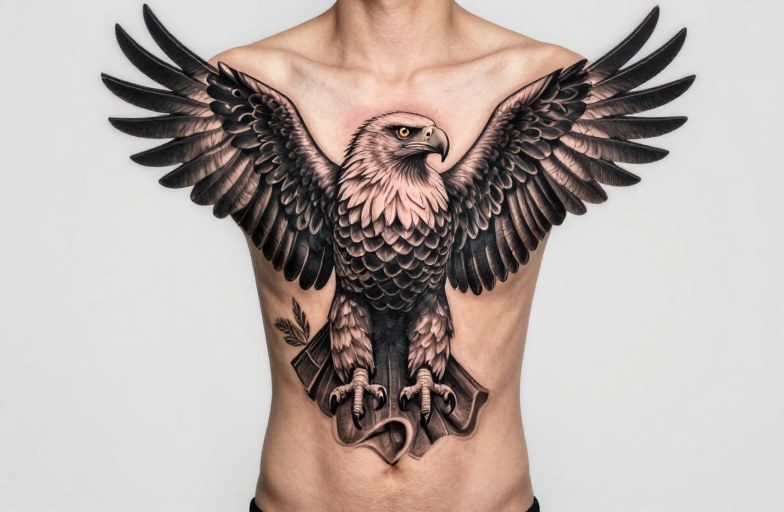
The Philippine eagle tattoo means rare power, national pride, and fierce resilience. As the national bird of the Philippines and one of the largest, most endangered eagles on earth, this raptor carries weight beyond its impressive wingspan. Most people choose it to honor Filipino heritage, mark survival through hardship, or embody a solitary, apex-predator mindset.
Best Placements
Where you put this bird changes how it reads. The Philippine eagle’s distinctive shaggy crest and massive beak need room to breathe, so small, hidden spots rarely do it justice.
Large Canvas: Back, Thigh, Chest
The full spread of wings demands space. A back piece lets the wingspan stretch across shoulder blades with the head turned in that famous hunting stare. Thighs work for vertical compositions, eagle perched, talons gripping a branch. Chest placements center the bird over the heart, wings wrapping onto pecs, which suits the patriotic angle. These large areas allow the layered brown and cream plumage to show through shading, not just line work. Plan for multiple sessions and expect the crest feathers to need touch-ups as they age, fine detail softens first.
Medium & Compact: Outer Arm, Calf, Ribs
Outer bicep or forearm works for a portrait-style head study, beak open, crest flared. Calf muscle gives a vertical perch composition. Ribs hurt more but suit private, personal meanings, the bird partially hidden by your arm at rest. At this scale, simplify. Too many feather lines blur together in five years. Bold beak shape, strong eye, simplified crest, that silhouette reads instantly even when details fade.
- Back: full wingspan, 8+ hours minimum, ages well with proper shading depth
- Thigh: vertical perch, good for mixed heritage symbols below or around
- Outer arm: head portrait, easiest to show or cover
- Calf: moderate detail, heals relatively easy, stays out of sun mostly
- Ribs: high pain, intimate placement, plan for two sessions minimum
History & Cultural Roots
The Philippine eagle, Pithecophaga jefferyi, was first documented scientifically in 1896, but its presence in the archipelago stretches back millennia. Indigenous communities in Mindanao and Luzon often linked large raptors to ancestral spirits and sky gods. Spanish colonization suppressed many of these practices, yet the bird persisted in local oral traditions.
National Symbol Status
In 1995, the Philippine eagle became the official national bird, replacing the maya. This wasn’t arbitrary. The species is endemic, found nowhere else on earth, critically endangered with perhaps four hundred breeding pairs remaining. That rarity made it a loaded symbol for Filipino identity, something stolen, threatened, yet still fighting. Tattoos referencing this status often incorporate sun rays from the flag, three stars, or color work in red, blue, and yellow.
Conservation Connection
Some wearers choose the bird specifically to raise awareness. The Philippine Eagle Foundation has worked since the 1980s to breed and release captive birds. A tattoo can signal financial or volunteer support, or simply grief for habitat lost to logging and mining. This angle tends toward realistic portraiture, sometimes with a broken chain, a single feather falling, or the scientific name in small script.
Religious & Spiritual Angles
Christianity dominates the Philippines, yet pre-colonial animism persists in blended forms. The eagle occupies an interesting middle space, neither purely pagan nor comfortably biblical.
Pre-Colonial Beliefs
Among some Lumad and Cordillera groups, large birds mediated between human and spirit worlds. They carried messages to ancestors, watched from above, punished oath-breakers. A tattoo drawing on this layer might pair the eagle with geometric patterns from specific tribal traditions, though appropriation concerns matter. Research whether your family connects to these groups, or commission a Filipino artist who understands the distinctions.
Christian Readings
The eagle appears in scripture, Isaiah’s renewed strength, John’s Revelation. Filipino Catholicism often merges these texts with folk practice. A Philippine eagle tattoo can read as spiritual renewal, God’s protection, or the soul’s ascent. Crosses, rosary beads, or sunbursts behind the bird mark this interpretation. The crest itself resembles a crown of thorns to some eyes, an accidental resonance that certain wearers emphasize.
Who Chooses This Tattoo
Heritage connection drives most choices. First-generation immigrants, second-generation kids reconnecting with roots, mixed-race Filipinos navigating identity. The eagle offers a masculine-coded national symbol without the baggage of some historical figures. Women choose it too, drawn to the maternal reality, Philippine eagles raise single chicks for two years, intense parental investment.
Survivors of illness, violence, or migration sometimes select the bird for its endangered persistence. “Still here despite everything.” Military and law enforcement with Filipino backgrounds use it as a unit or personal emblem, though this overlaps with broader eagle tattoo tradition and can read generic without specific Philippine markers.
A smaller group consists of birders, conservationists, and biologists who’ve worked in the Philippines. Their tattoos tend toward scientific accuracy, specific plumage patterns, sometimes GPS coordinates of a nesting site.
Mythology & Folklore
Strictly speaking, the Philippine eagle lacks the deep mythological archive of the Javan garuda or the American thunderbird. But folklore surrounds it, and creative tattooing draws on adjacent traditions.
Local Names and Stories
The bird is called “haribon,” from haring ibon, king bird. Some trace this to Spanish-era folklore where it guarded gold in remote mountains. Others say pre-colonial origin stories named it the first creature to fly after the great flood, scouting for dry land. These narratives give tattoo artists compositional prompts, the eagle over waves, the eagle with gold or sun in its talons, the eagle as sentinel on a mountain peak.
Adjacent Raptor Myths
Filipino tattooists sometimes blend the haribon with broader Austronesian bird-deity forms. The manaul, a mythical bird in Visayan and Tagalog stories, shares some characteristics, size, power, connection to the sky world. Tattoos merging these traditions need care, the Philippine eagle is a real, living species with conservation status, not a free-floating mythic figure. The best work respects both layers without collapsing them.
Similar & Related Symbols
The Philippine eagle sits in a crowded symbolic field. Understanding alternatives helps clarify your choice and avoid unintended overlap.
The American bald eagle reads patriotism to a global audience, but lacks the endangered rarity and specifically Filipino resonance. The Javan garuda carries Hindu-Buddhist weight across Southeast Asia, more established mythologically but not Philippine. The monkey-eating eagle’s old name, still sometimes used, connects to diet specificity, some tattoos show prey in talons to emphasize this.
Other national symbols sometimes accompany the eagle in combination pieces. The sampaguita flower softens the composition, adds feminine association. The sun and three stars from the flag anchor patriotic meaning. Anahaw leaves or volcanic mountains place the bird geographically. These combinations work best when an artist understands scale hierarchy, the eagle dominates, supporting elements frame without competing.
Generic “tribal” eagle tattoos from the 1990s and 2000s remain common in flash books. The Philippine eagle demands more specificity, the crest, the eye color, the massive beak proportions. Without these, you have an eagle tattoo, not this eagle.
Before You Decide
Consider your connection honestly. Filipino heritage gives solid grounding, but the bird’s endangered status means something even without bloodline. Still, wearing a national symbol without context risks reading as tourism or trend. Talk to Filipino artists if possible, many in the diaspora communities of California, Hawaii, the Gulf States specialize in this iconography.
Style matters for longevity. Heavy black outlines around the beak and eye keep the face readable as shading softens. Color work in the plumage looks stunning fresh but plan for fading, browns and creams shift unevenly. Watercolor backgrounds behind a realistic eagle rarely age well, the contrast between precise bird and loose splash looks dated faster than either alone.
Healing a large piece with fine feather detail takes discipline. The chest and back move constantly with breathing, scabbing disrupts delicate lines. Budget for a touch-up at six months, especially on the crest and wing tips where single-needle work was likely used.
Finally, the Philippine eagle’s conservation status adds a responsibility some wearers feel acutely. A few donate to the Eagle Foundation upon finishing their tattoo, making the mark part of a living commitment rather than static decoration. Whether you go that far or not, know the bird’s reality, rare, threatened, magnificent, and let that inform what you carry.
Frequently Asked Questions
How much does a detailed Philippine eagle tattoo typically cost?
A large back or chest piece with realistic detail runs 800 to 2,500 dollars depending on artist reputation and location. Smaller head portraits on arms or calves might start around 400. Filipino specialist artists sometimes command premium rates due to cultural knowledge and demand.
Can non-Filipinos get this tattoo without it being appropriative?
The bird itself is a real species, so appreciation without heritage connection is possible. Avoid combining it with specific tribal patterns you don’t understand. Focus on conservation, natural history, or aesthetic admiration rather than claiming national identity.
What tattoo style works best for the Philippine eagle’s distinctive crest?
Neo-traditional and realistic styles handle the shaggy crest most effectively. Heavy black outlines at the crest base with textured shading above create readable contrast that ages better than fine individual lines mimicking each feather.
Should I include the scientific name or local name in the design?
Pithecophaga jefferyi or haribon can work as small script elements, usually below or beside the main image. Keep lettering minimal and legible, the bird should dominate. Some wearers choose Filipino languages for names or dates to deepen personal connection.
Leave a Reply