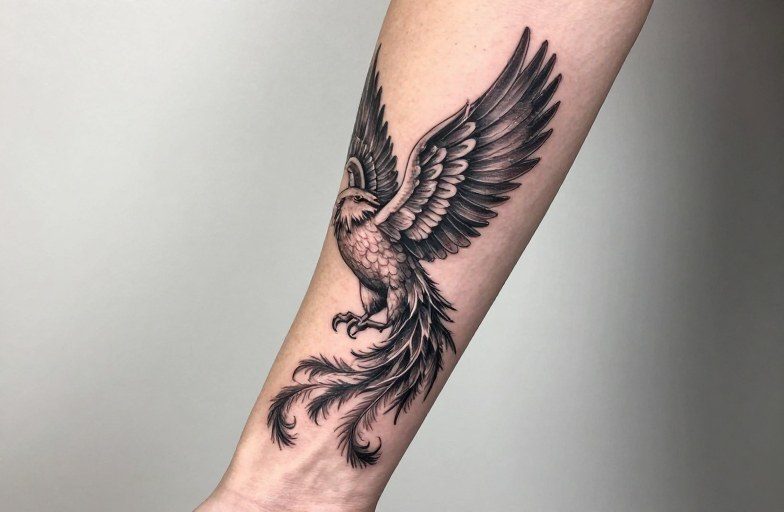
A phoenix bird tattoo on the forearm means rebirth, endurance, and rising after destruction. The forearm makes this declaration visible to others and impossible to hide from yourself. It’s a placement chosen when the meaning needs daily reinforcement, not private reflection.
How It Ages on Skin
Forearm Wear and Sun Exposure
The forearm catches sunlight constantly, driving, walking, sleeves pushed up. UV radiation breaks down tattoo ink faster here than on torso or thigh. Black linework holds; reds and oranges, the colors most people want in a phoenix, fade quickest. A piece that blazes at year three can look chalky by year ten without consistent SPF protection.
Skin on the outer forearm (the radius side, where you check a watch) sees more friction from desks, armrests, and gym equipment. Inner forearm skin is thinner, more prone to blowout during tattooing, but ages more gently because it’s shielded from impact. Plan your phoenix orientation with this in mind: wings spanning the outer arm will weather harder than a body tucked along the inner curve.
Line vs. Shading Longevity
Phoenix designs live or die by their flames. Heavy black outlines around feather shapes preserve readability for decades. Soft color gradients mimicking fire, those sunset fades from crimson through gold to nothing, blur within five to eight years on this placement. Solid saturation outlasts subtlety. If you want the bird to read as fire rather than suggestion, your artist needs to pack pigment, not airbrush it.
White ink highlights, popular for “hot spots” in flames, disappear fastest on forearm skin. Yellow follows close behind. Consider whether your design still works when those accents vanish, because they will.
Symbolism & Core Meaning
The Myth Itself
The phoenix narrative is straightforward: the bird burns, dies, and regenerates from ash. That cycle, total loss followed by involuntary renewal, carries weight whether you lost a job, a person, a version of yourself, or years to addiction or illness. The symbol doesn’t require belief in the supernatural to function. It describes a process many people actually live through.
Unlike the ouroboros (endless circular return) or the lotus (emergence from murk), the phoenix demands destruction first. There’s no rebirth without the fire being real. That specificity matters. People drawn to this image often aren’t celebrating growth; they’re marking survival of something that should have finished them.
Fire as Powerful Agent
Fire in the phoenix isn’t background decoration. It represents the mechanism of change, painful, uncontrolled, consuming what existed. The forearm placement means you see this process while typing, eating, reaching. The tattoo becomes a kinetic reminder that transformation isn’t gentle.
- Clawed feet gripping embers: holding on through the burning
- Wings mid-beat: motion, not rest, rebirth as ongoing
- Head thrown back, beak open: the cry of the process, not the triumph after
Each compositional choice shifts whether the tattoo reads as victory lap or warning.
Personal & Modern Meanings
Addiction Recovery and Mental Health
Forearm phoenixes appear frequently in recovery communities. The visibility matters: hiding tracks, hiding drinking, hiding depression, those behaviors thrive in concealment. A forearm piece refuses that architecture. It’s not about broadcasting to others so much as refusing to let yourself forget the alternative path.
Some pair the phoenix with dates, with coordinates, with small text that names the specific fire. Others let the image stand alone. Both approaches work; the latter demands a stronger design, since it carries all narrative weight visually.
Career Pivots and Late Starts
People restarting professionally at forty, fifty, sixty, this demographic has grown. The phoenix on the forearm marks not a youthful mistake overcome but a deliberate demolition of one life for another. The placement says: I’m not hiding my age, my history, my unconventional path. The bird faces forward, not backward.
Modern interpretations sometimes strip the mythic elements entirely. Geometric phoenixes, negative-space designs where the bird is what remains when flame-shaped cutouts are removed, these speak to engineering-minded people who want the concept without the fantasy aesthetic.
Religious & Spiritual Angles
Christian Resonance
The phoenix predates Christianity but was adopted by early Church writers as a symbol of resurrection. Some trace it to Clement of Rome’s first-century letter; others note Tertullian’s explicit comparison. For Christian wearers, the forearm placement can echo the visibility of faith, “I will not be ashamed of the gospel” rendered in mythic rather than scriptural imagery. The bird becomes a proxy for Christ’s resurrection without requiring explicit crucifixion iconography.
Eastern Adaptations
The fenghuang, often conflated with the phoenix in Western parlance, carries different baggage: harmony, imperial virtue, yin-yang balance. Some tattoo wearers deliberately blend the two traditions, though this can read as muddled to those familiar with either source. More commonly, people simply want the rebirth narrative and don’t care about taxonomic accuracy.
Contemporary spiritual-but-not-religious wearers often treat the phoenix as a process symbol without metaphysical commitment. The fire becomes psychological, the ash a metaphor for ego death, the rebirth a model of continuous self-recreation. The forearm keeps this philosophy present during mundane moments, traffic, checkout lines, handshakes.
Similar & Related Symbols
Ouroboros and Lotus
The ouroboros (serpent eating its tail) shares cyclical rebirth but lacks the catastrophic break. It’s for people who believe in gradual evolution, not crash-and-rebuild. The lotus rises from mud, not flame, gentler origins, less dramatic transformation. Neither carries the violence that makes the phoenix specific.
Thunderbird and Garuda
Native American thunderbird imagery sometimes gets requested by people wanting indigenous connection without understanding tribal specificity, a problematic impulse. The Garuda, Hindu mount of Vishnu, destroys serpents and protects. Both are powerful birds, but neither is reborn from destruction. Choosing them instead of phoenix means choosing different values: protection over transformation, authority over recovery.
Japanese hou-ou, like the fenghuang, emphasizes virtue and auspicious timing rather than fire-survival. The visual similarity confuses many; the meaning divergence matters if you’re tattooing something permanent.
Who Chooses This Tattoo
Forearm placement signals intent. People who want private reminders choose ribs, thighs, upper arms. The forearm is for those who need the symbol to function in public, whether as self-accountability, as conversation starter, or as unspoken signal to others who’ve burned.
Demographically, this crosses age and gender predictably. What unites wearers isn’t background but timeline: something ended recently enough that the ending still smarts, but the new beginning has enough traction to commit to. Get it too early, you’re still in the fire with no evidence of rising. Too late, and the triumph feels distant, the tattoo commemorative rather than active.
Professionally, forearm visibility still carries cost in conservative fields. The phoenix’s upward wing motion can be partially concealed by long sleeves, but the head and chest usually remain visible. People in corporate environments sometimes orient the bird vertically along the inner forearm, maximizing coverable real estate while keeping personal visibility.
Final Thoughts
A phoenix on the forearm is a specific commitment: you are claiming transformation in a place where you and everyone else must see it. The symbolism works because the myth is structurally honest, destruction first, then emergence, no guarantee the fire won’t return. The forearm ages it faster, exposes it more, demands more maintenance. That friction between symbol and placement isn’t a flaw. It’s the point. The tattoo becomes itself a thing that must survive wear, sun, time, and still be readable. Like the bird, if you want it to last, you tend it.
Frequently Asked Questions
Should a forearm phoenix face toward or away from my hand?
Toward the hand (distal) creates forward motion, like the bird is emerging from your sleeve or past. Toward the elbow (proximal) reads as arrival, culmination. Most choose distal for active transformation, proximal for completed rebirth. Consider which phase you’re marking.
How big should a forearm phoenix be to stay readable over time?
Minimum four inches in the longest dimension for basic silhouette recognition; six-plus for detail that survives aging. Too small and the flame elements merge into red blur within a few years. Your artist should draw it at size and step back ten feet, if it’s not clearly a bird in flames, scale up.
Can a forearm phoenix be covered if needed for work?
Long sleeves cover it completely. Makeup can conceal for short periods but struggles with the color saturation phoenixes require. If coverability is essential, consider inner forearm placement (easier to hide in natural arm position) or a design that terminates above the wrist bone.
Why do so many phoenix tattoos look similar?
The pose is constrained by the myth: wings spread, head back, talons grasping flames. Artists vary feather rendering, flame stylization, and color palette, but the core composition resists radical innovation. If you want distinctiveness, invest in an artist with strong illustrative or Japanese background who can bend the form without breaking its readability.

Leave a Reply