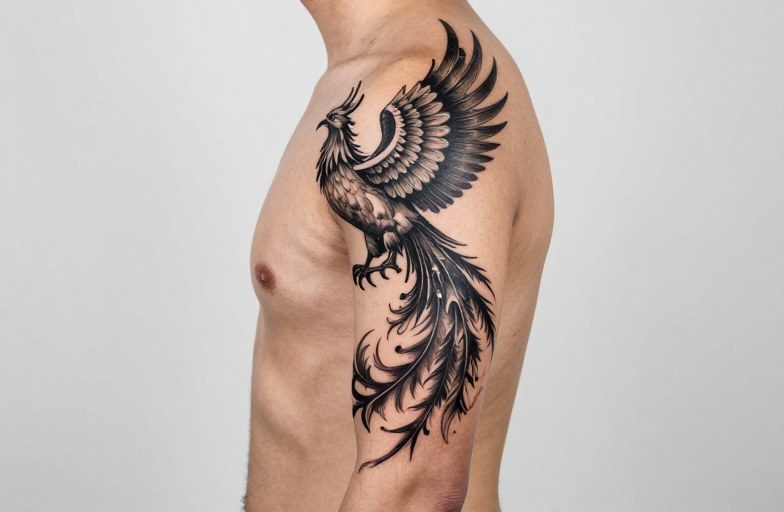
The tribal phoenix tattoo fuses the mythological bird of rebirth with the bold, high-contrast visual language of tribal tattooing. Stripped of color and rendered in sweeping black lines and geometric patterns, it becomes a symbol of transformation that reads clearly from a distance. The meaning centers on survival through destruction, rising after failure, loss, or personal collapse, with the tribal style adding an ancestral weight and raw graphic power.
Symbolism & Core Meaning
At its foundation, this design carries the phoenix’s ancient promise: what burns down can rebuild. The tribal treatment amplifies this through deliberate visual choices. Where a realistic phoenix might show delicate feathers and flame-colored plumage, the tribal version reduces the bird to essential force, beak, wings, tail, arranged in patterns that suggest motion and heat without depicting them literally.
The Fire Element in Black Ink
Tribal artists suggest flame through negative space and line weight rather than color. Tapered points, spiraling curves, and sudden thick-to-thin transitions create the impression of something alive and consuming. The absence of red or orange doesn’t weaken the fire symbolism; it makes it more stark and permanent. Black ink holds. A tribal phoenix at ten years looks like it did at two, which matters for a symbol about enduring through cycles.
Rebirth Without Sentimentality
The tribal style’s aggression suits people who want the rebirth narrative without softness. This isn’t a watercolor bird perched on a branch. The angles are sharp, the flow is muscular, and the overall impression is of something fighting its way back rather than gently emerging. For people rebuilding after addiction, divorce, prison, or profound failure, that visual tone can feel more honest than prettier alternatives.
Mythology & Folklore
The phoenix myth spans cultures, though details shift. Greek sources describe a single bird living for centuries, then building its own funeral pyre and rising from ash. Egyptian tradition, often linked to the bennu bird, connects it to solar cycles and the flooding Nile. Chinese phoenix imagery, the fenghuang, pairs it with the dragon and associates it with virtue and prosperity rather than solitary rebirth.
Tribal Tattoo Traditions
The “tribal” style as commonly practiced descends from Polynesian tattooing, Maori ta moko, Samoan pe’a, and related forms, though most contemporary tribal phoenix designs are fusion work rather than authentic cultural expression. Traditional Polynesian tattooing uses specific patterns with genealogical and status meaning, applied by hand with comb and mallet. Modern tribal phoenix tattoos borrow the visual vocabulary (bold black, geometric patterning, flowing asymmetry) without claiming the cultural framework. Some artists now explicitly distinguish between “tribal-style” and actual Indigenous tattoo practices, which matters for clients seeking respectful work.
Common Variations & Styles
Not all tribal phoenix tattoos look alike. The category has splintered into recognizable approaches, each with different technical demands and visual results.
- Neo-tribal: Incorporates gray shading, subtle color accents, or more realistic phoenix anatomy within bold black outlines. Softer than pure tribal but still graphic.
- Abstract geometric: The bird dissolves into pure pattern, wings become chevrons, body becomes a spiral, tail feathers become repeating triangles. Recognition depends on viewer familiarity with the motif.
- Biomechanical tribal: Merges tribal flow with mechanical elements, gears, pistons, metal plates, suggesting a phoenix rebuilt from technology rather than nature.
- Celtic knotwork hybrid: Interlaces tribal blackwork with endless knot patterns, particularly popular on upper arms and calves where the band format suits both traditions.
Linework vs. Solid Black
Pure linework tribal phoenixes use outline and negative space, healing faster and aging with cleaner edges. Solid black fill creates more dramatic contrast but requires heavier saturation, longer sessions, and more careful aftercare to prevent patchy healing. Large solid areas also risk “blowout”, ink spreading beyond intended lines, especially on thinner skin or areas with lots of movement.
Best Placements
The tribal phoenix demands space. Its wings need room to spread, and the tail’s flowing lines require uninterrupted canvas. Certain placements solve these needs better than others.
Upper Back and Shoulder Blades
The classic placement. Wings span the shoulder blades or wrap onto deltoids; the tail trails down the spine or curves along the lower back. This flat, broad surface lets the artist build symmetrical or asymmetrical compositions with equal clarity. Shirt coverage is easy, professional settings rarely see this area.
Thigh and Calf
The thigh offers a large, relatively flat surface with manageable pain levels. The calf’s natural taper suits phoenix tails that flow toward the ankle. Both locations keep the design visible in shorts but hideable for work. Calf tattoos do require careful afterthought about sock and shoe friction during healing.
Chest and Ribs
More painful, more private. A chest phoenix with wings extending across pecs creates powerful bilateral imagery. Rib placement suits smaller, more vertical compositions, phoenix rising rather than phoenix in full flight. The ribs move constantly with breathing, which challenges both the artist’s application and the client’s stillness.
Avoid: fingers, tops of feet, and behind the ear. These locations lack the real estate for meaningful detail, and blackwork in high-wear areas fades unpredictably.
How It Ages on Skin
Tribal tattoos age better than most styles, but the phoenix’s specific features present challenges. Fine tail feathers and delicate wing tips, common in more detailed designs, can blur over decades. The solution is in the original design: bold lines, generous spacing between elements, and avoidance of excessive detail that won’t survive skin’s natural changes.
Sun and Black Ink
Black ink absorbs UV radiation, which means it heats up and breaks down faster than lighter colors in sun-exposed skin. A tribal phoenix on the forearm or calf will soften and gray faster than one on the back or thigh. Consistent sunscreen application isn’t optional for long-term clarity, it’s maintenance.
Weight Fluctuation and Wing Geometry
Significant muscle gain or loss, pregnancy, or aging skin can distort symmetrical wing placement. The upper back is relatively stable; the abdomen and inner thighs are not. Artists often compensate by building slight asymmetry into the original design, so natural body changes look intentional rather than damaging.
Personal & Modern Meanings
Beyond the classical rebirth narrative, people choose this design for specific contemporary contexts. Recovery from addiction, where the phoenix represents a life that had to completely end before rebuilding could begin. Career reinvention after layoffs or industry collapse. Gender transition, with the burning and rising mapped onto bodily and social transformation. Military veterans leaving service and reconstructing civilian identity.
The tribal style’s aggression suits these contexts when the experience was brutal rather than gently evolutionary. Someone who quietly grew into a better version of themselves might choose a different aesthetic. Someone who crashed, burned, and clawed back often gravitates toward the visual weight of blackwork and sharp angles.
Modern collectors also sometimes choose the design simply for its graphic strength, without deep personal narrative. This is valid, the form itself carries enough cultural resonance that personal meaning can develop after wearing it. The tattoo doesn’t require a confession to justify its presence.
The Takeaway
The tribal phoenix tattoo works because two strong traditions reinforce each other. The phoenix brings narrative weight, transformation through destruction, the cycle of endings and beginnings. The tribal style brings visual permanence, bold clarity, and a rawness that refuses prettification. Together they create something that reads immediately across a room and sustains meaning across decades.
Choose this design if you want the rebirth symbol without decorative softness. Work with an artist who understands negative space and line weight, not just someone who can fill a stencil. Place it where it has room to breathe and where your life won’t constantly rub against healing skin. Maintain it with sunscreen and realistic expectations. The myth is ancient, but the skin is yours, and the combination is what matters.
Frequently Asked Questions
Does a tribal phoenix tattoo have to be all black?
Traditional tribal style uses only black ink, but neo-tribal variations sometimes add gray shading or small color accents. Pure black holds longer and stays truer to the style’s origins, though the choice depends on your aesthetic preference and your artist’s specialization.
How long does a full-back tribal phoenix usually take?
A large, detailed piece spanning the full upper back typically requires 15-25 hours across multiple sessions, depending on the artist’s pace, your pain tolerance, and whether the design uses solid black fill or primarily linework.
Will the detailed tail feathers blur together over time?
Fine details in any tattoo soften with age, but a well-designed tribal phoenix uses bold negative space between elements specifically to prevent this. Choose an artist who designs for the long term, not just fresh impact.
Is it disrespectful to get tribal-style work if I’m not Polynesian?
The key distinction is between borrowing visual style and claiming cultural meaning. Tribal-style phoenix tattoos that don’t replicate specific sacred patterns or pretend to be traditional ta moko are generally accepted as fusion art, though some artists prefer the term “blackwork” or “neo-tribal” to acknowledge the distinction.


Leave a Reply