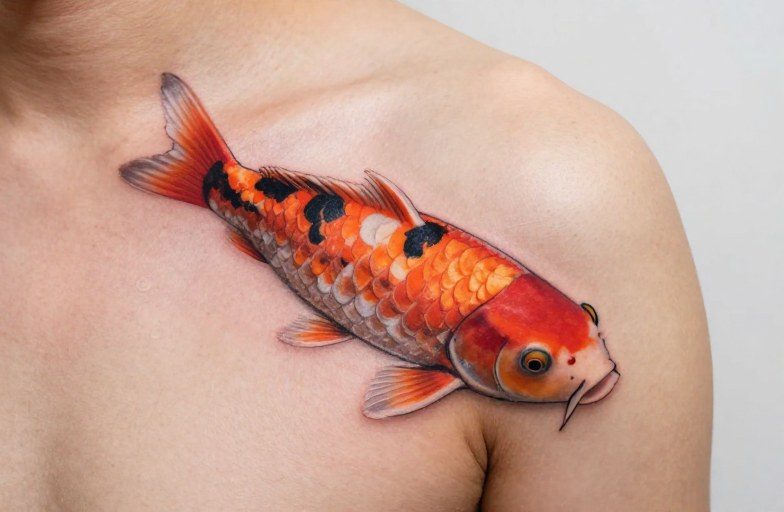
A Japanese koi tattoo primarily symbolizes perseverance, courage, and transformation. The imagery draws from the legend of koi swimming upstream and becoming dragons, an arc of struggle rewarded with metamorphosis. Color choices, direction of swim, and pairing with waves or lotus flowers all shift the specific meaning, making this one of the most narratively flexible designs in tattooing.
Color vs Black and Grey
Reading the Palette
Color in koi tattoos isn’t decorative fluff, it carries specific symbolic weight rooted in Japanese tradition. Red koi, the most common request, signify love, bravery, and motherhood. Gold or yellow koi map directly to wealth and prosperity. Black koi traditionally mark a overcoming of adversity, a survivor’s emblem. Blue skews toward serenity and the masculine, often chosen for son or father commemorations. White with red accents, the Kohaku pattern, signals career success and ambition.
White koi alone occupy trickier territory. They can represent purity or transformation, but in some contexts they carry funeral associations. A knowledgeable artist will flag this if you’re working from reference images alone.
Black and Grey Interpretations
Stripped of color, koi tattoos shift toward form and movement. The design lives or dies on contrast: crisp scales against water, the weight of the body suggested through graduated shading. Black and grey koi often read more somber, more focused on the struggle itself rather than the reward. They’re popular in larger backpieces where the fish needs to hold visual weight against complex backgrounds of waves, rocks, or wind bars.
Without color cues, the direction of swim becomes more critical. Upstream koi in black and grey emphasize defiance; downstream suggests you’ve already overcome and now possess the thing you fought for.
Personal & Modern Meanings
Contemporary wearers rarely hew strictly to traditional color codings. The koi’s core narrative, against-the-odds struggle, adapts to personal milestones: recovery from illness, surviving divorce, career pivots, military service, gender transition. The fish becomes a vessel because its story is structurally simple but emotionally open.
Modern compositions often pair koi with non-traditional elements: geometric frames, stippled backgrounds, or hybridized with other cultural imagery. These work when the artist understands Japanese tattoo fundamentals, scale patterns, fin placement, the S-curve of the body, rather than treating the koi as a generic fish shape. Poorly drawn koi read as catfish or goldfish; the specific anatomy matters.
- Two koi circling: partnership, duality, sometimes yin-yang concepts
- Koi with cherry blossoms: beauty’s transience, living fully before death
- Koi breaking water surface: achievement, the moment of transformation
- Koi with skull: memento mori, struggle against mortality itself
How It Ages on Skin
The Reality of Color Fading
Bright koi colors, especially the oranges, reds, and yellows, fade predictably. What reads as bold at month six softens significantly by year five. The yellow-golds often fade fastest, sometimes to a pale cream that loses its symbolic punch. Reds hold longer but can shift toward pink or brown depending on ink quality and sun exposure. Blacks and deep blues remain the most stable over decades.
White ink presents a specific problem. In koi work, white often highlights scales or creates the fish’s underbelly. It yellows on most skin tones and can disappear entirely into lighter complexions. Experienced artists plan for this, building contrast through negative space rather than relying on white alone.
Scale Detail and Skin Texture
Tight scale patterns look stunning in fresh photos but blur as skin ages and loses elasticity. The tiny circles merge into texture rather than readable pattern. Better long-term results come from slightly larger, more open scale work with stronger dark outlines defining the fish’s silhouette. Shading within scales, darker toward the spine, lighter at the belly, creates roundness that survives better than line-only approaches.
On areas with frequent movement (ribs, inner bicep, thigh), koi bodies can distort significantly. The curved spine that looks elegant in a reference drawing may warp with muscle flexion. Artists compensate by designing flatter body angles for high-movement zones.
Best Placements
The koi’s natural S-curve suits the body’s contours exceptionally well. Traditional Japanese placement follows the body’s musculature: wrapping the thigh, swimming up the forearm, curving across the shoulder blade. These aren’t arbitrary, they use the fish’s movement to enhance the body’s own geometry.
The full back remains the classic canvas for serious koi work. A large koi paired with crashing waves and wind bars creates a complete narrative environment. The scale allows for proper detail in fins, barbels, and the subtle color gradations that define premium koi varieties.
Forearms and calves work well for medium-sized single koi, though the cylindrical shape limits how dramatically the fish can curve. Ribs and sides offer vertical space perfect for upstream swimming compositions, but the pain factor and healing challenges (constant movement, friction from clothing) make this commitment significant.
Hands, feet, and necks present problems. The small scale forces simplification that loses the koi’s specific identity. Fingers in particular blur quickly; what starts as a koi becomes an indistinct orange blob within a few years.
History & Cultural Roots
The Legend’s Origins
The koi-dragon transformation story is often linked to Chinese mythology, specifically the Yellow River at Longmen, where carp that successfully leaped the waterfall became dragons. This narrative migrated to Japan and intertwined with Boys’ Day celebrations, where families flew koi-shaped streamers representing each son’s strength and potential.
In Japanese tattooing specifically, koi entered the repertoire through the same channels as other nature imagery: as part of full-body suits developed by woodblock-influenced artists in the late Edo and Meiji periods. The fish carried working-class associations, fishermen, manual laborers, before broader adoption.
Irezumi Context
Traditional Japanese tattooing (irezumi) treats koi as one element within larger compositions, rarely standalone. The fish swims through water, past lotus, beneath cherry blossoms, near turtles or dragons. Each element modifies the others. Isolating a koi from this context, common in Western tattooing, shifts the meaning toward personal symbolism and away from the collective narrative traditions of Japanese work.
Some trace specific koi varieties to particular regions or samurai clans, though these associations are less documented than cherry blossom or dragon clan links. The Magoi (black wild carp) specifically carries the strongest perseverance associations due to its actual behavior in rivers.
Who Chooses This Tattoo
The demographic has broadened significantly. Originally male-dominated in both Japanese and Western contexts, koi tattoos now cross gender lines extensively. Women often choose smaller, more delicately rendered koi or pair them with softer floral elements. Men still dominate the large-scale back and leg pieces, particularly in traditional Japanese styling.
Age patterns are notable. Koi frequently mark transition points, early thirties career changes, post-divorce, recovery milestones, military discharge. They’re less common as first tattoos than simpler imagery, suggesting people arrive at koi after living enough to identify with the struggle narrative.
Cultural background matters in execution choice, not eligibility. Non-Japanese wearers can absolutely choose koi, but the respect gap shows in quality. Those who research the tradition, find artists trained in Japanese fundamentals, and engage with the symbolism authentically get better tattoos than those grabbing Pinterest references for “pretty fish.”
Cover-up requests often land on koi because the fish’s body shape can absorb and redirect older linework. The flowing form and heavy shading capacity make it forgiving for hiding past mistakes, ironically, another transformation narrative.
The Takeaway
A Japanese koi tattoo rewards preparation. The symbolism is genuinely deep, but only when the craft supports it, proper anatomy, thoughtful color choices, placement that respects the body’s movement. Cheap koi work fails twice: aesthetically, as poorly drawn fish, and narratively, as hollow gesture toward meaning the wearer didn’t invest in understanding.
Choose this design when you have a specific struggle or transformation to anchor it to. The fish carries enough cultural weight that vague “strength” claims feel thin. Better to know whether your koi swims upstream or down, what color tradition maps to your situation, and why you’re pairing it with whatever surrounds it. The tattoo lasts longer than the moment of getting it; build something that sustains meaning through the years when the fresh ink excitement has fully faded.
Frequently Asked Questions
Does a koi tattoo’s direction, upstream or downstream, actually change the meaning?
Yes. Upstream koi represent ongoing struggle and perseverance against obstacles. Downstream koi suggest you’ve overcome the challenge and now possess the strength or reward gained through that effort. Some compositions include both to show the full journey.
Can I get a koi tattoo if I’m not Japanese?
The imagery is widely adopted globally, but execution quality varies enormously. Research artists who understand Japanese tattoo fundamentals, proper scale patterns, fin anatomy, and compositional traditions, rather than treating it as generic fish imagery. Respect for the craft matters more than ethnicity.
Why do some koi tattoos include lotus flowers or waves?
Lotus flowers reinforce the purity-through-adversity theme, since lotus roots in mud but blooms clean. Waves represent the obstacles the koi surmounts; their turbulence and scale relative to the fish show the magnitude of struggle. These aren’t random decorations, they’re narrative elements.
How much does color choice affect the long-term appearance of a koi tattoo?
Dramatically. Reds and oranges hold reasonably well but soften within five years. Yellows fade fastest, sometimes to near-invisibility. Blacks and deep blues remain stable for decades. White highlights often yellow or disappear. Plan your design knowing which colors will dominate the aged tattoo versus the fresh one.

Leave a Reply