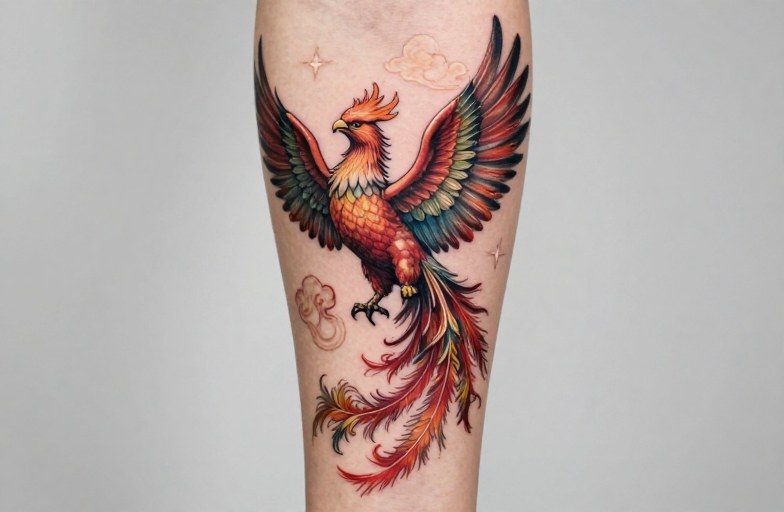
A phoenix mythology tattoo most commonly signals survival through destruction, rising after burnout, divorce, addiction, or loss. The bird’s cyclical death and rebirth gives visual form to the idea that endings aren’t permanent. Beyond personal recovery, it can mark ambition, creative regeneration, or simply an attraction to one of mythology’s most visually dramatic creatures.
How It Ages on Skin
Phoenix designs are notoriously demanding over time. The bird’s elaborate plumage, feathers rendered in fine lines, flame effects, dramatic wing spreads, contains exactly the kind of detail that blurs fastest.
Line Work vs. Saturated Color
Thin linework feathers soften into indistinct texture within five to eight years, especially on high-movement areas like shoulders and ribs where the skin flexes constantly. A phoenix built on bold outline with selective color packing ages far cleaner than one relying on hair-fine detail throughout. Red and orange inks, popular for flame elements, fade faster than black and blue; they also tend to spread slightly more under the skin, giving older flame work a watercolor-bleed quality that some people love and others regret.
Placement Reality
Upper arms and outer thighs offer the most stable canvas for complex phoenix composition. Chest pieces work well for the full wings-spread pose but require the wearer to commit to larger scale, small chest phoenixes often look crowded and lose legibility. The ribs and stomach, despite being classic “meaningful placement” territory, punish this design: the skin stretches with weight fluctuation, and the bird’s long tail feathers distort asymmetrically. Lower back phoenixes from the early 2000s now show significant sag-related warping as that skin ages.
- Black-and-grey phoenixes with strategic white highlights age 30-40% cleaner than full-color versions
- Single-needle feather detail requires touch-up within 3-5 years on most bodies
- Flame elements placed near joints (elbow, knee) distort predictably with movement
- Large-scale back pieces need 15+ hours; budget for multiple sessions and healing time between
Similar & Related Symbols
The phoenix shares territory with several other rebirth and renewal motifs, though each carries distinct visual and cultural weight.
Ouroboros and the Serpent
Where the phoenix emphasizes rupture and return, death as violent, rebirth as glorious, the ouroboros (serpent eating its tail) represents continuous cycles without the dramatic break. People drawn to phoenix mythology often reject the ouroboros as too passive, too closed-loop. Conversely, those who find the phoenix melodramatic sometimes prefer the serpent’s quieter self-containment. In composition, ouroboros wraps and frames; phoenix explodes outward.
Butterfly and Lotus
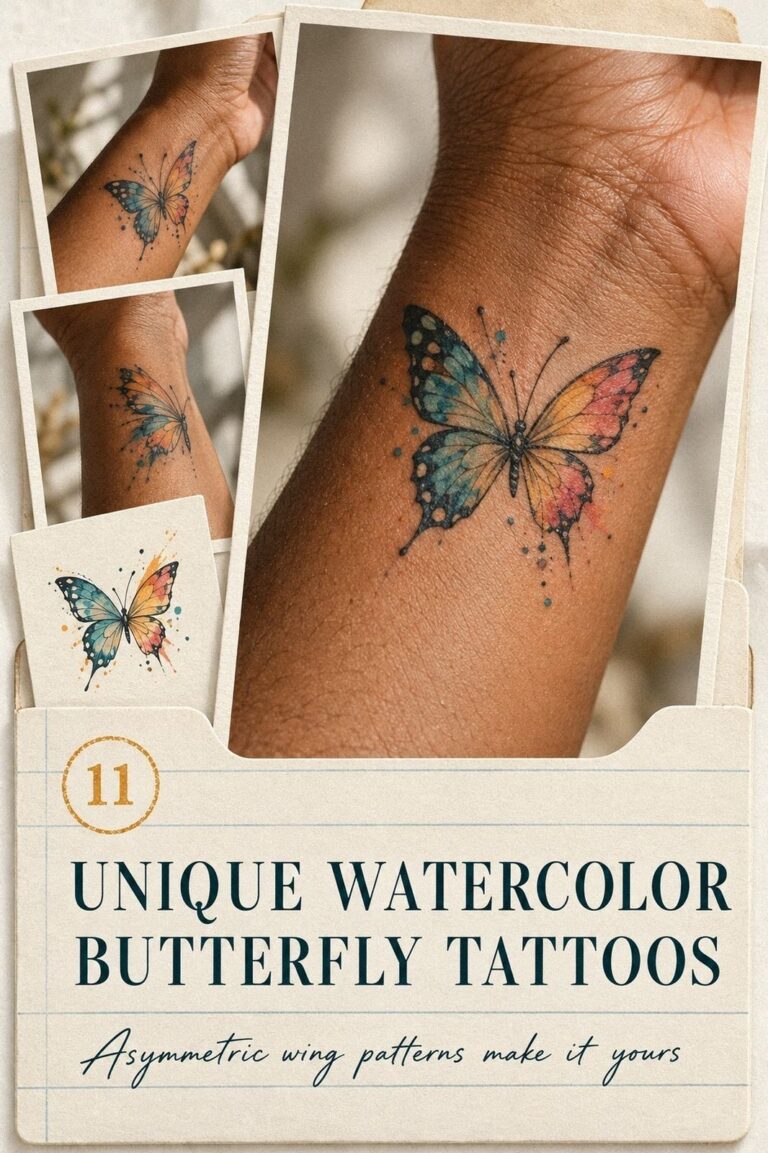
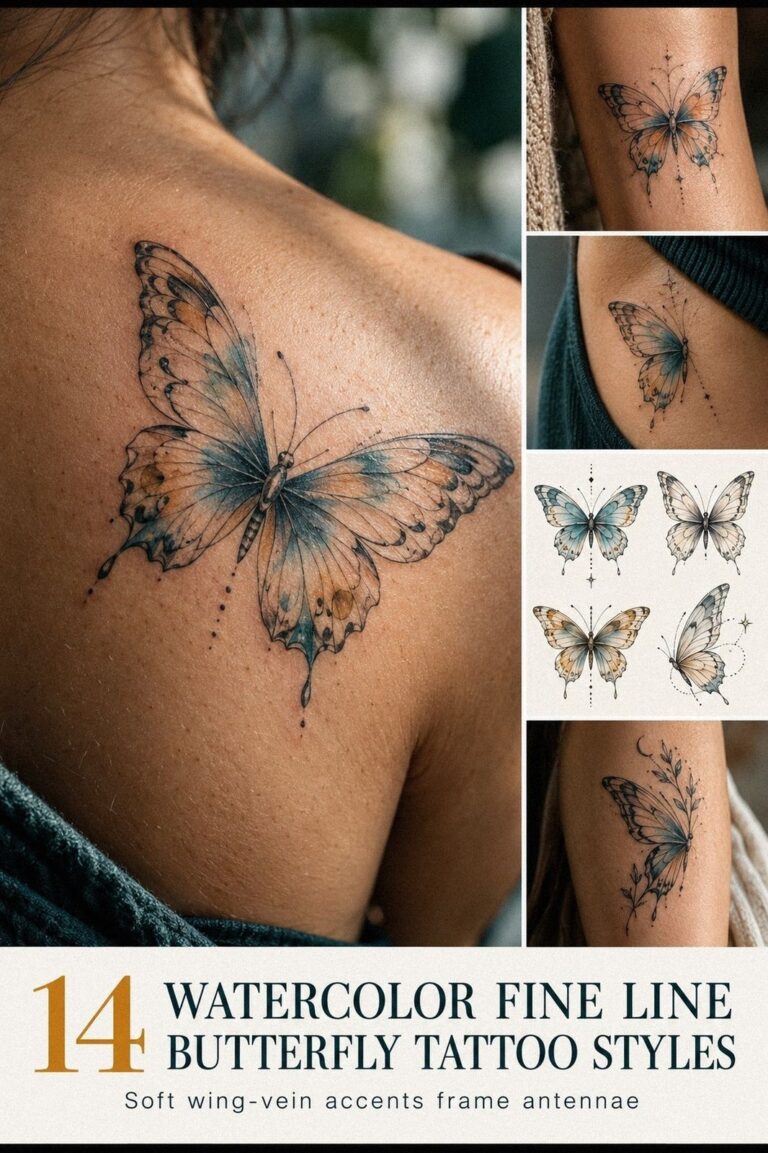
Butterfly transformation reads softer, more gradual, often gendered feminine in Western tattoo culture despite no mythological basis for that association. The lotus offers spiritual rebirth without the fire and ash. Neither carries the phoenix’s implicit aggression, the sense that something had to be destroyed against its will. Clients sometimes combine phoenix with lotus to balance destruction with peace, or with butterfly to sequence the transformation (ashes to wings, in effect).
Mythology & Folklore
The phoenix’s origins resist clean attribution, which hasn’t stopped tattoo culture from treating it as universally legible.
Classical and Early Sources
Greek writers from Herodotus onward described a bird of Arabia or Egypt that lived for centuries, built a pyre, and regenerated from the flames. Roman sources added the detail of a single egg laid in the nest of spices, from which the new bird emerged. These accounts were already blending observation, hearsay, and symbolic invention by the time they were written down. The Egyptian bennu bird, often linked to the phoenix in modern retellings, was actually a heron-like deity associated with solar cycles and creation, similar thematic territory, but distinct iconography that only merged with the phoenix in later European interpretation.
Chinese Fenghuang and Japanese Hou-ou
The fenghuang, sometimes translated as “Chinese phoenix,” is properly a paired masculine-feminine bird symbolizing virtue and prosperity, not individual rebirth. Its five-color plumage and association with the empress make it visually related but mythologically separate. The Japanese hou-ou descends from Chinese tradition but acquired Buddhist significance as a guardian of the law. Tattoo clients sometimes request “phoenix” and receive hou-ou-inspired designs without knowing the distinction, a meaningful mix-up when the wearer intended personal survival symbolism and got imperial virtue instead.
Who Chooses This Tattoo
Certain life circumstances predictably precede phoenix requests, though the execution varies enormously.
Post-Crisis Markers
Recovery from substance dependence, surviving abusive relationships, and major health events dominate the stated motivations. The tattoo functions as external proof of an internal shift, something visible when the struggle itself wasn’t. Less dramatically, career pivots and relocations also prompt phoenix work, particularly among people who burned professional bridges or left identities behind. The common thread is voluntary or involuntary destruction of a former self, with the bird marking the new construction.
Placement and Gender Patterns
Full-back phoenixes remain disproportionately male in American shop data, though the gap has narrowed since 2010. Women more often choose rib or thigh placements with the bird in flight rather than full display. Chest phoenixes cross gender lines but tend toward black-and-grey execution in masculine-presenting clients, color in feminine-presenting ones, a pattern reflecting broader tattoo culture conventions rather than anything inherent to the symbol.
Personal & Modern Meanings
Beyond mythology, the phoenix has accumulated contemporary associations that shift its use.
Entrepreneurship and Creative Burnout
Startup culture adopted phoenix imagery for “failing forward” and company pivots, which has bled into individual founders getting the tattoo after business collapse. Similarly, musicians and writers sometimes mark project abandonment and return with phoenix work, the album that never released, the novel shelved and rewritten. The meaning here isn’t survival of external attack but self-inflicted creative destruction, which carries a different emotional texture.
Commemorative and Memorial Use
Parents who lost children to miscarriage or stillbirth sometimes choose phoenix imagery, particularly when paired with dates or small additional elements (a single feather, a specific flower). The bird’s cyclical nature offers hope without denying the death. This usage requires careful composition to avoid visual cliché, too many memorial phoenixes default to identical crying-bird poses that flatten individual grief into generic symbol.
Religious & Spiritual Angles
The phoenix’s spiritual portability is both its strength and its vagueness.
Early Christian writers adopted the phoenix as resurrection symbol, a natural fit that persists in some Catholic iconography. This makes the tattoo available to believers who want bodily resurrection imagery without the crucifix’s explicit suffering. Contemporary pagan and eclectic spiritual practitioners often use the phoenix for personal transformation rituals, sometimes getting the tattoo to seal a magical working or dedication. The bird’s lack of fixed doctrinal attachment lets it travel between systems, though this same flexibility means it can read as spiritually noncommittal, decorative rather than devotional.
Some Buddhist practitioners specifically reject phoenix tattoos as misunderstanding the hou-ou’s role, or as importing Western individualism into imagery that originally signified collective harmony. This tension rarely surfaces in American shops but matters for clients with actual Buddhist practice versus aesthetic attraction to “Eastern” symbolism.
The Bottom Line
The phoenix mythology tattoo works best when the wearer genuinely needs the specific violence of its narrative, not gentle growth but burning and return. Its visual demands are significant: this is not a symbol that tolerates small scale or careless execution. The mythology is deep enough to reward research, common enough that lazy treatment blends into background noise. If you’re drawn to it, commit to the size and the sessions it requires, and be precise about which phoenix tradition you’re actually referencing. The difference between personal rebirth and imperial virtue is worth knowing before the needle starts.
Frequently Asked Questions
How big does a phoenix tattoo need to be to hold detail over time?
For legible feather detail that lasts, plan on at least 8-10 inches in the longest dimension. Smaller phoenixes inevitably sacrifice feather definition for readability, often ending up as generic bird shapes within a decade.
Can a phoenix tattoo work in black and grey, or does it need color?
Black and grey phoenixes age significantly better and can be striking with strategic white highlights for flame effects. Color isn’t required for the symbol to read; many experienced collectors prefer the longevity of greywash execution.
What’s the difference between a phoenix and a Japanese hou-ou tattoo?
The hou-ou derives from Chinese tradition and traditionally symbolizes virtue, prosperity, and Buddhist law rather than individual rebirth. Its plumage follows specific color conventions and it often appears with paulownia or bamboo. A phoenix emphasizes cyclical destruction and renewal.
How painful is a phoenix tattoo compared to other designs?
Pain depends entirely on placement, not imagery. A full-back phoenix involves spine, shoulder blade, and rib work, among the more intense locations. Upper arm or thigh phoenixes rate moderate, comparable to any large piece in those areas.
Leave a Reply