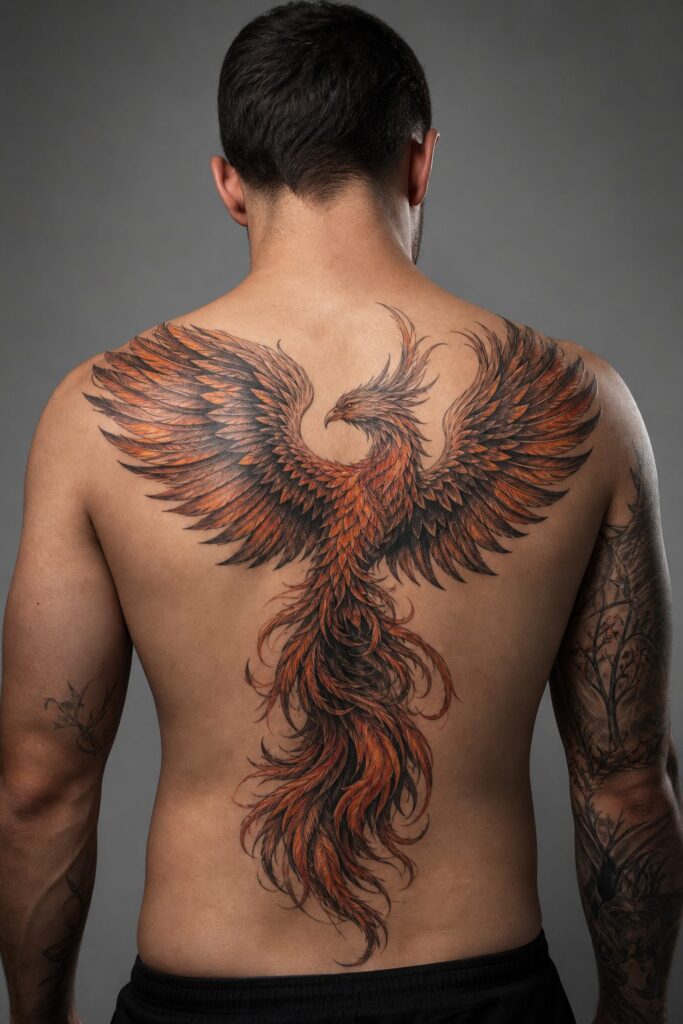
A phoenix on the back means survival through destruction, rising after burnout, divorce, addiction, or any collapse that didn’t finish you. The full back placement matters: the bird’s wingspan matches your shoulder width, and the spine becomes the center of the flame. This isn’t a small reminder hidden under a shirt; it’s a declaration that you rebuilt yourself.
Symbolism & Core Meaning
What the Phoenix Actually Represents
The phoenix burns and returns. That cycle, death as prerequisite for renewal, drives most back pieces. People choose it after concrete endings: career implosions, health crises, leaving countries or religions or marriages. The tattoo marks not just survival but active transformation, the willingness to let the old version char completely.
On the back specifically, the symbolism gains physical weight. You can’t see it without mirrors. Others register it before you do. That placement suits people who don’t need daily visual prompting, they carry the proof internally, and the tattoo exists for witness, not reminder.
Color vs. Black and Grey
Fire-colored phoenixes (scarlet, gold, orange) read as triumph, loud and unmissable. Black and grey versions shift toward solemnity, more funeral pyre than victory lap. Both work on the back; the choice depends on whether you want to commemorate what burned or celebrate what emerged. Many artists recommend color for the body and ash-grey for the trailing feathers, merging both readings.
Design Tips & Pairings
Composition for the Back Canvas
The full back offers rare symmetry. Centered phoenixes with wings spread across the shoulder blades read as classical and balanced. Asymmetrical designs, bird ascending from lower back toward one shoulder, flames trailing diagonally, create motion and break the “butterfly spread” cliché.
- Upper back focus: wings spanning scapulae, head at neckline, tail descending toward mid-back. Reads well in tank tops and open-back clothing.
- Full back piece: bird emerging from lower back flames, climbing the spine. Dramatic but requires 20-40 hours of sitting.
- Spine accent: phoenix body following the vertebral line, wings wrapping slightly to ribs. Painful on bone, but the anatomical alignment is striking.
Common Pairings That Work
Geometric mandalas behind the head or between wings add structure. Cherry blossoms or lotus flowers at the base ground the fire in organic cycles. Some clients add text, quotes, dates, names, spine-aligned or tucked in flame negative space. Script works best in the bird’s own language (Greek for the classical version, Chinese or Japanese characters if referencing the fenghuang), but English lettering tends to shrink the imagery into illustration-with-caption.
Clocks, hourglasses, or sundials paired with phoenixes often signal specific losses, time burned, time regained. Use them sparingly; the bird already carries temporal meaning.
Mythology & Folklore
Multiple traditions feed the modern phoenix, and conflating them creates muddled tattoos. The Greek phoenix, often linked to the sun god Helios, cycles every 500 to 1,461 years depending on the source. It builds its own pyre from aromatic branches, dies in flame, and the new bird rises from ash. Herodotus and Pliny the Elder described it; early Christians adopted it as resurrection metaphor.
The Chinese Fenghuang
The fenghuang differs significantly. Male (feng) and female (huang) aspects merged into one bird representing imperial virtue and cosmic balance. It appears during prosperous, peaceful reigns, not after destruction. Tattoo clients sometimes request “phoenix” and receive fenghuang-inspired designs with peacock tails and five-color plumage. Know which lineage you want. The fenghuang pairs with the dragon in wedding symbolism; solo, it carries different weight.
Japanese and Egyptian Variants
Japanese hou-ou resembles the fenghuang, associated with the south and fire season, appearing as auspicious omen. The Egyptian bennu, a heron-like solar bird connected to Osiris and rebirth, predates Greek accounts. Some trace the phoenix concept to Egyptian texts, though direct lineage remains debated. Tattoo designs rarely distinguish these; the visual language has merged into a generic “mythic fire bird.” Specificity in your reference images prevents generic results.
Religious & Spiritual Angles
Christian Adaptation
Early church fathers used the phoenix as natural proof of resurrection. Clement of Rome referenced it; the bird appears in medieval bestiaries. Modern Christian wearers sometimes add crosses, ichthys symbols, or scripture references. The back placement suits this, baptismal imagery of death and rebirth, the spine as spiritual axis. However, the phoenix remains extra-biblical; some denominations view it as pagan syncretism.
Secular and Personal Spirituality
Non-religious clients gravitate toward the phoenix as pure metaphor for psychological resilience. No deity required; the fire is circumstance, the ash is depression or trauma, the flight is therapy, sobriety, or simply enduring. This interpretation dominates contemporary back pieces. The tattoo becomes ritual object, something endured (painfully applied) that marks endurance itself.
Some New Age practitioners associate the phoenix with kundalini rising, spinal fire awakening. The back placement then aligns with chakra systems, flames at the base, bird emerging at crown. This reading requires informed consent between artist and client, esoteric symbolism embedded in anatomy demands precision.
How It Ages on Skin
Line Weight and Detail Survival
Back skin varies dramatically by zone. Upper back and shoulder blades, thick, relatively immobile, hold detail well. Lower back and flank areas stretch and compress more, blurring fine lines over years. The phoenix’s delicate feather barbs and flame tendrils suffer first. Artists compensate with heavier line weights in high-movement areas and strategic simplification of wing edges.
Color saturation determines longevity. Warm pigments (reds, oranges, yellows) fade faster than cool tones, and sun exposure accelerates this. A bold fire bird in 2025 may read as muted copper by 2035. Black and grey ages more gracefully but can muddy if over-shaded. The solution: initial design with contrast gaps, not continuous dense fill, allowing future touch-ups to refresh rather than rebuild.
Scale Reality
Full back phoenixes require large scale to resolve. Wings smaller than 8 inches across lose individual feather distinction; the bird becomes generic bird. Most effective pieces use the full shoulder-to-shoulder width. This commits the entire back and limits future additions. Plan accordingly, surrounding the phoenix later with filler elements rarely integrates cleanly.
Similar & Related Symbols
Clients considering phoenixes often compare related imagery. Understanding distinctions prevents regret.
- Ouroboros: Snake consuming its tail, cyclical renewal without the destruction-rebirth drama. More cosmic, less personal. Works better as arm band or chest piece than full back statement.
- Butterfly/moth: Transformation through metamorphosis, gentler, less violent. Common for gender transition or coming-of-age. Lacks the phoenix’s explicit “I survived the fire” weight.
- Dragon: Power and protection, Eastern or Western variants. Can pair with phoenix in yin-yang compositions, but solo dragon reads differently, established strength rather than recovered strength.
- Rising sun: New beginnings, simpler, less narrative. Often too generic; the phoenix offers specific story structure.
- Three-headed raven/Corvus variants: Memory and prophecy, Norse and Celtic strands. Darker, more fatalistic. Less common but emotionally precise for certain losses.
The phoenix dominates back placement specifically because its wings demand horizontal span. Ouroboros and dragon coil vertically; butterflies scale too small. The back’s architecture suits the bird’s architecture.
Final Thoughts
A phoenix on the back succeeds when the wearer understands what burned. The tattoo’s power comes from specificity, your particular collapse, your particular reconstruction. Generic rebirth imagery decorates; earned rebirth communicates. Work with artists who ask what the fire was, not just how you want the flames to look. The best back pieces carry that history in every feather, visible to the world behind you, invisible to you except in reflection, which is, finally, the point.
Frequently Asked Questions
How painful is a full back phoenix tattoo compared to other placements?
The upper back over muscle tolerates needles well. Spine, shoulder blade edges, and lower back near kidneys hurt significantly more. Expect 15-30 hours total for detailed work, usually split across multiple sessions.
Can a phoenix back tattoo be covered up later if I change my mind?
Large, dark phoenixes are difficult to cover. The extensive black and saturated color limit options. Laser removal is possible but expensive for full back scale. Commit to the design before starting.
What’s the difference between a phoenix and a fenghuang tattoo?
The phoenix rises from ashes after destruction; the fenghuang appears during prosperity and peace. Visually, fenghuang designs incorporate peacock tails, pheasant features, and five colors. Clarify which tradition you want with your artist.
How do I keep the red and orange colors from fading too fast?
Strict sun protection is essential, clothing coverage or high-SPF mineral sunscreen. Initial aftercare matters less than long-term UV avoidance. Plan for touch-ups every 5-8 years to maintain vibrancy.
Related Tattoo Meanings
One response to “Phoenix On Back Tattoo Meaning: Symbolism & Design Guide”
[…] Phoenix On Back Tattoo Meaning: Symbolism Design Guide […]
Leave a Reply