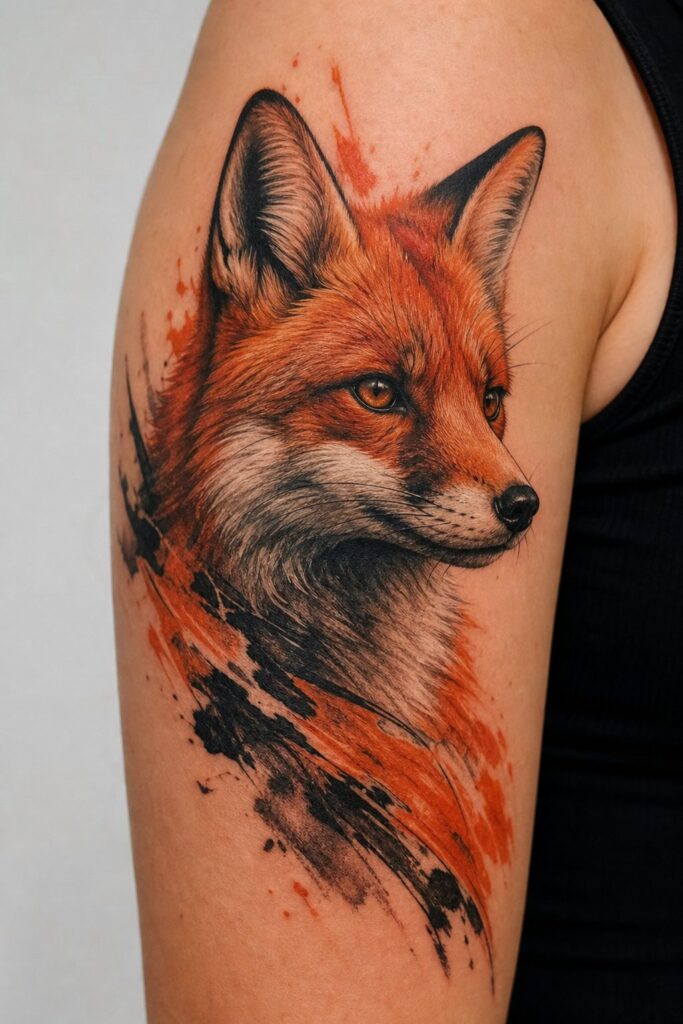
The cervena fox tattoo draws its name and spirit from Slavic and Central European folklore, where the red fox, cervena meaning red in several Slavic languages, operates as a figure of cunning, survival, and transformation. In the imagery, she is flame-colored, impossible to catch, and often one step ahead of hunters, farmers, and even death itself. The tattoo channels that specific energy: intelligence with an edge, adaptability without surrender, and a certain wildness that refuses domestication.
Who Chooses This Tattoo
People drawn to the cervena fox rarely announce themselves. They tend to be readers, gamers, folklore enthusiasts, or those with Slavic heritage reconnecting with roots their grandparents spoke about in kitchen-table stories. The appeal crosses cleanly between men and women, though the expression differs.
Heritage Seekers vs. Aesthetic Adopters
For those with Czech, Slovak, Polish, or broader Slavic ancestry, the cervena fox functions as a cultural anchor, something more specific than a generic Celtic knot or vague “tribal” band. It says I know where this comes from. For others without that lineage, the attraction is the archetype itself: the trickster who survives by wit, not force. Both groups are valid, but the tattoo hits differently when there’s actual blood memory behind it. Artists notice this in consultation; the heritage client usually has a specific regional tale they want referenced, while the aesthetic client responds more to the visual drama of russet fur and sharp eyes.
The Gaming and Fantasy Crossover
Video games and fantasy novels have amplified fox imagery significantly. The cervena fox specifically appears in Slavic-inspired game settings, and some clients arrive with screenshot references. The challenge for the artist becomes translating a digital render into something that ages on skin, flattening exaggerated proportions, adjusting colors that only glow on backlit screens, and grounding the piece in anatomical reality so it doesn’t look like a sticker in five years.
History & Cultural Roots
Slavic fox folklore runs deeper than the sanitized Aesop version most English speakers grew up with. The cervena fox is often linked to vila and other shape-shifting spirits, blurring the line between animal and something supernatural. In some Moravian and Slovak tales, the fox leads the hunter in circles until dawn, not out of malice but as a test, only the worthy catch their quarry, and sometimes the quarry was never truly an animal at all.
Regional Variations in the Stories
Bohemian traditions emphasize the fox’s connection to fire and the hearth, sometimes as a thief of warmth, sometimes as a bringer of it. Carpathian stories, by contrast, lean into the predatory and dangerous, the fox as something that walks near villages but belongs to the deep forest. These distinctions matter for tattoo design. A Bohemian-reference piece might incorporate flame motifs or domestic architecture in the background. A Carpathian-influenced one might use darker shading, pine or birch elements, and a more aggressive posture.
From Oral Tradition to Visual Symbol
The jump from spoken folklore to skin art happened gradually. Some trace it to 20th-century Czech illustration revivalists who rendered folk tales in bold, graphic styles suitable for print and later adaptation. The tattoo form crystallized more recently as Slavic pagan revival movements and neo-folk aesthetics gained visibility in European and North American tattoo communities. It’s not an ancient tattoo tradition, it’s a modern interpretation of genuinely old stories.
Religious & Spiritual Angles
Christianization of Slavic regions attempted to suppress animal-spirit folklore, but the cervena fox persisted in liminal spaces, neither fully demonized like the wolf nor sanctified like the lamb. This ambiguity makes her spiritually flexible for modern wearers.
Pagan and Rodnover Connections
Contemporary Slavic native faith practitioners sometimes invoke the fox as a spirit of cunning and boundary-crossing, associated with Veles or other chthonic figures rather than the thunder-god Perun. The tattoo in this context functions as a kind of devotional mark or protective emblem, though practitioners vary widely in how literally they take such symbolism. Most artists working with these clients report requests for specific accompanying runes or ritual symbols that require research to execute respectfully.
Secular Symbolism
Plenty of cervena fox wearers hold no spiritual affiliation at all. For them, the symbolism collapses to personal qualities: outsmarting systems that weren’t built for them, recovering from situations where they were underestimated, or simply refusing to be pinned down. The fox’s biological reality, small, solitary, opportunistic, successful, resonates more than any metaphysical overlay.
Design Tips & Pairings
The cervena fox lives or dies in color choice and line quality. “Red” in the name is not optional; the tattoo needs warmth to read correctly, though how that warmth arrives varies by technique.
Color vs. Black and Grey
Full color with orange, russet, and cream yields the most immediate readability, especially for clients with lighter skin tones where the reds can pop without fighting undertones. On darker skin, artists often shift strategy: deeper crimson and burnt sienna rather than bright orange, or a black-and-grey approach with selective red highlights in eyes or tail tips. The latter ages better anyway, pure orange pigments are notorious for fading to a muddy peach within a decade.
Common Pairings and Compositional Choices
- Forest elements: Birch trunks, pine needles, or mushrooms ground the fox in her habitat and provide vertical framing for arm or leg placements.
- Floral accents: Poppies, cornflowers, or marigolds add Slavic regional specificity; avoid generic roses or lotus flowers that dilute the cultural anchor.
- Celestial motifs: Moon phases or stars pair naturally with the fox’s nocturnal associations in folklore.
- Script: Short phrases in Czech, Slovak, or Old Church Slavonic work when the client actually reads the language; otherwise it’s costume.
Line weight matters enormously. Fine single-needle fur detail looks stunning fresh but blurs within years. A mix of bold contour lines for structure with medium-weight texture lines for fur gives the best longevity compromise.
Best Placements
The cervena fox’s elongated body and sweeping tail suit vertical or diagonal compositions better than strict horizontal bands. Artists steer clients away from trying to force her into a standard lower-back or wrist-band format.
High-Impact Locations
The outer thigh offers the most real estate for a full-figure pose with environmental context, forest floor, moon, running motion. The ribcage works for a coiled or leaping posture, though the pain factor and the area’s tendency to blur with age make this a commitment for experienced collectors. The upper arm, particularly wrapping from outer to inner bicep, accommodates a mid-stride fox with tail flowing over the shoulder.
Smaller Adaptations
Behind the ear or on the wrist, the design must simplify to head-and-shoulders or a curled sleeping form. These work best as black-and-grey with minimal detail, or as a small color piece with limited palette. The ankle and foot see heavy wear and sun exposure; a cervena fox here fades faster than average, so the client needs to understand maintenance realities.
Similar & Related Symbols
The cervena fox occupies a crowded symbolic neighborhood. Understanding adjacent imagery helps clients clarify what they actually want and helps artists avoid lazy visual shorthand.
The Japanese kitsune is the most common confusion. Multiple tails, temple settings, or specific facial markings signal Japanese tradition, not Slavic. The European Reynard the Fox tradition overlaps more closely, medieval beast-epic material from France and Germany that influenced Slavic storytelling, but tends toward satire and social commentary rather than the mystical survival focus of the cervena.
The wolf carries more pack-oriented, warrior symbolism across most European traditions; the cervena fox is solitary by contrast. The raven shares trickster territory but operates in air and death-symbolism rather than earth and fire. For clients wanting Slavic specificity without the fox, the firebird (zhar-ptitsa) offers a more overtly magical alternative, while the bear connects to Veles and healing traditions.
What to Remember
The cervena fox tattoo succeeds when the wearer knows why the fox is red, not just that she looks striking. The color is functional camouflage in autumn forests, and it’s the visual cue that separates this figure from generic fox tattoos. Design for the long term: warm pigments shift, fine lines spread, and the skin you have at thirty is not the skin you’ll have at fifty. Work with an artist who can render animal anatomy accurately, a fox that reads as dog or cat undermines the entire point. And respect the source. Slavic folklore isn’t empty aesthetic material; it’s living culture for millions of people. The tattoo should reflect that weight, if you’re inside that heritage or borrowing from its edge with awareness.
Frequently Asked Questions
Does the cervena fox tattoo have to be in color to work?
No, but it needs some warmth to read as ‘cervena.’ Black-and-grey with selective red in eyes or tail tips often ages better than full orange. Pure black-and-grey risks looking like any other fox unless the Slavic context is built in through accompanying symbols.
How do I make sure my cervena fox doesn’t look like a Japanese kitsune?
Avoid multiple tails, temple or torii imagery, and specific facial markings like the hoshi no tama star. Stick to European forest environments, Slavic floral or celestial accents, and consult your artist about regional visual differences in folklore art.
What’s the most common mistake people make with this design?
Overloading fine detail in fur texture that won’t survive five years of skin aging. A good artist balances bold structure lines with medium texture work, and keeps the face readable at a distance since that’s where expression lives.
Can I get this tattoo if I don’t have Slavic heritage?
Yes, but approach it with the same respect you’d bring to any culturally specific symbol. Research the stories, avoid mixing unrelated traditions, and be prepared to explain why this particular figure resonates when asked.


Leave a Reply