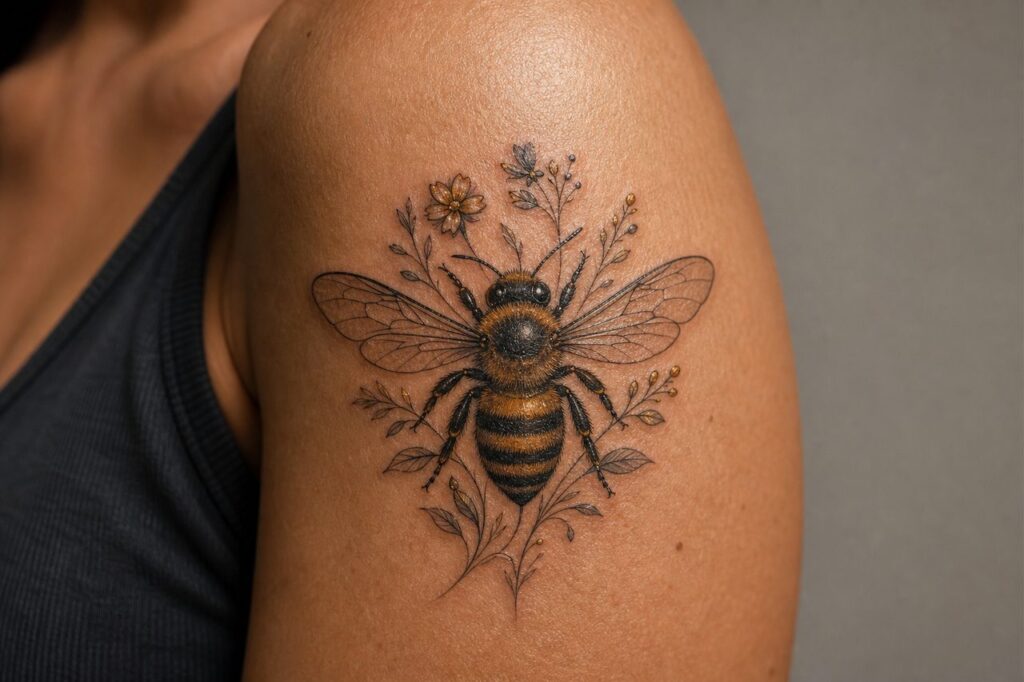
A bee tattoo most commonly represents hard work, loyalty, and the balance between individual effort and collective good. The symbolism stretches from ancient mythology to modern workplace culture, making it one of the most versatile insect designs you can wear. Some people choose it to mark a period of intense personal labor; others for the sweetness that follows struggle, playing on the honey connection.
How It Ages on Skin
Ink on skin is a slow negotiation with time, and bee designs have specific vulnerabilities you should plan for from the start.
Line Work vs. Shading
Thin wing veins and delicate antennae are the first casualties of aging. A bee’s striped body holds up well, bold black bands against yellow or uncolored skin maintain readability for years. The problem areas are the extremities. Wings drawn with single-needle lines blur into soft gray smudges within five to eight years, especially on high-movement spots like wrists or ankles. If you want longevity, ask for wing structures that use slightly heavier line weight or stippled shading rather than hair-thin outlines.
Yellow ink presents another challenge. Most yellow pigments fade faster than black, shifting toward a mustard or cream tone. On lighter skin, this softens the contrast; on darker skin, the yellow may disappear almost entirely, leaving only the black stripes. Some artists compensate by packing more pigment or switching to a golden-orange base that retains visibility longer.
Placement Realities
- Forearms and calves: Good visibility, moderate sun exposure, the stripes stay crisp
- Fingers and hands: Rapid fading, lines blow out, bees become blobs, generally avoid
- Ribs and sternum: Fine for detail, but stretching and weight fluctuation distort the rounded body shape
- Behind the ear: Popular for small bees, but expect touch-ups; the area sheds ink quickly
Black-and-gray bees age more gracefully than full-color versions. If you want color, consider limiting it to the stripes and leaving wings in graywash.
Similar & Related Symbols
Bee imagery sits within a broader family of insect and nature tattoos that carry overlapping but distinct meanings.
Close Comparisons
The wasp shares the striped body and wings but carries sharper associations, defense, aggression, the capacity to sting. Where bees die after one sting, wasps survive multiple attacks, making them symbols of persistence through conflict rather than sacrifice. A hornet amps this up further toward intimidation.
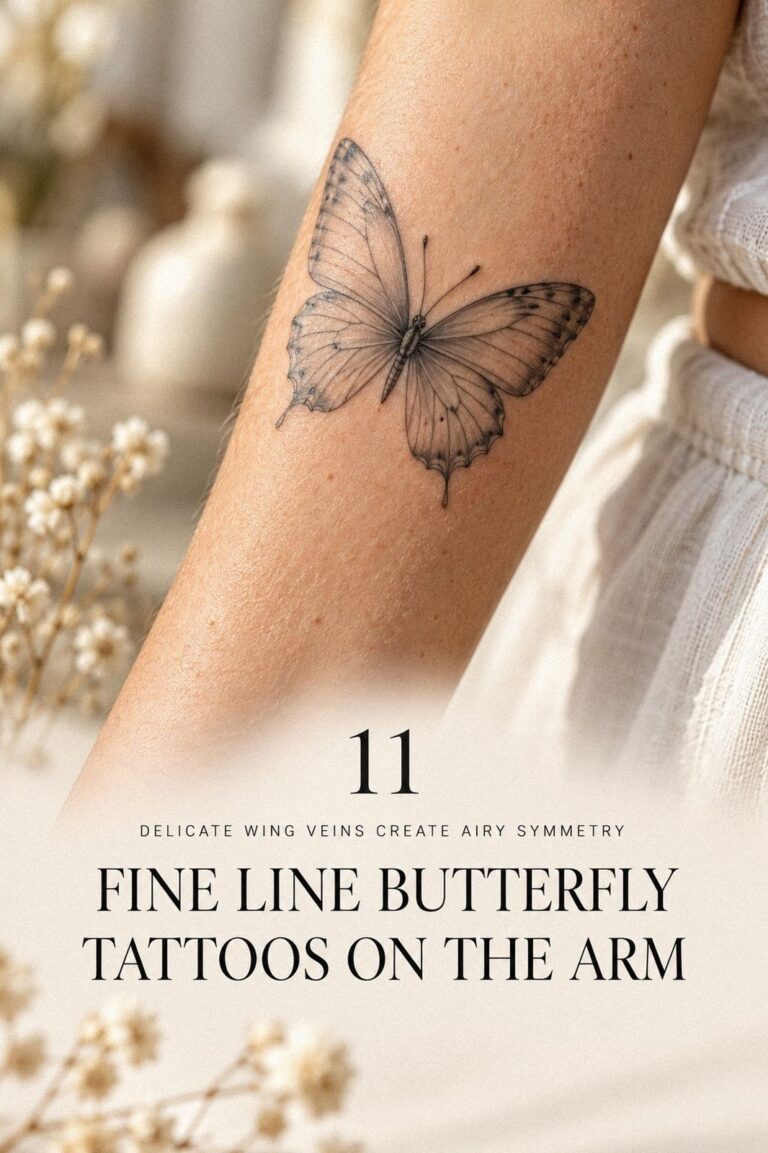
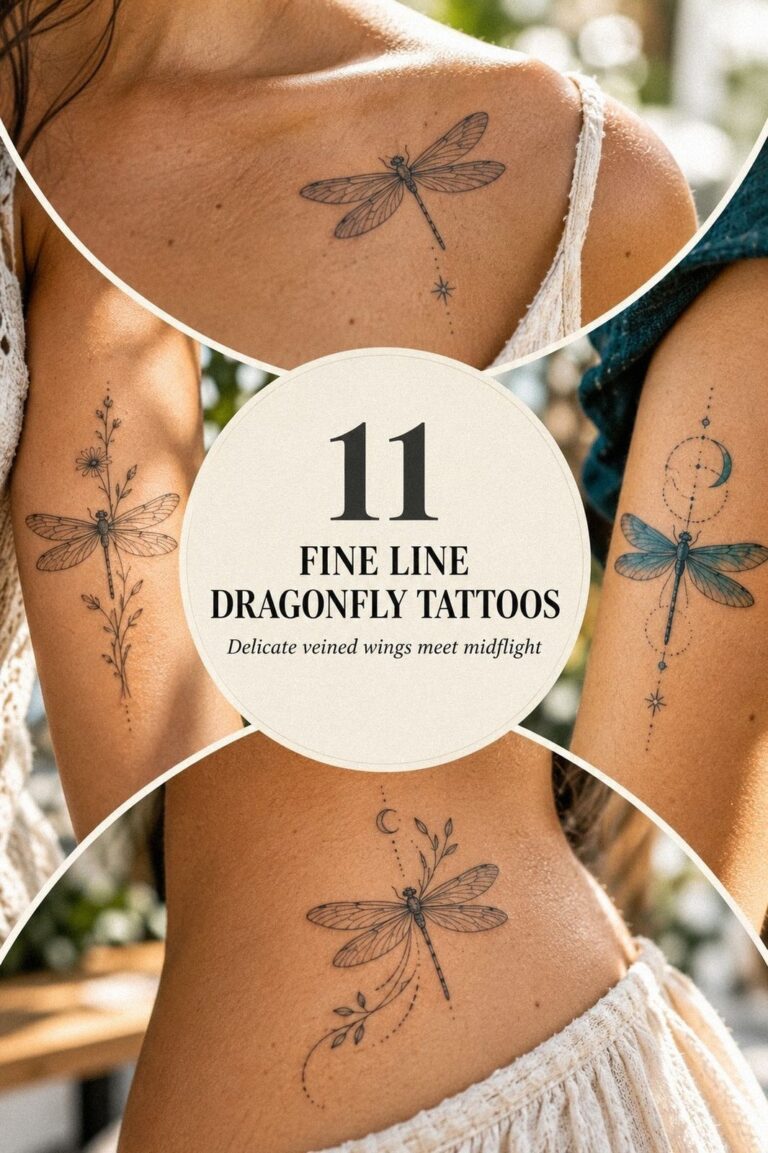
Butterflies and moths represent transformation, but passively; the bee’s meaning stays rooted in ongoing labor. A butterfly marks change completed; a bee marks work continuing. Dragonflies share the wing structure and flight symbolism but lean toward adaptability and illusion rather than productivity.
Combinations That Shift Meaning
- Bee + flower: The natural relationship, emphasizing pollination and mutual benefit
- Bee + honeycomb: Structure, order, the architecture of collective effort
- Bee + skull: Mortality of the worker, the finite life of service, or environmental warning
- Bee + crown: Leadership within the hive, the queen aspect specifically
Bees also pair naturally with agricultural imagery, wheat, sunflowers, fruit, emphasizing the harvest that follows labor.
Personal & Modern Meanings
Contemporary wearers often layer personal significance onto traditional symbolism without contradicting it.
Work and Career
The “worker bee” concept translates directly into modern hustle culture, though many people now use it with more ambivalence. Some wear it to celebrate grind and productivity; others as gentle mockery of their own overwork, a small joke about being “busy as a bee” in a system that extracts their labor. The same image carries both sincere pride and ironic distance depending on context.
Entrepreneurs sometimes choose bees to mark self-built businesses, especially in food, agriculture, or creative fields where the connection to “making” feels literal. The Manchester bee, adopted after the 2017 arena bombing, has become a specific regional symbol of resilience and community solidarity, distinct from general bee meaning, but widely recognized in the UK.
Relationships and Identity
Bees function as matching tattoos for couples or friends who see themselves as a “hive”, interdependent, each with roles, producing something together they couldn’t alone. This works especially well for people in collaborative professions or shared creative projects.
For some, the queen bee specifically represents feminine authority, reproductive power, or matriarchal family structures. The drone’s single reproductive function and death after mating offers a darker mirror: pure biological purpose, consumed by it.
Design Tips & Pairings
A bee’s small size tempts people toward minimalism, but the anatomy rewards detail if you have the space.
Style Approaches
Traditional American handles bees well: bold outlines, limited color palette, the stripes read instantly even at small scale. Neo-traditional allows for more ornamental wings, jewel tones, decorative florals. Realistic bee portraits require a larger minimum size, about three inches across, to render the fuzzy thorax, segmented eyes, and translucent wing membranes with any fidelity. Below that threshold, realism collapses into indistinguishable dark spots.
Geometric and dotwork bees have gained traction, using hexagonal patterns to reference honeycomb structure within the body itself. This reads as clever design but can sacrifice immediate bee recognition from distance.
Color Strategy
- Classic: Black and yellow, high contrast, universally readable
- Monochrome: Black and gray, better aging, subtle, works on any skin tone
- Muted: Amber, ochre, burnt orange instead of bright yellow, more sophisticated, less cartoon
- Blue or green bees: Orchid bee reference, rare in nature, signals uniqueness or tropical connection
Consider the direction of flight. A bee facing upward suggests aspiration; downward, returning home; horizontal, in motion. Tattoo flow should follow muscle structure, along the forearm, not across it, for instance.
Religious & Spiritual Angles
Bee symbolism predates organized religion but was absorbed into several spiritual traditions.
Ancient and Pagan Connections
The bee was often linked to goddesses of love and fertility, Aphrodite, Demeter, later the Virgin Mary through medieval iconography where bees represented her purity and productive sweetness. Some trace the “bee” connection to the Hebrew word for Deborah, meaning “bee,” and the prophetess-judge of that name. The Delphic oracle was sometimes called “the bee” in ancient Greek sources, and priestesses of various mystery cults used bee imagery.
Honey itself carried sacred weight across cultures: food of the gods, preservative, symbol of eloquence (“honey-tongued”). A bee tattoo can channel this older sense of divine messenger or sacred laborer rather than modern work ethic.
Contemporary Spirituality
In some modern pagan practice, bees represent the threshold between worlds, their flight between flower and hive, their transformation of nectar into honey, mirrors spiritual alchemy. Environmental spirituality uses bee imagery to signal concern for colony collapse disorder, pollination crisis, and ecological interdependence. This meaning is activist rather than personal, marking the wearer as someone who sees small creatures as systemically vital.
History & Cultural Roots
The bee’s symbolic career spans millennia with remarkable consistency.
From Antiquity to Empire
Napoleon adopted the bee as his personal emblem, associating himself with industry, order, and the idea of a ruler who serves the collective. French imperial bees appeared on furniture, clothing, and architecture, gold bees on a crimson field. This political usage complicates the symbol: the same image means democratic cooperation or imperial authority depending on context.
Earlier, Egyptian culture used the bee in royal titulary. The king of Lower Egypt was “He of the Bee,” though scholars debate whether this refers to actual apiculture or a broader symbol of kingship. The bee and sedge plant together represented the unified kingdom.
Regional Variations Today
Utah’s beehive appears on its state flag, tracing back to Mormon settlers who called their territory “Deseret”, a word from the Book of Mormon commonly associated with honeybees. A bee tattoo there carries specific regional identity. In Appalachia, beekeeping families sometimes mark generations with bee imagery. European heraldry used bees for similar virtues: industry, thrift, productive citizenship.
Understanding this history helps avoid unintended associations. A bee with imperial French styling reads differently than one with folk-art naivety or scientific illustration accuracy.
Final Word
The bee endures as tattoo imagery because it balances specificity with flexibility. Everyone recognizes it; few agree on exactly what it means for any given wearer. That productive ambiguity lets you claim the aspects that fit, labor, sweetness, community, sacrifice, environmental concern, without being locked into a single narrative. The design succeeds technically when you respect its structural limits: bold stripes, careful wing treatment, honest placement. It succeeds personally when you know which of its many histories you’re entering, and why.
Frequently Asked Questions
Does a bee tattoo always mean hard work, or can it have negative meanings?
The bee is overwhelmingly positive, but context matters. Paired with barbed wire or dark imagery, it can suggest feeling trapped in labor. The wasp and hornet are deliberately chosen for aggression, so a bee misread as those carries unintended hostile energy. Most negative readings come from placement or combination, not the bee itself.
What’s the difference between a worker bee and queen bee tattoo?
Worker bees are smaller, simpler, and symbolize collective effort and anonymity. Queen bee designs are larger, often crowned or centered, emphasizing leadership, fertility, and singular authority. The visual distinction matters, choose based on whether you want to emphasize your role within a group or your individual power.
How small can a bee tattoo be before it becomes unrecognizable?
Below one inch, the stripes merge and wings disappear into a dark blob. For a readable bee with basic detail, plan for at least 1.5 inches. Realistic or highly detailed bees need three inches minimum. Simple traditional-style bees survive best at small scale due to their bold outlines and limited detail.
Is the Manchester bee different from other bee tattoos?
Yes, it’s a specific symbol of resilience adopted after the 2017 Manchester Arena bombing, featuring a distinct stylized worker bee. Wearing it without connection to Manchester or awareness of its origin can seem appropriative or clueless. If you love the design, research its specific graphic history before committing.
Leave a Reply