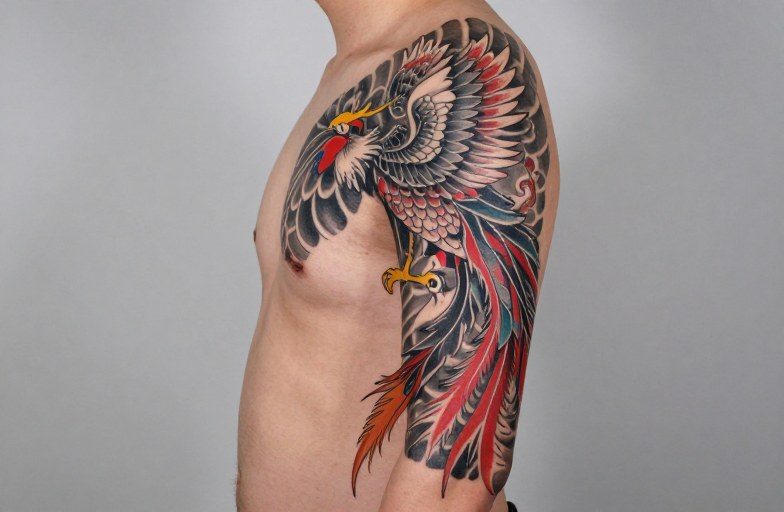
Japanese phoenix tattoos draw from the ho-ou, a mythical bird of renewal and virtue that’s been part of East Asian iconography for centuries. Unlike the Western phoenix rising from literal ashes, the ho-ou appears during eras of peace and righteous rule, an auspicious symbol rather than a recovery narrative. For tattoo collectors, this opens up design territory beyond the typical rebirth cliché: you can work with flowing tail feathers, flame-shaped plumage, and the bird’s distinctive five-color scheme of red, green, yellow, white, and black.
Trending Variations
Current shop floors are seeing several distinct approaches to the ho-ou that move past the standard spread-wing pose.
Pairing with Peonies
The ho-ou and peony combination has solid roots in traditional irezumi, but lately it’s showing up in tighter compositions, half-sleeves and thigh pieces rather than full back panels. The peony’s soft, layered petals contrast the phoenix’s sharp feather geometry, giving the artist room to vary line weight and saturation density across the piece. Red peonies with a predominantly red-and-gold bird risk bleeding together over time; consider purple or black-outline peonies to maintain separation as the ink settles.
Single-Focus Ho-Ou
Some collectors are stripping away the background entirely: just the bird, no clouds, no flames, no floral frame. This reads cleaner on smaller placements and ages better on areas with frequent sun exposure. The trade-off is that every line must hold its own without surrounding texture to distract from weak spots. Ask to see healed photos of similar single-subject work from your artist before committing.
Contemporary Color Shifts
Traditional ho-ou color rules are bending. Teal and electric blue plumage, borrowed from Chinese fenghuang interpretations, has started appearing in Japanese-styled pieces. The risk here is cultural drift; if you want recognized irezumi, stick closer to the classic palette. If you want a personal hybrid, own that choice and find an artist comfortable with the fusion.
Best Placements
The ho-ou’s elongated tail and wing structure dictate certain placements more naturally than others.
Back and Chest
Full back pieces remain the canonical placement for a reason: the bird’s trailing tail feathers follow the spine, wings can span the shoulder blades, and the head turns naturally toward one shoulder. Chest panels work similarly, with the bird’s body centering on the sternum and wings wrapping toward the armpits. Both areas offer enough flat skin for the fine detail work that makes or breaks a ho-ou’s face and talons. Chest placement does mean regular sun exposure if you wear V-necks; plan for touch-ups or consistent SPF use.
Thigh and Calf
Thigh pieces have gained ground for collectors who want substantial size without the visibility of back or chest work. The outer thigh’s relatively flat plane suits a side-profile ho-ou, while the calf’s cylindrical shape works better with a descending or ascending bird angle. For more on calf and thigh placement specifically, the leg phoenix tattoo placement guide covers what works at each height. Calf skin tends to hold saturation well but can swell significantly during healing, expect tight pants to be uncomfortable for two weeks minimum.
Arm and Sleeve Integration
Ho-ou sleeves require careful flow planning. The bird’s head typically sits at the shoulder or outer upper arm, with tail feathers trailing toward the wrist or wrapping to the inner bicep. This placement demands coordination with existing work; a ho-ou head fighting for space against a pre-existing Japanese koi carp tattoo or dragon rarely succeeds. Start fresh or plan a cover-up that accommodates the bird’s proportions.
How to Personalize It
Personalization in irezumi traditionally happens through combination and context rather than altering the core creature.
Background Elements
Wind bars, cherry blossoms, maple leaves, or swirling clouds frame the ho-ou and shift its emotional register. Wind bars suggest movement and urgency; cherry blossoms add seasonal transience that can read as mortality or beauty depending on density. Dense maple leaves (momiji) create autumn warmth and pair well with orange-leaning plumage. These aren’t arbitrary filler, they’re compositional tools that direct the eye and balance negative space.
Tail Feather Count and Pattern
The ho-ou’s tail is where an artist can subtly customize without breaking tradition. Longer, more numerous tail feathers extend the composition and create trailing lines that guide viewer attention. Some artists incorporate eye-spots in the tail feathers, similar to peacock plumage, though this is a modern interpolation rather than classical ho-ou depiction. The tail’s curl direction, clockwise or counterclockwise, can be adjusted to flow with your body’s natural lines.
Matching & Pairing Ideas
Ho-ou pairing follows established irezumi logic: certain creatures and plants share symbolic territory or create visual tension.
- Dragon and phoenix: The classic yin-yang pairing, representing masculine and feminine energies, cosmic balance. See oriental dragon tattoo meaning and symbolism if you’re planning this combination. This demands substantial space, don’t attempt this on a forearm unless you’re accepting extreme simplification.
- Ho-ou and paulownia: The paulownia tree is traditionally associated with the phoenix in Japanese art; the bird alights in its branches. This creates a vertical composition suited to ribs or side torso.
- Ho-ou and bamboo: Bamboo’s straight vertical lines contrast the bird’s curves, useful for rib or side placements where you need structural anchoring.
- Dual phoenixes: Two birds facing each other, often with a central element (flame, sun, jewel) between them. This mirrors well across symmetrical placements like chest or upper back/shoulders.
Matching tattoos between partners or friends using ho-ou imagery typically work better as complementary rather than identical pieces, one bird ascending, one descending, or each with distinct background elements that reference each other without duplication.
For First-Timers
Japanese phoenix work presents specific challenges for collectors without extensive tattoo experience.
Size Reality Check
A readable ho-ou with proper detail requires significant minimum dimensions. The head alone needs roughly palm-sized space to avoid blurring of facial features and feather texture. Attempting a small, detailed ho-ou on a wrist or behind the ear typically results in a muddy bird-shaped blob within five years. If you’re committed to a smaller first piece, consider a ho-ou feather or single tail plume rather than the full bird.
Artist Selection
Not every artist who does “Japanese style” has trained in the specific brush-derived techniques that make ho-ou work successful. Look for portfolios showing: varied line weight within single strokes, background elements that don’t overwhelm the main subject, and healed photos demonstrating how their color saturation holds. Ask specifically about their experience with ho-ou or hou-ou imagery, not just “phoenix tattoos” in general, which often means Western interpretations.
Pain and Healing Expectations
Common ho-ou placements rank moderate to high on the pain scale. Rib and side torso work involves frequent needle passes over bone and thin skin. Thigh and outer upper arm are generally more manageable. Healing requires 2-3 weeks of careful management; the extensive color fields in traditional ho-ou work mean more plasma and scabbing than a simple black-line piece. Loose, clean clothing is essential, nothing that will stick to or rub against the healing surface.
Standout Design Ideas
Pushing the ho-ou into distinctive territory without losing its recognizability takes specific compositional choices.
Negative Space Fire
Rather than filling background with flame or cloud texture, some artists are carving flame shapes out of negative space, using the skin itself as the “fire” surrounding a dark-inked bird. This inverts traditional approaches and creates dramatic contrast, but requires confident black saturation and careful planning around how the skin tone will read against healed black ink.
Broken Feather Transitions
Designing the ho-ou’s tail feathers to dissolve into abstract wind lines or cherry blossom petals at their extremities creates a softer boundary between subject and background. This works particularly well on placements where the tattoo meets untattooed skin without a hard border, upper chest transitioning to shoulder, or thigh piece fading toward the knee.
Monochrome Ho-Ou
Stripped of its traditional five-color mandate, a black-and-grey ho-ou relies entirely on line precision and shading gradation. This is technically demanding but ages exceptionally well on collectors who sun-expose their work or prefer understated pieces. The bird’s form must be immediately readable without color cues; this is not a shortcut for artists lacking color confidence.
Key Takeaways
Japanese phoenix tattoos reward collectors who respect the ho-ou’s formal requirements: sufficient size for detail, traditional or deliberately hybrid color logic, and placement that accommodates the bird’s horizontal or vertical flow. The difference between a successful ho-ou and a generic bird tattoo lies in specific feather structure, the distinctive crest, and the relationship between the creature and its background elements. Take time finding an artist with demonstrated ho-ou or broader irezumi experience, and commit to the scale this imagery genuinely needs. A rushed or undersized ho-ou ages poorly; a properly executed one becomes more integrated with your skin over years of wear.
Frequently Asked Questions
How long does a full Japanese phoenix back piece typically take?
A detailed full back ho-ou with background elements usually requires 30-50 hours across multiple sessions, depending on the artist’s pace and your pain tolerance. Sessions are typically spaced 2-4 weeks apart for proper healing.
Can a Japanese phoenix work with existing non-Japanese tattoos nearby?
Adjacent tattoos in radically different styles create visual dissonance. A realistic portrait next to a traditional ho-ou rarely harmonizes. Plan surrounding space or accept a deliberate stylistic boundary between pieces.
What’s the difference between a ho-ou and a Chinese fenghuang tattoo?
The fenghuang often features more elaborate, flowing tail plumage and may incorporate more feminine-associated imagery. Ho-ou in Japanese irezumi tends toward fiercer expression, sharper talon emphasis, and specific pairing conventions with peonies or paulownia.
Does the direction the phoenix faces matter in Japanese tattooing?
Traditional composition often places the bird looking upward or toward the viewer, suggesting vigilance and auspicious arrival. Downward-facing ho-ou is less common and can read as departure or decline unless carefully contextualized with background elements.
Leave a Reply