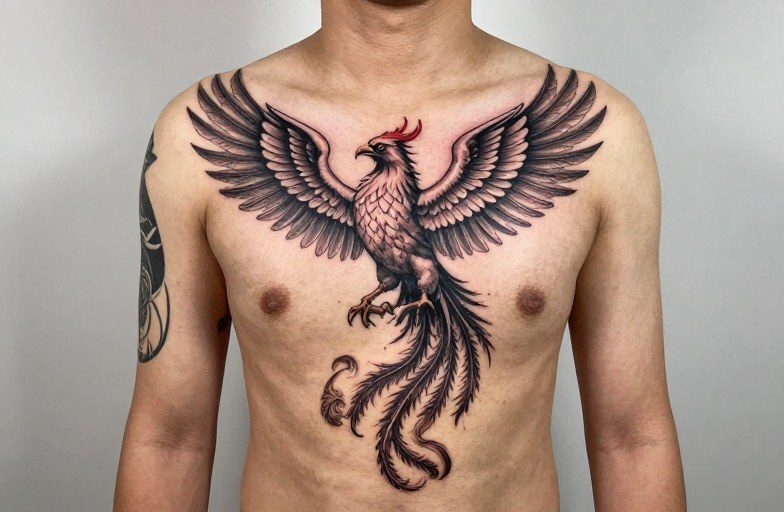
Phoenix tattoos carry weight without needing explanation. The bird, consumed and reborn, translates naturally to skin: wings spread, feathers catching light, flames at the edges. For men, the design tends toward the monumental: full backs, chest pieces, sleeves that wrap bone and muscle. But the phoenix also compresses well into smaller work when the composition is tight. The real question is not whether the symbol suits you; it is how to execute it so the tattoo holds up for decades rather than softening into a red blob by year ten.
Styles That Age
Style choice determines whether your phoenix reads as classical power or contemporary edge. These approaches dominate for good reason: they age predictably and photograph well fresh and healed.
Neo-Traditional and Japanese Influence
Neo-traditional phoenixes build on Sailor Jerry foundations but push the color saturation harder. Think crimson, molten gold, and near-black outlines thick enough to survive a decade of sun exposure. The Japanese phoenix (hou-ou) offers an alternative lineage: longer tail feathers, more deliberate negative space, often paired with paulownia or maple leaves. Both styles demand confident line work. The Japanese approach especially rewards patience; these pieces often require multiple sessions to build the layered color fields that give the feathers dimension.
One consideration often overlooked: the hou-ou carries specific cultural weight in Japanese tattooing. If you are not Japanese, discuss with your artist whether this particular rendering is appropriate or whether a more generalized phoenix form better respects the tradition while achieving your visual goals.
Black and Gray Realism
Photorealistic phoenixes have grown more common, though the style carries risks. Feathers rendered in smooth graywash can look stunning at six months. By year five, without adequate dark anchors, the piece muddies. Successful black-and-gray phoenixes rely on strategic contrast: deep blacks in the eye sockets and wing joints, brighter highlights on the crest and primary feathers. The flame elements prove hardest in this style; fire needs motion, and motion without color demands expert texture work. Ask to see healed photos of any artist’s flame work before committing.
- Color neo-traditional: bold outlines, limited palette, heals with clarity
- Japanese: flowing composition, pairs well with existing sleeve work
- Black and gray: demands master-level shading, verify healed results
- Geometric/phoenix hybrids: emerging style, feathers deconstructed into angular panels
Placement and Body Mechanics
The phoenix’s natural posture, wings raised, tail trailing, dictates certain placements more than others. A bird in flight needs room to breathe.
Full Back and Chest
The full back remains the canonical placement for a reason. Wingspan matches human wingspan; the spine becomes the bird’s breastbone, the scapulae its wing anchors. Chest pieces invert this logic: the phoenix emerging upward from the sternum, wings curling over the clavicles. Both locations handle detail well; skin thickness in the back and upper chest preserves line integrity longer than thinner areas. Expect fifteen to twenty-five hours for a full back, eight to twelve for a detailed chest piece.
Arm and Leg Sleeves
Arm sleeves work when the phoenix is oriented vertically, climbing the arm with tail feathers wrapping toward the elbow and the head positioned at the shoulder. The calf offers similar vertical real estate with less visibility commitment. Thighs accommodate the phoenix in a more horizontal spread, wings extending across the quadriceps. One practical note: knee and elbow skin moves constantly and heals poorly. Experienced artists design around these joints rather than placing critical detail across them.
Contemporary Variations
The core symbol stays constant, but artists keep finding new angles worth considering.
Mechanical and Bio-Mechanical
Mechanical phoenixes replace feathers with overlapping metal plates, combustion chambers where the heart would be. The style merges bio-mechanical tradition with the rebirth narrative, suggesting transformation through technology rather than nature. Execution is unforgiving; bad mechanical work looks like cluttered scrap metal. Verify the artist’s portfolio for clean panel lines and consistent light sourcing.
Minimalist and Linear
Minimalist line-work phoenixes strip the bird to essential contour: a single continuous line forming wing, body, and flame. These scale small: wrist, behind the ear, along the ribcage. The limitation is longevity. Thin lines blur faster; this style suits someone comfortable with touch-ups every few years or someone who views tattoos as ephemeral by nature.
Skull Integration
Skull-and-phoenix combinations have matured beyond the edgy novelty they once represented. Current iterations integrate the skull as the bird’s breastbone or nest the phoenix within an empty cranium, suggesting rebirth emerging from mortality rather than sitting beside it. The composition requires careful balance; either element can dominate and break the visual equation.
Personalizing Without Cluttering
Personalization without visual chaos demands restraint. The phoenix already carries maximum symbolic load; adding every meaningful element creates a crowded mess.
Subtle Integration
Consider embedding dates, coordinates, or names within the flame patterns, rendered as negative space or thin script that follows the fire’s natural flow. Constellation patterns worked into the night sky behind the bird can mark a specific date without literal numbering. Birth flowers or regional flora integrated into the tail feathers ground the mythical creature in personal geography.
Color Significance
Traditional phoenix palettes lean crimson and gold, but departure is possible. A phoenix rendered in deep forest green and copper suggests renewal through nature rather than fire. Blues and violets shift toward the more abstract “ice phoenix” variant, though this risks reading as generic fantasy without strong composition. One approach that works: match the flame colors to a specific real fire, sunset orange, forge yellow, bonfire red, rather than defaulting to tattoo-standard bright red.
First-Timers: Practical Grounding
A phoenix as a first tattoo is ambitious but not foolish if approached practically.
Start Smaller Than You Imagine
A phoenix on the upper arm or outer thigh allows you to test your pain tolerance and healing discipline without committing to a back piece you cannot see without mirrors. Many artists offer partial renderings, a single wing, the head and crest, a talon clutching flame, that read complete at small scale and can expand into a larger composition later.
Healing Reality
Healing a large phoenix demands planning. Color saturation requires keeping the area clean and moisturized for three weeks minimum. Back pieces interfere with sleeping position; chest pieces affect breathing comfort during the first few days. Schedule accordingly. Do not book the first session before a beach vacation or heavy manual labor period.
Choosing Your Artist
Artist selection matters more for phoenix work than for simpler designs. The complexity of feathers, flame, and implied motion separates competent tattooers from masters.
Evaluating Portfolios
Look specifically for healed photos, not just fresh work. Any artist can make red pop on day one; the question is whether that red stays distinct from adjacent orange and yellow after two years. Ask how they handle the transition zone where flame meets feather, where most phoenix tattoos visually collapse. Strong artists have a specific technique: whip shading, color packing, or deliberate negative space.
Consultation Red Flags
Beware the artist who promises a full back phoenix in two sessions. Proper saturation at that scale requires building color in layers with healing time between. Beware also the portfolio where every phoenix faces the same direction with identical wing posture. Custom work should respond to your body’s specific geometry: shoulder width, spine curvature, how your skin moves when you raise your arms.
Price transparency matters. Phoenix work is rarely quoted flat-rate because session count varies with your pain tolerance and the artist’s speed. Expect hourly billing, and expect a detailed back piece to run into the mid-four-figures. This is not the place to bargain hunt; a cheap phoenix ages into an expensive cover-up.
What to Remember
The phoenix endures as a tattoo subject because it adapts: monumental or intimate, colorful or restrained, traditional or fractured into contemporary geometry. What separates a successful piece from a regrettable one is patience in artist selection and honesty about placement scale. Match the design to your body’s movement, not just its current shape. Prioritize healed results over fresh photos. And recognize that the best phoenix tattoos do not need to explain themselves; the fire and the feathers do the work.
Frequently Asked Questions
How long does a full back phoenix tattoo take to complete?
A detailed full back phoenix typically requires fifteen to twenty-five hours across multiple sessions, with healing time between each. Rushing the process compromises color saturation and line integrity.
Do phoenix tattoos have to be colorful to look good?
No. Black and gray phoenixes can be striking, but they demand master-level shading and strategic contrast. Without adequate dark anchors, graywash feathers muddy within a few years. Always verify an artist’s healed black-and-gray work before committing.
What is the most beginner-friendly placement for a phoenix?
The upper arm or outer thigh. These areas offer enough flat surface for detail, moderate pain levels compared to ribs or spine, and allow future expansion into a larger piece if desired.
Can a small phoenix tattoo still look good?
Yes, if the composition is tight. Minimalist line-work versions work at small scale but require touch-ups more frequently. Partial renderings, a single wing or head and crest, can read complete without needing large area.
How do I know if an artist can actually execute good flame work?
Ask specifically for healed photos of their flame or fire tattoos, not fresh work. Fire without color demands expert texture work to suggest motion. If the artist cannot produce healed examples, consider another choice.
One response to “Phoenix Male Tattoo Ideas”
[…] phoenix tattoo works because the symbol is structurally honest about recovery. It doesn’t pretend the fire […]


Leave a Reply