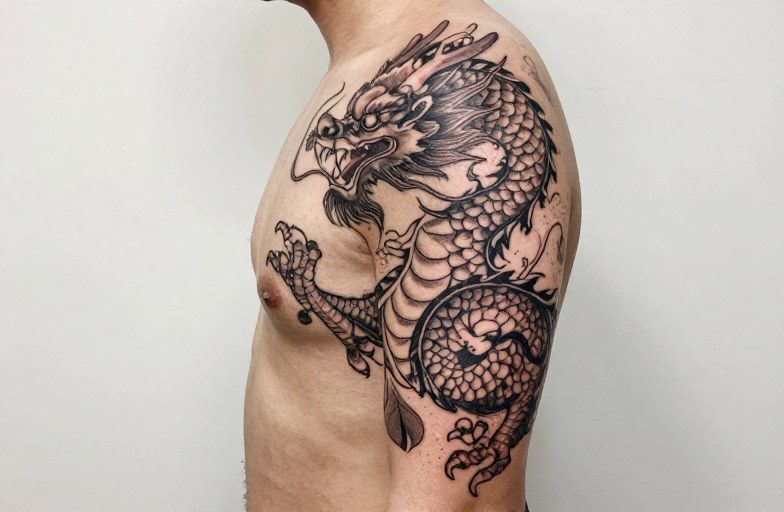
An oriental dragon tattoo carries fundamentally different energy than its Western counterpart. Where European dragons guard hoards and demand slaying, Eastern dragons, Chinese lóng, Japanese ryū or tatsu, Korean yong, are benevolent, wise, and closely tied to water, weather, and imperial authority. The core meanings cluster around power without cruelty, protection that doesn’t dominate, and wisdom earned through age rather than conquest. Someone wearing this symbol usually wants to channel controlled strength, summon good fortune, or mark a personal transformation that required patience and endurance.
Color vs Black and Grey
What Color Adds
Traditional Chinese and Japanese dragon tattoos often explode with color, and each choice carries specific weight. Red dragons connect to fire, passion, and celebration, common in festivals, aggressive on skin. Green and blue dragons belong to the eastern spring and ocean, tied to growth, renewal, and the water element that Eastern dragons fundamentally control. Gold or yellow dragons historically referenced imperial power; on modern skin, they read as aspiration and high achievement. Purple, rarely seen in older work, has gained traction for its association with spiritual advancement.
Color saturation demands larger scale. A red dragon claw or blue-scaled body needs room for the gradients to read properly, too small and it muddies into a bruise-like blob within a few years. The belly, typically rendered in lighter yellow or cream, provides the contrast that makes the body coils readable. Color also ages faster than black and grey; the reds dull to rust, blues shift toward grey-green. Expect touch-ups every 5-8 years if you want that original punch.
Black and Grey Approaches
Japanese irezumi traditions sometimes omit color entirely, building drama through line weight and shading alone. Black and grey dragons emphasize form over symbolism, you notice the musculature, the claw tension, the way the body disappears into smoke or clouds. This approach suits smaller placements where color would compete for attention. It also ages with more dignity; the grey wash softens uniformly rather than patch-fading.
Some artists use heavy black fill for the mane and whiskers, creating negative-space highlights that read as white hair against dark scales. The technique requires confidence, overworked black scars and heals shiny. For clients wanting the dragon’s meaning without the festival aesthetic, black and grey offers a quieter, more integrated presence on the body.
Common Variations & Styles
Regional Body Types
Chinese dragons typically show longer, serpentine bodies without wings, power through movement, not flight. They carry the pearl of wisdom, often rendered as a flaming or glowing sphere near the head or clutched in a claw. Japanese ryū tend toward stockier builds, more pronounced musculature, and sometimes incorporate wings borrowed from later Buddhist iconography. Korean yong often appear with the cintamani (wish-fulfilling jewel), a detail that distinguishes them in mixed Asian-style work.
The number of claws matters historically. Chinese imperial dragons held five claws; commoners displaying five-clawed dragons risked execution. Four claws spread to Korea and other vassal states. Three claws became standard in Japan. Modern tattooing ignores these restrictions, but knowing the distinction helps if you want cultural accuracy rather than generic “Asian dragon” imagery.
Compositional Motifs
Dragons entwined with cherry blossoms or peonies soften the aggression, creating a balance between power and beauty that appeals across gender expressions. Dragons emerging from or submerged in water reference their elemental control, waves rendered with specific curl patterns identify Japanese tradition, while Chinese water tends toward more stylized, repetitive foam. Dragons paired with tigers represent the classic duality of wind and thunder, strength versus ferocity, a composition that demands substantial back or thigh real estate to avoid crowding.
- Dragon and phoenix: marital harmony, balanced partnership, yin-yang complementarity
- Dragon coiling around a sword: protection of the warrior, disciplined strength
- Dragon descending versus ascending: the former suggests achieved power, the latter ambition still climbing
- Dragon with koi: the transformation narrative, perseverance rewarded with transcendence
Design Tips & Pairings
Placement Logic
Dragon tattoos flow with the body’s natural lines or fight against them, both work, but the choice changes the energy. A dragon climbing the arm, head at the shoulder and tail wrapping toward the wrist, follows the limb’s length and feels inevitable, organic. Wrapping a dragon around the calf or thigh creates a circular composition that traps the eye, more aggressive and self-contained. Full back pieces allow the complete body with all four limbs and the tail, the traditional irezumi approach that treats the back as a single canvas with the dragon’s head at the upper center, body descending toward the buttocks.
The head placement carries weight. Facing forward, mouth open, reads as confrontation and protection. Profile or three-quarter view suggests movement, passage, something passing through rather than guarding. Heads facing downward rather than upward can read as humility or, conversely, as something about to strike from above.
Complementary Elements
Clouds and wind bars separate dragon sections in traditional Japanese work, giving the eye rest and the artist natural breaks between sessions. Without these atmospheric elements, dense dragon scales become overwhelming. Smoke or flame can serve similar purposes in Chinese-influenced designs. The background matters as much as the figure, negative space isn’t empty, it’s breathing room.
Pairing dragons with text requires care. Chinese characters or Japanese kanji near a dragon compete for symbolic authority; usually one dominates. If you want both, place text in a banner or scroll format that the dragon interacts with rather than ignoring. English lettering rarely integrates cleanly with traditional dragon aesthetics unless heavily stylized.
Similar & Related Symbols
Western dragons share the serpent/reptile DNA but invert the moral reading: Western equals greed, destruction, chaos to be defeated; Eastern equals benevolent power, weather control, imperial authority. The phoenix shares Eastern positive associations but represents rebirth and feminine grace rather than masculine authority, pairing them creates balance. The snake, ancestor to dragon mythology in many scholars’ view, carries more earthbound, cunning energy; the dragon transcends it.
The qilin or kirin offers a gentler alternative from the same cultural family, hooved, scaled, antlered, associated with wise rulers and benevolent omens rather than raw power. For those drawn to Eastern mythical creatures but uncomfortable with the dragon’s aggression, the kirin provides similar cultural grounding without the predatory body language.
Personal & Modern Meanings
Beyond Cultural Heritage
Non-Asian wearers sometimes hesitate, fearing appropriation. The dragon’s global recognition and commercial circulation for centuries complicates this, dragon imagery appeared on European porcelain, in Art Nouveau, in countless Western adaptations before tattooing became mainstream. The meaningful question isn’t whether you have permission but whether you’ve done the visual homework: a generic “tribal dragon” with no coherent cultural reference disrespects the tradition more than a thoughtfully researched Japanese or Chinese piece worn by someone of any background.
Modern personal meanings often detach from the traditional symbolism entirely. Someone might choose a dragon after surviving illness, interpreting the creature’s water association as cleansing and renewal. Another might identify with the dragon’s solitary power, its self-sufficiency. The imperial authority reading translates directly to career ambition for some wearers, a dragon sleeve visible in a rolled-up dress shirt cuff sends a specific message in corporate environments.
Gender and the Dragon
Historically masculine-coded, dragon tattoos have shifted. Women wearing full dragon back pieces or leg sleeves challenge the assumption; the dragon’s power reads as personal rather than gendered when the composition suits the body. Smaller, more delicate linework dragons, single needle, minimal shading, offer a different register entirely, more spirit animal than warrior emblem. The meaning follows the execution, not the symbol in isolation.
History & Cultural Roots
Chinese Origins
The Chinese dragon’s earliest recognizable forms appear on Shang dynasty bronzes, often linked to rain-making rituals and agricultural fertility. The composite creature, antlers of deer, head of camel, eyes of rabbit, neck of snake, belly of clam, scales of carp, claws of eagle, paws of tiger, ears of cow, gathered power from multiple animals rather than representing one. Imperial adoption came gradually; the five-clawed dragon became restricted to the emperor only during the Yuan and Ming dynasties. Before that, regional variants flourished.
Japanese Adaptation
Dragons entered Japan through Korean and Chinese Buddhist transmission, commonly associated with temple guardianship and water deities. The Japanese ryū absorbed native serpent worship (hebi) and became protectors of specific locations, Lake Biwa’s dragon, the Ryūjin of the sea. Tattooing’s Edo-period development incorporated dragons as irezumi expanded from punishment marks to voluntary art, with the dragon among the most requested full-body designs by the late 1800s. The yakuza adoption of full dragon suits created Western associations between Japanese dragon tattoos and criminality that persist despite tattooing’s mainstream normalization in Japan itself.
What to Remember
An oriental dragon tattoo means power, but specifically the kind that doesn’t need to prove itself constantly. The symbol carries enough visual weight that elaborate storytelling in the design often weakens rather than strengthens it, let the form do the work. Choose your regional reference deliberately; mixing Chinese claws with Japanese wave patterns without intention looks careless, not eclectic. Consider how the piece will age in your specific skin tone and how much maintenance you’re willing to commit. Most importantly, the dragon’s traditional benevolence means this symbol works best when the wearer identifies with protection and guidance rather than domination, the dragon guards, it doesn’t conquer. That distinction separates meaningful work from mere decoration.
Frequently Asked Questions
Does the number of claws on an oriental dragon tattoo matter?
Historically, five claws indicated Chinese imperial status, four spread to vassal states, and three became standard in Japan. Modern tattooing ignores these restrictions, but knowing the distinction helps if you want cultural accuracy in your design.
Can non-Asian people get oriental dragon tattoos respectfully?
Thoughtful research and coherent cultural reference matter more than ethnicity. Avoid generic ‘tribal dragon’ mashups; choose a specific tradition and execute it with understanding rather than treating the symbol as exotic decoration.
What’s the best placement for a first oriental dragon tattoo?
The outer upper arm or thigh offers enough flat surface for the body to coil naturally while remaining concealable. These areas also heal relatively easily and allow for future expansion into a larger composition if desired.
How do oriental dragon tattoos age compared to other styles?
Dense black linework and solid color saturation age better than fine detail or heavy white highlights. Expect color pieces to need refreshment every 5-8 years; black and grey maintains readability longer with less maintenance.
Leave a Reply