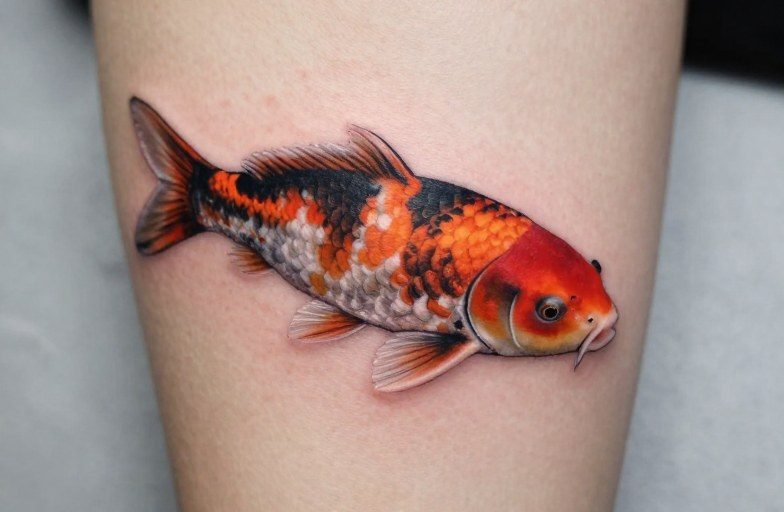
Koi fish tattoos carry layered meaning rooted in Asian folklore and personal symbolism. At their core, they represent perseverance against adversity, swimming upstream, transforming, refusing to yield. The specific message of any koi piece depends heavily on color choice, direction, surrounding elements, and how the artist handles the water around it.
Symbolism & Core Meaning
The koi’s reputation as a symbol of determination comes from its biological reality: these carp actually do swim against strong currents to spawn. That observable behavior got mythologized over centuries, and tattooing grabbed onto the metaphor. A koi moving upward typically signals ambition, struggle, or overcoming hardship. One drifting downstream can mean the battle is won, or acceptance of what cannot be changed.
Direction Matters
Upward-facing koi read as active striving, climbing waterfalls, pushing forward. Downward koi carry quieter energy: arrival, accomplishment, sometimes surrender. The angle of the body matters too. A koi swimming straight up a forearm hits differently than one circling a shoulder. Water flow lines, splashes, and bubbles all reinforce which way the energy moves.
Single vs. Pairing
- One koi: individual struggle, personal transformation, self-reliance
- Two koi (often one red, one black): duality, balance, sometimes romantic partnership
- Multiple koi in a school: family, community, collective perseverance
Mythology & Folklore
The most famous koi legend, often linked to Chinese origins though widely adopted in Japanese culture, describes carp swimming upstream and being rewarded with transformation into dragons. Some trace it to the Yellow River’s Dragon Gate, where any carp strong enough to leap the falls became divine. This narrative gave tattoo culture its dominant koi motif: the fish at the waterfall’s edge, body tensed, about to change.
Another strand commonly associated with samurai culture adopted the koi as an emblem of unwavering courage in death, fish that kept swimming even when caught and prepared. That darker reading surfaces in designs where the koi appears wounded, bleeding, or among maple leaves that symbolize life’s end.
Dragon Gate Variations
Artists handle the transformation moment differently. Some show the koi mid-leap with scales already shifting to dragon armor. Others keep the fish purely carp, letting the waterfall itself imply what’s coming. The first approach literalizes the myth; the second trusts the viewer to know the reference. Both work, but they attract different collectors.
Color vs Black and Grey
Color koi carry specific traditional associations that black and grey pieces intentionally abandon or complicate. Red and orange koi connect to love, motherhood, and intense life force. Black koi reference overcoming depression or major life change. Gold koi mean wealth and prosperity. White with red spots (the kohaku pattern) signals career success. Blue and grey koi represent sonship and family legacy.
When Black and Grey Works Better
Monochrome koi tattoos suit collectors who want the form without the cultural color coding, or who need the piece to coordinate with existing black and grey work. The challenge: koi read as “fish” through their color more than their anatomy. In black and grey, the artist must exaggerate scale texture, fin flow, and water movement so the creature doesn’t flatten into generic carp. Good black and grey koi rely on whip shading for scale depth and dense black backgrounds to make the negative-space highlights pop.
Color Longevity Reality
Red and orange pigments in koi tattoos fade fastest, expect noticeable softening in 5-8 years without touchups. Black outlines hold, but the warm belly tones that give koi their living quality need maintenance. Yellows and golds shift toward greenish tones as they age, especially on cooler skin undertones. This doesn’t mean avoid color; it means plan for it.
Personal & Modern Meanings
Contemporary collectors layer personal narrative onto traditional koi framework. Someone recovering from addiction might choose a black koi turning upward. A parent mourning a child sometimes selects a white koi with a single red spot, reinterpreting the career-success meaning as purity marked by loss. The form accommodates private readings without requiring anyone else’s understanding.
Modern twists include geometric fragmentation, koi dissolving into triangles or mandala patterns, and surreal combinations like koi with human eyes or mechanical fins. These aren’t “disrespecting tradition” so much as speaking a different visual language. The core symbol (perseverance, transformation) remains recognizable even when the execution departs dramatically.
Design Tips & Pairings
Koi rarely stand alone in strong compositions. The surrounding elements do as much symbolic work as the fish itself.
- Water: lotus flowers for spiritual emergence, waves for ongoing struggle, still ponds for peace achieved
- Maple leaves: autumn, mortality, beauty in ending
- Cherry blossoms: transient beauty, life’s fragility
- Dragon: completion of transformation, ultimate achievement
- Peonies: wealth, honor, masculine energy in Japanese tradition
Composition Dynamics
Koi bodies create natural S-curves that artists exploit for flow. The tail should move, not hang dead. Fins need to feel weightless, almost translucent, which requires careful greywash or color packing. Water splashes around a leaping koi must read as liquid, not solid decoration, this is where inexperienced artists often falter, rendering frozen fireworks instead of motion.
Background Choices
Full Japanese water backgrounds (water, wind bars, finger waves) give koi their traditional context but demand significant skin commitment. Isolated koi with minimal water work for smaller scales but risk looking like clip art. The middle path, suggestive water movement, partial background fade, offers flexibility for future expansion.
Best Placements
Koi anatomy suits certain body contours. The natural curve of a koi’s body follows the calf muscle, the outer thigh, the side of a torso. Forearms work for upward-swimming compositions that lead the eye toward the shoulder. Backs offer the largest canvas for full transformation scenes with dragon emergence.
Scaling to Size
Small koi tattoos (under 4 inches) lose the scale detail that makes them read as koi rather than generic fish. The minimum viable size for recognizable koi with proper fin and scale work sits around 5-6 inches in the longest dimension. Wrist and ankle placements almost always require simplification that sacrifices the species-specific qualities.
Flow and Aging
On areas with significant skin movement (inner bicep, stomach, thigh inner surface), koi fins and whiskers blur faster. The fine lines that define barbels and tail rays spread. Placing these details on more stable skin or accepting they’ll soften guides better long-term outcomes. Chest placements over pectoral muscle hold detail well but distort the composition when the muscle flexes, something to discuss during design if you’re built or planning to be.
The Bottom Line
A koi tattoo’s meaning lives in its specifics: which color, which direction, what surrounds it, where it sits on your body. The symbol of perseverance is broad enough to hold almost any personal struggle, but the tattoo only communicates if the artist understands fish anatomy, water dynamics, and how ink ages in skin. Choose someone with demonstrated koi work in their portfolio, not just Japanese-style flash. Ask how they’ll handle your particular skin tone and placement. The difference between a koi that looks alive in ten years and one that collapses into a colorful blob starts with those practical choices, not the mythology you bring to the chair.
Frequently Asked Questions
Does a koi fish tattoo have to be Japanese-style to be authentic?
No. Traditional Japanese execution (bold outlines, specific color palettes, full backgrounds) is one valid approach among many. New school, realism, and geometric interpretations all work if the artist understands koi anatomy and the symbolism matters to you personally.
How much does a detailed koi sleeve typically cost?
Full Japanese-style koi sleeves require 25-40 hours of tattooing across multiple sessions, making them a significant investment. Pricing varies enormously by region and artist reputation, but expect this to be a multi-thousand-dollar project completed over months or years.
Can a koi tattoo face downward without negative meaning?
Absolutely. Downward-facing koi traditionally represent accomplishment and peace after struggle, not failure. The negative interpretation is a modern misconception. What matters is your intention and the overall composition’s flow.
Do koi tattoos work on darker skin tones?
Yes, with adjusted approaches. Deep, saturated colors (crimson, cobalt, emerald) show better than pastels. Black and grey koi with strong contrast and dense shading can be stunning. The key is an experienced artist who understands how pigment interacts with your specific melanin levels.
Leave a Reply