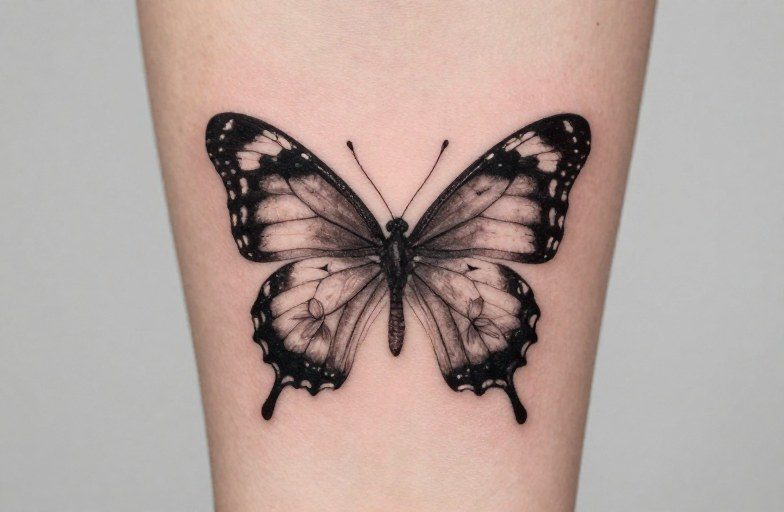
A butterfly paired with flowers is one of the most enduring tattoo combinations, and its meaning is straightforward: transformation happening within a living, growing environment. The butterfly represents change, emergence, and the brief, intense nature of life. Flowers ground that idea in cycles, blooming, wilting, returning. Together, they create a symbol of personal evolution that isn’t isolated or solitary, but connected to something larger and organic.
Color vs Black and Grey
This pairing demands a choice that fundamentally changes how the symbolism reads on skin.
Color: Monarchs, Gardens, and Fading Realities
Color butterfly and flower tattoos carry immediate visual impact. Monarch orange against purple lilac, or blue morpho wings catching light near red roses, these combinations pop. The trade-off is longevity. Bright yellows and soft pinks fade fastest, often settling into a muted version within five to eight years. Sun exposure accelerates this. If you choose color, plan for touch-ups. The benefit: color allows specific species representation. A monarch specifically signals migration and endurance; a cherry blossom branch with a butterfly anchors the piece in Japanese visual tradition.
Black and Grey: Texture and Timelessness
Black and grey shifts focus to form. Wing veins become architectural. Petal edges read through shading gradation rather than hue contrast. This approach ages more gracefully, there’s no red turning salmon, no blue turning grey-green. Dotwork and whip shading can suggest scales and pollen dust without literal color. For smaller pieces or areas with frequent sun exposure, black and grey often proves the smarter long-term investment.
Best Placements
Butterfly wings need space to open. Flower stems need length to curve. The combination creates specific spatial demands.
Where the Composition Works
- Shoulder blade: The natural slope lets wings spread across the bone while flowers trail toward the spine or armpit. This placement accommodates both front and side views.
- Forearm: Vertical compositions work well here, butterfly perched at wrist level, stem running toward the elbow. Visible but coverable.
- Ribcage: The long, narrow canvas suits a butterfly mid-flight above a cluster of flowers. Pain is significant here; the bone proximity and thin skin make this a commitment.
- Thigh: Front or outer thigh provides ample flat area for detail. The muscle movement creates subtle animation, petals and wings seem to shift slightly when you walk.
Placements to Reconsider
Hands and feet present problems. Butterfly wings require fine detail that blurs in high-wear zones. Finger skin sheds and regenerates rapidly; what starts crisp becomes indistinct within a few years. Ankles suffer similar wear, and the curved surface distorts wing symmetry. If you’re drawn to these areas, consider simplified silhouettes rather than detailed naturalism.
Mythology & Folklore
Butterfly and flower pairings appear across cultures, though specific meanings vary considerably.
In Mexican tradition, the monarch butterfly is often linked to Día de los Muertos and the return of ancestral spirits. Marigolds, cempasúchil, are the flower of the dead, creating a specific cultural pairing that carries weight beyond generic beauty. Some trace the visual combination of butterfly and flower to Aztec iconography, where butterflies represented the souls of warriors.
Japanese folklore associates butterflies with the soul, sometimes specifically the soul of a living person or the departed. When paired with cherry blossoms, the combination emphasizes transience, both the brief bloom and the fragile insect speak to mono no aware, the pathos of things.
Celtic traditions sometimes connected butterflies to transformation and rebirth, with certain flowers carrying protective properties. The pairing appears in illuminated manuscripts, though the specific symbolic intention remains debated among scholars.
Contemporary Western tattoo culture largely treats the combination as personal symbolism, growth, change, beauty, resilience, stripped from specific cultural anchors unless the wearer deliberately chooses them.
How It Ages on Skin
Understanding deterioration helps you design for longevity.
Line Spread and Detail Loss
Butterfly wing veins start as fine lines, often 3RL or single needle work. Over a decade, these lines spread. A vein that began at 1mm width may blur to 2-3mm. This softens the wing’s structure, sometimes making it look moth-eaten or simply muddy. Flowers suffer similarly, petal edges that were sharp become blob-like. Designing with slightly heavier initial lines, or planning for the blur by leaving more negative space between elements, helps the piece read clearly at fifteen years.
Color Shifts
White highlights on wings disappear first, absorbed into surrounding pigment. Purple flowers often shift toward blue or grey as red components fade faster than blue. Greens generally hold longest. Black outlines remain the most stable element, which is why strong black structure underneath color keeps a piece coherent even as hues mute.
Skin changes matter too. Weight fluctuation stretches or compresses the composition. Aging skin loses elasticity, and a butterfly that looked perched on firm muscle may seem to droop as tissue softens. Placements with stable underlying structure, bone-adjacent areas like the shoulder or forearm, maintain integrity better than purely soft-tissue placements like the abdomen or inner thigh.
Who Chooses This Tattoo
Demographics are broad, but patterns exist in the specific choices people make.
First tattoos often include this combination because it carries positive, accessible symbolism without aggression. The butterfly-with-flowers motif offers a safe entry point, socially acceptable, visually pretty, meaningful without being heavy. Parents memorializing children frequently choose this pairing, with birth flowers or butterflies representing each child. The growth and transformation themes resonate with recovery narratives: sobriety, surviving illness, leaving destructive relationships.
There’s also a significant population who simply find the image beautiful and reject the pressure to attach narrative. This is valid. Not every tattoo needs to represent trauma or triumph. The visual pleasure of a well-executed butterfly among flowers is sufficient motivation.
Gender and Evolving Trends
Historically coded feminine, this combination has seen increased adoption across gender presentations as traditional tattoo gendering breaks down. Men choosing the motif often modify it, darker palettes, more aggressive styling, integration with other elements like skulls or daggers, or simply wear the traditional version without modification, rejecting the gendered assumption entirely.
Common Variations & Styles
The core combination adapts to nearly every tattoo genre.
- Traditional American: Bold black outlines, limited color palette, stylized rather than realistic. Butterflies read as iconic rather than literal; flowers are simplified to recognizable shapes.
- Neo-traditional: Expanded color range, more dimensional shading, often incorporating decorative elements like jewels or geometric frames around the central image.
- Realism: Photographic reference required. Success depends entirely on the artist’s ability to render translucent wing scales and delicate petal texture. Best at larger sizes.
- Japanese (Irezumi): Butterflies appear less frequently than koi or dragons, but when combined with peonies or chrysanthemums, they follow the tradition’s rules: background elements, specific color conventions, integration with larger body suits.
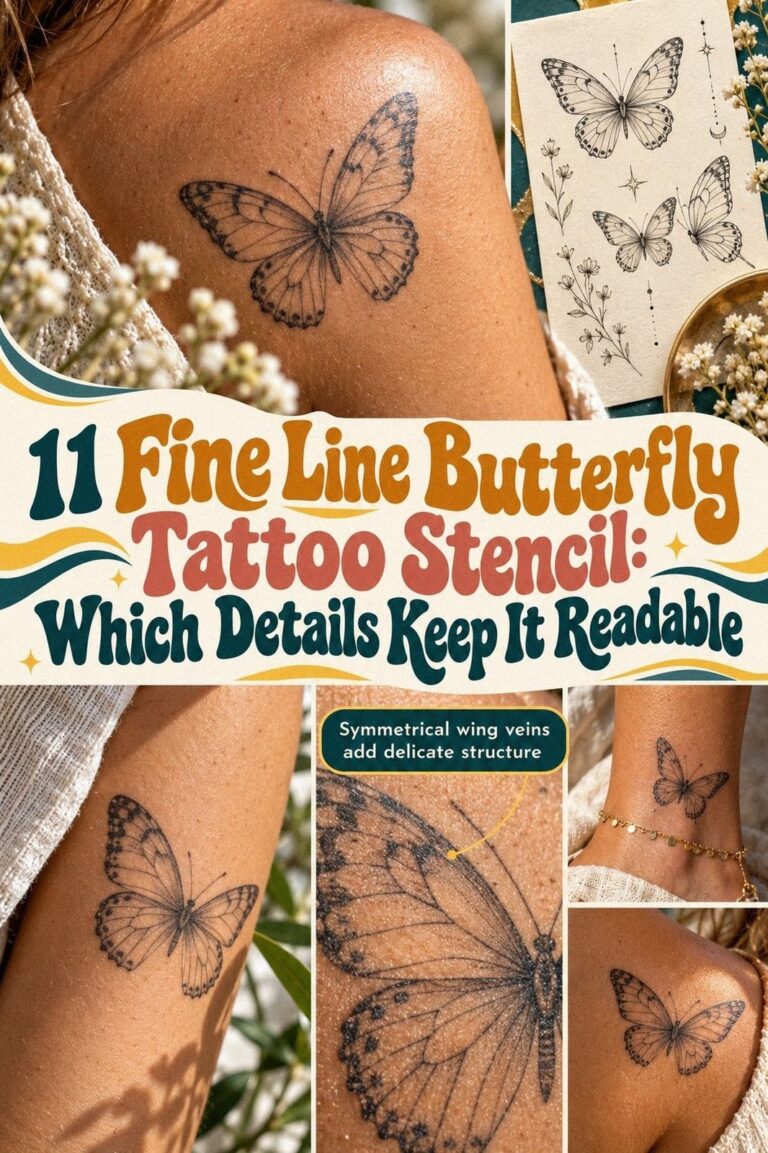
- Fineline: Single needle or 3RL throughout. Ethereal, contemporary aesthetic. Fades faster, requires more maintenance, but suits clients wanting minimal visual weight.
- Botanical illustration: Scientific accuracy in flower rendering paired with accurate butterfly species. Appeals to gardeners, entomologists, those wanting specific personal symbolism through real species.
What to Remember
Butterfly with flowers tattoos succeed or fail on specificity. Generic clip-art butterflies with generic five-petal flowers look like stickers because they lack the irregularities of real life. A monarch’s wing damage, a rose’s imperfect outer petals, the slight asymmetry of natural growth, these details separate living artwork from decoration.
Choose your artist by their portfolio of similar work, not by convenience. Naturalistic color requires different skills than black and grey illustration. Ask to see healed photos, not just fresh work. The bright, saturated image on Instagram represents a two-week window; the healed, settled version is what you live with.
Plan for the long term. If you’re drawn to fine detail, accept that touch-ups are part of the commitment. If you want low maintenance, simplify the design and strengthen the black structure. The meaning you attach to the image is your own, but the technical reality of how it sits on skin is shared by everyone who wears this combination. Respect both, and you’ll have a piece that carries its symbolism clearly for decades.
Frequently Asked Questions
Do butterfly and flower tattoos have to include specific species to mean something?
No. Specific species add layers, monarchs for migration, lotus for spiritual emergence, but the general combination of transformation and growth works without botanical or entomological accuracy. Choose based on what resonates with you, not symbolic obligation.
How much should I expect to pay for a quality butterfly with flowers piece?
A palm-sized color piece from a skilled artist typically runs $400, 800 in most US markets. Larger, more detailed work, full forearm, thigh piece, back shoulder, can reach $1,500, 3,000. Fineline specialists and realism artists often charge premium rates. Avoid bargain pricing; this combination requires technical skill that cheap work rarely delivers.
Can a butterfly with flowers tattoo be easily covered up later?
Coverage depends on size and placement. Small, light-colored pieces are easier to obscure. Dark, saturated butterflies with heavy black outlines limit coverup options. If you’re uncertain about long-term commitment, start smaller and lighter, or choose placement with surrounding skin available for future expansion or modification.
How long does a detailed butterfly and flower tattoo take to complete?
A medium-complexity piece, say, four-inch wingspan with surrounding flowers, takes three to five hours in one session, or two sessions of two to three hours if color saturation requires healing between passes. Large-scale realism can span ten to fifteen hours across multiple appointments. Your artist’s pace and your skin’s response to saturation determine actual timing.
Leave a Reply